 Charles Schwab
 Fidelity
 Interactive Brokers
 E*TRADE
 Webull
 Robinhood
 TradeStation
 tastytrade
 eToro
eToro Trading 212
 Interactive Investor
 IG
IG Interactive Brokers
 XTB
XTB Hargreaves Lansdown
 Saxo
Saxo Charles Stanley Direct
 CIBC Investor's Edge
 Interactive Brokers
 Moomoo
 Questrade
 Qtrade
 TD Direct Investing
 Wealthsimple
 Finviz
 Stock Rover
 Seeking Alpha
 StockHero
 TipRanks
 TrendSpider
 Trade Ideas
 TraderSync
 TradingView
 Tradervue
 TradeZella
Best Brokerage Accounts and Online Stock Brokers for 2026

Written by Jessica Inskip
Director of Investor Research

Edited by Jeff Anberg
Senior Editor

Reviewed by Blain Reinkensmeyer
Managing Partner
Jessica InskipDirector of Investor Research
Jessica Inskip is Director of Investor Research at StockBrokers.com, bringing 15 years of experience in brokerage and trading strategy. Jessica focuses on investor education and brokerage industry research.


 Why you can trust us
Led by Jessica Inskip, Director of Investor Research, the StockBrokers.com research team collects thousands of data points across hundreds of variables. We evaluate features important to every kind of investor, including beginners, casual investors, passive investors, and active traders. We carefully track data on margin rates, trading costs, and fees to rate stock brokers across our proprietary testing categories.
Our researchers open personal brokerage accounts and test all available platforms on desktop, web, and mobile for each broker reviewed on StockBrokers.com. Learn more about how we test.
The best brokerage accounts in 2026 are Charles Schwab, Fidelity, and Interactive Brokers. Schwab pairs a beginner-friendly app with thinkorswim for active trading. Fidelity has the deepest research and education for new investors. Interactive Brokers gives the widest access to global markets and complex derivatives.
Choosing the right brokerage account matters as much as choosing the right investments. Commission-free trading is now the industry standard, so brokers compete on tools and features rather than price.
I spent hundreds of hours testing online brokers and mobile apps, placing trades, exploring tools, and gathering thousands of data points. Here are my picks for the best brokerage accounts of 2026.
Best Brokerage Accounts of 2026
To choose the best online broker, I went beyond marketing brochures and opened real accounts funded with my own capital. I tested these brokerage accounts exactly how you would: executing trades, stress-testing mobile apps during market volatility, and challenging customer service teams with complex questions. My evaluation process analyzes more than 300 variables across six core categories.
My criteria combine quantitative verification of features with hands-on testing of workflow design, proprietary research, and technology stack stability. The brokers that score highest deliver the same experience on desktop, web, and mobile, with strong security and order execution. Whether you are a beginner or a seasoned pro, the following list represents the pinnacle of what the industry has to offer in 2026.
- Minimum Deposit: $0.00
- Stock Trades: $0.00
- Options (Per Contract): $0.65
For most investors, the search for a great broker ends with Charles Schwab. Retaining the #1 Overall ranking in 2026, Schwab continues to set the industry standard. The broker uniquely balances scale with sophistication, offering both simplified mobile tools and the professional-grade thinkorswim platform. From buying a first fractional share to managing a multimillion-dollar estate, Schwab provides a platform tailored to every need, serving as the definitive operating system for modern wealth. Read full review
- thinkorswim is the industry benchmark for professional-grade trading and charting.
- Best in Class Research features actionable daily updates and deep fundamental data.
- Top-tier education with webinars, videos, and courses.
- No spot crypto trading (limited to ETFs and futures).
- "Stock Slices" (fractional shares) are limited to S&P 500 companies.
- Base margin rates are significantly higher than dedicated low-cost competitors.
- Minimum Deposit: $0.00
- Stock Trades: $0.00
- Options (Per Contract): $0.65
Fidelity is a value-driven online broker offering $0 trades, industry-leading research, excellent trading tools and an easy-to-use mobile app. Read full review
- Excellent research and mobile app
- Top-notch education
- Decades of reliable client service
- No dedicated mobile app for active trading
- Minimum Deposit: $0.00
- Stock Trades: $0.00
- Options (Per Contract): $0.65
Interactive Brokers is a go-to choice for professionals because of its institutional-grade desktop trading platform, high-quality trade executions and low margin rates. Read full review
- 170+ markets to trade.
- IBKR Desktop platform has institutional power and intuitive usability.
- Industry-leading margin rates and competitive interest yields.
- Density of features requires a significant time investment.
- Educational content skips over the basics for true beginners.
- Certain tools lack the curated context needed.
- Minimum Deposit: $0.00
- Stock Trades: $0.00
- Options (Per Contract): $0.65
With two distinct platforms (E*TRADE Web and Power E*TRADE) the broker effectively serves both the "set-it-and-forget-it" investor and the high-volume derivatives trader. Whether you aim to construct a long-term retirement portfolio or deploy complex options strategies, E*TRADE provides a sophisticated, dependable environment that grows with your ambition. Read full review
- High-quality experience for both passive investors and active traders.
- Access to Morgan Stanley’s deep market analysis and interactive reports.
- Excellent bond resource center and a user-friendly ladder tool.
- Base margin rates, starting at over 12%, are significantly higher than top competitors.
- Spot crypto trading is limited to Bitcoin, Ethereum, and Solana, and those assets are held at zerohash rather than at E*TRADE.
- Minimum Deposit: $0.00
- Stock Trades: $0.00
- Options (Per Contract): $0.65
Merrill Edge and its parent, Bank of America, make for a well-rounded offering, with $0 trades, robust research, reliable customer service; and its Stock Stories and Fund Stories are an industry standout. There are some gaps in investment offerings, including crypto and futures. Read full review
- Integration with Bank of America’s Preferred Rewards program.
- The Options Strategy Assistant blends education with execution.
- Tax Resource Center and Retirement Income Portfolios maximize savings and income.
- No cryptocurrency, futures, or fractional shares available for trading.
- Trading options on the mobile app is a frustrating experience.
- The MarketPro platform lacks the polish required for active trading.
- Minimum Deposit: $0.00
- Stock Trades: $0.00
- Options (Per Contract): $0.00
Webull has evolved past its origins as a low-cost disruptor, solidifying its position as a sophisticated hub for active market participants. It offers a great mobile experience and a fantastic paper trading platform that offers a perfect sandbox to test strategies without risking capital. With AI-powered summaries that slice through market noise and industry-leading paper trading tools for testing strategies, Webull presents a compelling choice for traders. Read full review
- Zero commissions for options contracts.
- Crypto trading has been reintegrated into the main app.
- Phenomenal, award-winning paper trading platform.
- Lack of account types like Inherited IRAs, Trust accounts, and custodial accounts.
- Constructing multi-leg options strategies can feel cumbersome.
- Education is often disorganized and can be confusing for beginners.
- Minimum Deposit: $0.00
- Stock Trades: $0.00
- Options (Per Contract): $0.00
Robinhood is best known for its commission-free trading, modern mobile and desktop platforms, and low-cost access to options, margin, and futures trading. Read full review
- Robinhood Legend offers 90+ technical indicators.
- 3% IRA match on contributions.
- The Investor's Guild explains complex topics.
- Futures trading and 24-hour trading.
- No economic calendars, sector heat maps, or Treasury yield curves.
- No deep fundamental research.
- Legend lacks critical tools.
- No mutual funds, individual bonds, custodial or trust accounts.
Compare trading platforms head-to-head
Use the broker comparison tool to compare over 150 different account features and fees.
Winners Summary
1. Charles Schwab - Best stock broker for 2026
Charles Schwab is the best brokerage account for 2026 because it successfully bridges the gap between a user-friendly beginner app and a day trading platform. Following the final integration of TD Ameritrade, Schwab now offers a dual-platform approach that satisfies every type of investor: the flagship web/mobile experience for wealth management and the legendary thinkorswim (TOS) for active trading.
Charles Schwab stands out in the following areas:
Education and research: For most investors, the strength lies in Schwab’s "contextual education." Instead of burying tutorials in a separate library, Schwab integrates definitions and strategy guides directly into the trade tickets and research pages. The research offering is equally impressive. The "widgetized" layout allows you to compare stock valuations against peer groups and indices instantly. I particularly valued the "Schwab Market Update," a daily podcast that condenses macro headlines into actionable insights, making market analysis accessible during a morning commute.
Advanced trading platform: For active traders, thinkorswim remains the industry benchmark. Whether on desktop or mobile, the ability to overlay economic data, like Federal Reserve interest rate probabilities, directly onto price charts is a fantastic feature. While the primary Schwab app is excellent for managing a long-term portfolio, TOS handles complex multi-leg options and futures with precision. With 24/5 trading on hundreds of securities and a massive selection of no-transaction-fee funds, Schwab delivers the most complete brokerage experience on the market.

This screenshot showcases a desktop chart of U.S. unemployment rates alongside a live news feed and streaming headlines, enabling traders to track macroeconomic trends in real time. Access to this level of economic insight helps investors connect data with market movement.
Jessica's take
"My favorite feature within TOS charting, and probably the whole platform, is the integration of economic data. You can pull data on interest rates, employment costs, population, labor markets, international data, business surveys, and so much more! "
Jessica Inskip
Director of Investor Research
Awards won: #1 Overall Broker, Best for Advanced Trading, Best for Mobile Trading Apps, Best for Ease of Use, Best for High Net Worth Investors, and Best for Customer Service. Schwab also won industry awards for #1 Active Trading Desktop Platform and #1 Stock Research.
2. Fidelity - Best for beginners
Fidelity is the ultimate "do-it-all" platform, securing its spot as the second best online broker for 2026. While it narrowly misses the top spot due to Schwab's superior active trading technology, Fidelity arguably offers a better daily driver experience for the everyday investor. It excels at being a holistic financial hub, seamlessly blending sophisticated market analysis with the ease of use typically found in modern fintech banks.
Fidelity stands out in the following areas:
Education and research: The unique feature for stock pickers is the proprietary "Equity Summary Score." Instead of forcing you to sift through dozens of conflicting analyst reports from third-party firms, Fidelity consolidates them into a single, color-coded sentiment score. This simplifies the research process significantly. I also found their economic calendar to be the best in the industry. Rather than simply listing data releases, it provides context on "why investors care," helping you understand how specific metrics like CPI or unemployment claims impact your holdings.
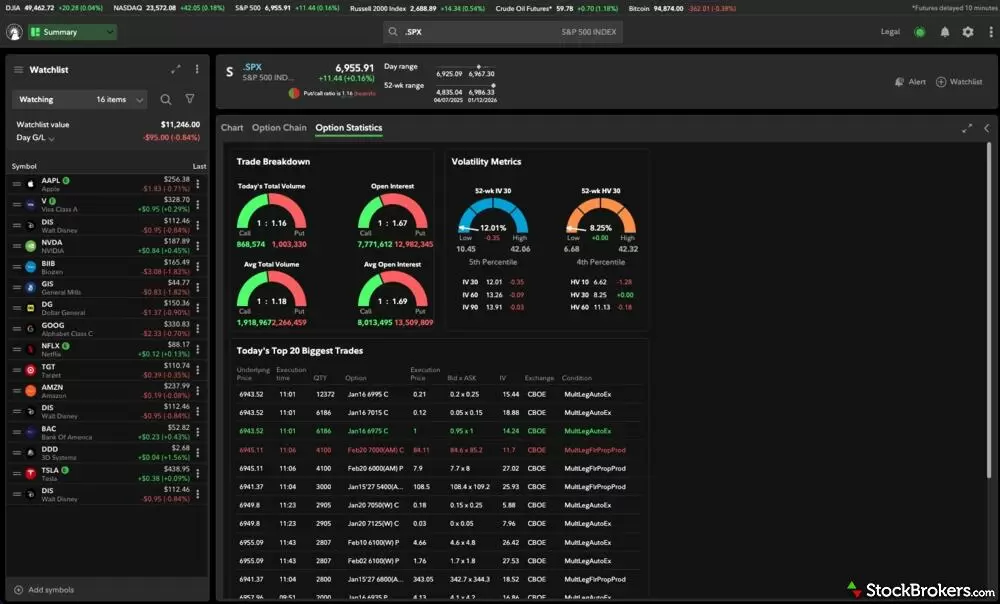
Fidelity’s trading dashboard brings everything together in one place. Here, I’ve linked SPY across all widgets for a seamless view. You can dive into options statistics, volatility indices, and my personal favorite: the trade breakdown activity, which gives great insight into how traders are positioning.
Fixed-income: For income-focused investors trading bonds, Fidelity is unrivaled. It provides access to primary bond auctions, a rarity among retail brokers, and features an intuitive CD ladder tool that simplifies generating yield in a complex rate environment.
Mobile app: On the mobile front, Fidelity has aggressively modernized its interface. The new "Discover" tab delivers bite-sized, short-form market updates that allow you to learn without endlessly scrolling. While the desktop Active Trader Pro platform remains a reliable workhorse for complex charting, the mobile experience is the real star here. Combined with the ability to set automated, recurring dollar-based investments into individual stocks and ETFs, Fidelity effectively allows you to put your portfolio on autopilot.
Awards won: Best for Research, Best for Education, Best for Beginners, and Best for Retirement Accounts. Fidelity also won industry awards for #1 Investor App, #1 Stock Trading Platform, #1 Bond Investing, #1 Youth Investors, and #1 Small Business Owners.
3. Interactive Brokers - Best for professional traders
Interactive Brokers (IBKR) has long been the choice for Wall Street veterans, but recent updates have made it one of the best brokerage accounts for any serious investor looking to graduate from a basic app. If your strategy involves global markets, currency trading, or complex derivatives, IBKR provides a depth of access that domestic-focused brokers simply cannot match.
Interactive Brokers stands out in the following areas:
Advanced trading: The Trader Workstation (TWS) operates as the flagship component of the offering, anchored by the 'Daily Lineup' feature. In my testing, this was the most efficient way to start a trading day. It aggregates a snapshot of world markets, analyst upgrades, and an AI-driven summary of top news into a single, scannable window. I also found the new "Connections" tool to be a game-changer for idea generation. It instantly links a stock to its competitors, suppliers, and ETF exposure, allowing you to visualize the entire market around a specific trade rather than viewing it in isolation.
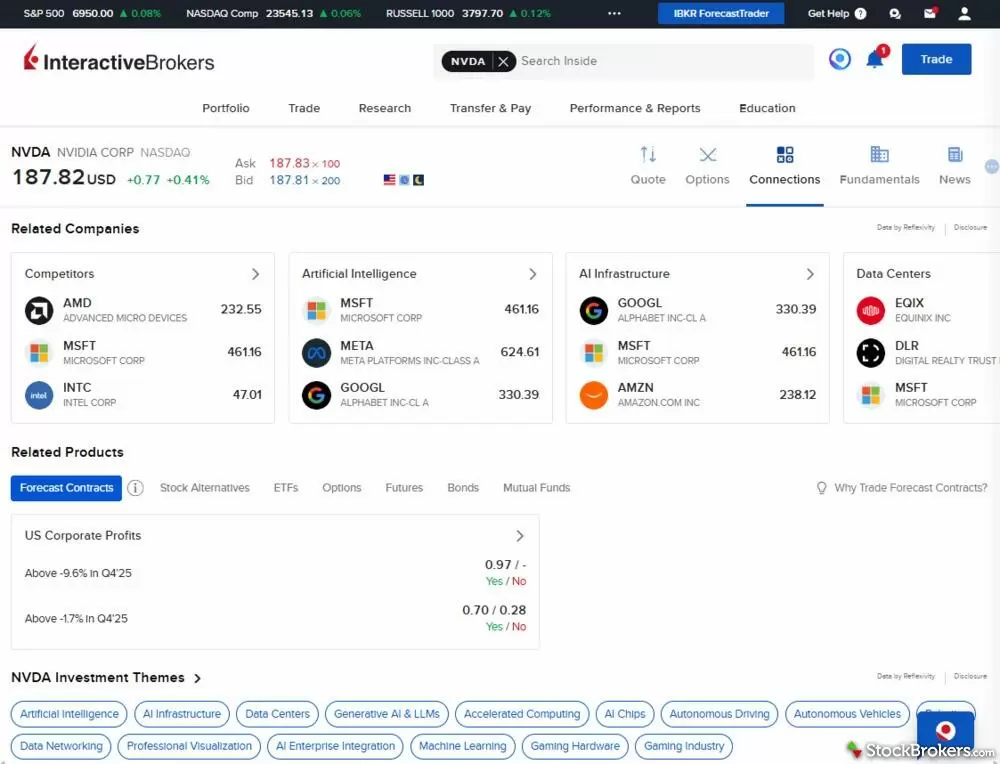
Interactive Brokers’ Connections tab, shown here for NVIDIA (NVDA), gives investors a 360° contextual research view by linking the selected stock to related competitors, thematic sectors like AI infrastructure and data centers, and tradable products such as Forecast Contracts and ETFs. Connections helps traders uncover peers, trends, and broader market relationships beyond just the price quote.
Portfolio management: For portfolio management, IBKR offers the "PortfolioAnalyst" tool, which is essentially an institutional-grade risk engine available to retail clients. It allows you to run "what-if" scenarios, beta-weight your portfolio against specific indices, and even consolidate external accounts to analyze your true net worth. While the learning curve is steeper than its peers, the payoff is unparalleled control over order execution and risk management.
Awards won: Best Range of Investments, Best for Active Traders, and Best for Futures Trading. It also won industry awards for #1 International Trading, #1 Thematic Investing, #1 Professional Trading, #1 Trader App, #1 Client Dashboard, #1 New Tool, and #1 24-Hour Trading.
4. E*TRADE from Morgan Stanley - Best advanced web platform
E*TRADE remains one of the best choices for traders who want professional-grade tools without downloading clunky desktop software. It essentially offers the best brokerage account for versatility. Passive investors get a clean, modern dashboard for managing IRAs, while active traders get access to Power E*TRADE, a robust web-based platform that rivals downloadable software.
The standout feature is the Power E*TRADE web interface. It simplifies complex options strategies into intuitive "risk slides," allowing you to visually see how a trade will perform if the market moves against you. I also found the mobile app to be exceptionally easy to use for quick check-ins, although serious analysis is better done on the web. E*TRADE is particularly strong for investors who want to automate their portfolio. The automatic investing options for ETFs are seamless, making it easy to set up recurring weekly deposits into low-cost funds.
Awards won: #1 Active Trading Web Platform and #1 Passive Investors.
5. Merrill Edge Self-Directed – Best for banking integration
For existing or prospective Bank of America clients, Merrill Edge is arguably the best brokerage account to maximize the value of your entire financial life. The platform's "Preferred Rewards" program is the value proposition: by linking your Merrill investment portfolio with your BofA checking account, you can unlock tier-based boosters on credit card rewards, savings interest rates, and mortgage discounts.
Beyond the banking perks, Merrill’s research tools are surprisingly comprehensive for a bank-affiliated broker. The "Stock Story" feature is worth a mention, transforming dense financial data into an interactive, question-and-answer format that makes researching companies approachable for beginners. While the active trading platform, MarketPro, feels a bit dated compared to Schwab's thinkorswim or Power E*TRADE, the seamless integration of banking and investing makes Merrill the clear winner for anyone looking to consolidate their finances under one roof.
Awards won: Best Bank Brokerage.
Other stock brokers I tested
6. Webull - Best community experience
Webull continues to gain ground among the top online brokers by catering to the modern, mobile-first trader who values community and technicals over traditional research reports. It distinguishes itself with a social feed integrated directly into the stock quote pages. The "Comments" tab allows you to discuss trade ideas and sentiment with fellow investors in real-time, effectively creating a social network within your brokerage app.
For chartists, the mobile experience is surprisingly powerful. The new "Replay Mode" allows you to replay historical price action bar-by-bar, a fantastic tool for backtesting strategies visually on a small screen. Additionally, the "Sage Tracker" offers a glimpse into institutional order flow, helping retail traders spot where the "smart money" might be positioning. While it lacks the deep fundamental research and account types (like custodial IRAs) found at legacy firms, Webull is the premier choice for traders who want a collaborative, data-rich mobile trading platform.
Awards won: #1 Paper Trading. Webull also finished Best in Class for Mobile Trading Apps.
7. Robinhood - Easy to use and sleek
Rounding out our list of the top online brokerages is Robinhood, which has matured significantly beyond its mobile-only roots. The introduction of "Robinhood Legend," a sleek, widget-based desktop platform, demonstrates a serious commitment to active traders. It offers the most user-friendly charting experience I’ve tested, allowing you to drag, drop, and customize technical indicators with zero friction.
The mobile app remains the gold standard for simplicity. The "Digests" feature, powered by AI, provides concise explanations for why a stock is moving, stripping away the noise of traditional financial news feeds. While it lacks some fundamental data (like free cash flow or payout ratios) found at legacy brokers, Robinhood’s intuitive design and high-quality educational content make it the perfect entry point for new investors or those who prefer a minimalist trading environment.
Awards won: #1 Prediction Markets. Robinhood also finished Best in Class for Beginners.
8. TradeStation - Best-in-class for active traders
For serious technical traders, TradeStation remains a top contender among the best brokerage accounts for pure execution and charting power. The launch of its new Titan X platform has modernized the experience significantly, offering a drag-and-drop interface that rivals the ease of TradingView while retaining the institutional-grade muscle TradeStation is famous for.
The standout feature here is the "Portfolio Maestro," a tool that allows you to run Monte Carlo simulations and correlation analyses on your entire portfolio. This is critical for hedging risk in volatile markets. While it lacks the fundamental research depth of a Fidelity or Merrill, its "Hot Lists" scanner is exceptional for finding pre-market movers based on volume and volatility. If your strategy relies on technical analysis and automated trading scripts, TradeStation provides the most robust sandbox to build and test your edge.
Awards won: #1 Innovation for TradeStation MCP. TradeStation also finished Best in Class for Active Traders, Advanced Trading, and Futures Trading.
9. Firstrade - A great deep discount offering
Firstrade secures its place as a top online broker by offering a rare combination: a true discount cost structure with a full-service investment menu. While many low-cost apps restrict you to just stocks and ETFs, Firstrade provides fee-free access to mutual funds, fixed income, and even options strategies without per-contract fees. It is the ideal destination for the cost-conscious investor who refuses to compromise on asset class variety.
The platform also shines in research depth. The data provided on fund composition is exceptionally deep. You can analyze fixed income exposure within a balanced fund down to the effective duration and credit quality, a level of detail usually reserved for institutional terminals. Additionally, it remains a top choice for international investors, accepting accounts from over 60 countries with a fully translated Mandarin interface.
Awards won: Best in Class for Range of Investments.
10. J.P. Morgan Self-Directed Investing - Best for all-in-one financial management
If you already bank with Chase, J.P. Morgan Self-Directed Investing is one of the best brokerage accounts to consolidate your finances. The seamless integration means you can view your checking, savings, and investment accounts in a single app, with instant transfers between them.
While it lacks the advanced trading tools of a Schwab or IBKR, it compensates with exceptional proprietary research. The Markets page offers a clean, widget-based view of what’s moving the indices, and the fixed income section is surprisingly comprehensive, offering clear visualizations of yield curves that many competitors lack. For the "set it and forget it" investor who values simplicity and institutional-grade insights over complex charting, J.P. Morgan is a solid, reliable choice.
Awards won: Best in Class for Customer Service, Education, and Retirement Accounts.
Compare the best brokerage accounts
The table below compares my top brokerage account picks side by side. It lists each broker’s overall rating, minimum deposit, 2026 award, uninvested cash APY, and fractional shares availability so you can weigh cost, features, and account requirements in one place before opening an account.
| Company | Overall | Minimum Deposit | 2026 Award | Fractional Shares (Stocks) | Options (Per Contract) |
 Charles Schwab Charles Schwab
|
|
$0.00 | #1 Overall Broker | Yes | $0.65 |
 Fidelity Fidelity
|
|
$0.00 | #1 for Beginners | Yes | $0.65 |
 Interactive Brokers Interactive Brokers
|
|
$0.00 | #1 for Active Traders | Yes | $0.65 |
 E*TRADE E*TRADE
|
|
$0.00 | #1 Active Trading Web Platform | Yes | $0.65 |
 Merrill Edge Merrill Edge
|
|
$0.00 | #1 Bank Brokerage | No | $0.65 |
 Webull Webull
|
|
$0.00 | #1 Paper Trading | Yes | $0.00 |
 Robinhood Robinhood
|
|
$0.00 | #1 Prediction Markets | Yes | $0.00 |
FAQs
What is a brokerage account?
A brokerage account is an account provided by a brokerage firm that allows you to buy and sell stocks, bonds, ETFs, and mutual funds using an online trading platform. Think of it as your direct link to the markets, giving you access to a variety of investment products and the tools you need to build and manage your portfolio. Depending on what the broker offers, you might also be able to explore more advanced trading options, including complex derivatives such as options and futures, or use helpful features like in-depth research and portfolio analysis to guide your decisions.
There are different flavors of brokerage accounts tailored to your investing style. With a cash account, you pay for each investment in full at the time of purchase, keeping things simple and limiting your risk, but it’s important to be mindful of settlement dates to avoid any penalties for premature trading. On the other hand, a margin account lets you borrow funds to potentially boost your buying power, which can amplify gains but also comes with its own drawbacks. You’ll need to pay interest on the borrowed amount, and if your investments decline in value, you could face a margin call requiring you to deposit more funds or liquidate positions, increasing the risk and complexity of your investment strategy.
How much money do I need to open a brokerage account?
The amount of money needed to open a brokerage account and trade stocks varies by firm. While some stock brokers require a minimum deposit, others have no minimum at all, which is increasingly becoming more common. However, even with no set minimum, you'll need enough funds to purchase at least a fractional share of the investment you're interested in, ensuring you can start building your portfolio right away.
Even as little as $5 is enough to start investing with at a broker like Charles Schwab, which offers Stock Slices — fractional shares of S&P 500 companies. For other ideas on where to invest your initial capital, read more about how to invest $100, $1,000, $10,000 or more.
Is my money safe with a broker?
Money held at a brokerage firm is protected in several ways. Most U.S. brokers are members of the Securities Investor Protection Corporation (SIPC), which protects up to $500,000 in securities and cash per customer, including a $250,000 limit for cash, if the brokerage firm fails. SIPC does not protect against investment losses from market movements. It only covers the loss of assets held by a failed member firm. Many brokers also carry supplemental insurance above SIPC limits. Before opening an account, confirm that the broker is a SIPC member and review how your assets are held and protected.
How long does it take to open a brokerage account?
Opening a brokerage account online usually takes about 10 to 15 minutes, and many brokers approve new accounts within minutes. You will need to provide personal information, including your Social Security number, employment details, and financial background. Once the account is approved, funding it by linking a bank account or transferring funds can take a few days to clear before you can start trading. Transfers from another broker take longer, often up to a week or more.
Can I have multiple brokerage accounts?
Yes, you can have multiple brokerage accounts. Many investors choose to open accounts with different brokers to access unique tools, optimize fees, or separate investment strategies. This approach can offer enhanced portfolio management and diversification while also allowing you to take advantage of each broker's specific strengths and features.
What are some tips for choosing a broker?
When choosing a broker, it's important to consider your unique trading style and long-term investment goals. Here are some key factors to help you narrow down your options:
- Great for Mobile Trading: If you prefer trading on the go, look for brokers with top-rated mobile apps. Check out our mobile trading guide.
- Best for IRAs: For retirement planning, choose brokers offering robust IRA options and expert retirement planning tools. See our IRA guide.
- Options Trading: If options are your focus, look for brokers offering advanced options trading tools, risk management features, and clear pricing structures. Head on over to our guides on the best options trading platforms, best options apps, and options brokers for beginners.
- Futures Trading: For those interested in futures, select a broker with specialized platforms and competitive margins that cater to fast-paced markets. Visit our guide to the best futures trading platforms.
- Low Fees & Minimum Deposits: Compare commission structures and account minimums to ensure you're getting a cost-effective solution that fits your budget. Check out our guide to the best free stock trading accounts.
- Powerful Research & Tools: Opt for brokers that provide comprehensive market research, analysis tools, and educational resources to support your trading decisions. Visit our guide to the best brokers for research or our guide to the best brokers for education.
- User-Friendly Platform & Support: A well-designed, intuitive trading platform paired with reliable customer support can make all the difference in your investing experience. To that end, head on over to our guide to the best brokers for user experience.
What broker offers the best trading platform?
Charles Schwab offers the best online trading platform for most people due to its strong overall rankings across key categories, particularly in its ease of use and mobile trading apps. That said, there will often be specific concerns for you as a trader or investor that'll make a different broker an even better fit. The brokerage account testing team at StockBrokers.com maintained live accounts at 14 brokers in 2026 and used them to evaluate each broker’s tools, ease of use, data, design, and content. Here are the five top-scoring brokerage firms and the accolades won in the StockBrokers.com Annual Awards for 2026:
- Charles Schwab —
: Our pick for #1 Overall Broker, including Best for Advanced Trading, Mobile Trading Apps, and Ease of Use. We also found it to be Best for High Net Worth Investors, and Customer Service. Schwab also won industry awards for #1 Active Trading Desktop Platform and #1 Stock Research.
- Fidelity —
- Interactive Brokers —
- E*TRADE from Morgan Stanley —
: Industry awards for #1 Active Trading Web Platform and #1 Passive Investors.
- Merrill Edge —
Stock broker reviews
Our Robinhood review tests $0 stock and options trades, #1-ranked prediction markets, and AI agent trading, plus where its website research falls short.
Jessica Inskip October 01, 2026
Read our 2026 E*TRADE review to see how powerful research, versatile platforms, and diverse investments make it a top choice for all investors.
Jessica Inskip September 29, 2026
Read our Webull review and discover its commission-free trading, sleek platforms, paper trading tools, and fractional shares.
Jessica Inskip October 20, 2026
Fidelity charges $0 stock and ETF trades and won #1 for Research and Education in 2026. See our tested review of its fees, platforms, IRAs, and apps.
Jessica Inskip September 30, 2026
Read our Merrill Edge Self-Directed review and see how it combines powerful investing tools, robust research, and integrated banking benefits.
Jessica Inskip September 29, 2026
Read our Charles Schwab review to learn why its platforms, research, and investor resources make it one of the top-ranked brokerages.
Jessica Inskip September 30, 2026Related guides

Practice trading risk-free with the best paper trading apps and simulators of 2026. Compare Webull, Schwab thinkorswim, Interactive Brokers, E*TRADE and TradeStation, plus how paper trading works.
Jessica Inskip July 24, 2026
We tested dozens of platforms to find the eight best stock trading apps for 2026. Compare top picks like Schwab and Fidelity for every investing style.
Jessica Inskip August 06, 2026
Compare the best brokers for 24-hour stock trading in 2026. Overnight, pre-market and after-hours access at Interactive Brokers, Schwab, Firstrade, Webull and Robinhood, plus what the SEC and Nasdaq changes mean.
Jessica Inskip August 14, 2026
Fidelity, E*TRADE, and Schwab top our 2026 list of trading platforms and apps for beginners, with $0 minimums, $0 stock trades, and built-in education.
Jessica Inskip October 15, 2026More guides
We tested 14 brokers with real accounts. See the best options trading platforms for beginners, low fees and advanced traders, with contract fees compared.
Jessica Inskip September 09, 2026
The best day trading platforms and apps for 2026. Interactive Brokers, Schwab thinkorswim, Fidelity, E*TRADE and TradeStation tested on execution speed, Level 2 data, hotkeys, margin rates and the pattern day trader rule.
Jessica Inskip October 05, 2026
Practice trading risk-free with the best paper trading apps and simulators of 2026. Compare Webull, Schwab thinkorswim, Interactive Brokers, E*TRADE and TradeStation, plus how paper trading works.
Jessica Inskip July 24, 2026
Find the best crypto trading platform for 2026. We rank eToro, Fidelity, Interactive Brokers, Webull, and Robinhood on fees, security, and coin selection.
Steven Hatzakis May 27, 2026
Find the best penny stock brokers. Compare Fidelity, Firstrade, Schwab, E*TRADE, and TradeStation for OTC access, fees, and tools.
Jessica Inskip August 02, 2026
Find the best IRA accounts. Compare Fidelity, Schwab, Merrill Edge, E*TRADE, & J.P. Morgan for retirement planning, fees, tools, and account flexibility.
Jessica Inskip March 31, 2026
Find the top bank brokerages. From Merrill Edge to Ally, discover brokers that combine banking, investing, and rewards in one account.
Jessica Inskip April 16, 2026
Find the best rollover IRA accounts. Compare Fidelity, Schwab, and E*TRADE for easy transfers, low fees, and smart retirement investing tools.
Andrea Coombes May 15, 2026
Find top U.S. forex brokers. From tastyfx to OANDA, explore platforms with strong regulation, great tools, and user-friendly trading.
Steven Hatzakis May 29, 2026
Explore the best international brokers for U.S. investors. Compare Interactive Brokers, Charles Schwab, and Fidelity for global stock trading access.
Jessica Inskip May 22, 2026
Find the best Roth IRA accounts. Fidelity, Schwab, and E*TRADE lead with low fees, smart investing tools, and retirement planning support.
Andrea Coombes April 27, 2026
Fidelity, E*TRADE, and Schwab top our 2026 list of trading platforms and apps for beginners, with $0 minimums, $0 stock trades, and built-in education.
Jessica Inskip October 15, 2026
The best free stock trading platforms and commission-free apps for 2026. Interactive Brokers, Fidelity, Ally, J.P. Morgan and E*TRADE tested on the true cost of $0 trades, hidden fees and how free brokers make money.
Jessica Inskip September 02, 2026
Find the best brokerage for high-net-worth investors. Compare Fidelity, Schwab, Merrill, and more for premium services and tailored investment tools.
Jessica Inskip January 27, 2026
Discover the best brokers for trade execution. Compare Fidelity, Interactive Brokers, and more for price improvement, speed, and transparency.
Jessica Inskip October 12, 2026
We tested the 5 best futures trading platforms of 2026. IBKR wins overall, and TradeStation has the lowest day-trade margins we found. Compare commissions, margins, and micros.
Jessica Inskip October 05, 2026About the Editorial Team
Jessica Inskip is Director of Investor Research at StockBrokers.com, bringing 15 years of experience in brokerage and trading strategy. A former FINRA-licensed rep, she held Series 7, 63, 66, and 4 licenses. Jessica focuses on investor education and brokerage industry research, appears regularly on CNBC, Bloomberg, The Schwab Network, Fox Business, and Yahoo! Finance, and hosts the Market MakeHer podcast.
Jeff Anberg is a Senior Editor at StockBrokers.com. Along with years of experience in media distribution at a global newsroom, Jeff has a versatile knowledge base encompassing the technology and financial markets. He is a long-time active investor and engages in research on emerging markets like cryptocurrency. Jeff holds a Bachelor’s Degree in English Literature with a minor in Philosophy from San Francisco State University.
Blain Reinkensmeyer has 25 years of trading experience with over 2,500 trades placed during that time. He heads research for all U.S.-based brokerages on StockBrokers.com and is respected by executives as the leading expert covering the online broker industry. Blain’s insights have been featured in the New York Times, Wall Street Journal, Forbes, and the Chicago Tribune, among other media outlets.