 Charles Schwab
 Fidelity
 Interactive Brokers
 E*TRADE
 Webull
 TradeStation
 tastytrade
 eToro
eToro Trading 212
 Interactive Investor
 IG
IG Interactive Brokers
 XTB
XTB Hargreaves Lansdown
 Saxo
Saxo Charles Stanley Direct
 CIBC Investor's Edge
 Interactive Brokers
 Moomoo
 Questrade
 Qtrade
 TD Direct Investing
 Wealthsimple
 Finviz
 Stock Rover
 Seeking Alpha
 StockHero
 TipRanks
 TrendSpider
 Trade Ideas
 TraderSync
 TradingView
 Tradervue
 TradeZella
Best Paper Trading Apps & Platforms for 2026

Written by Jessica Inskip
Director of Investor Research

Edited by Hannah Smith
Staff Editor

Fact-checked by Steven Hatzakis
Director of Online Broker Research

Reviewed by Blain Reinkensmeyer
Managing Partner
Jessica InskipDirector of Investor Research
Jessica Inskip is Director of Investor Research at StockBrokers.com, bringing 15 years of experience in brokerage and trading strategy. Jessica focuses on investor education and brokerage industry research.


 Why you can trust us
Led by Jessica Inskip, Director of Investor Research, the StockBrokers.com research team collects thousands of data points across hundreds of variables. We evaluate features important to every kind of investor, including beginners, casual investors, passive investors, and active traders. We carefully track data on margin rates, trading costs, and fees to rate stock brokers across our proprietary testing categories.
Our researchers open personal brokerage accounts and test all available platforms on desktop, web, and mobile for each broker reviewed on StockBrokers.com. Learn more about how we test.
Starting your investment journey doesn’t have to involve immediate financial risk. The stock market is complex, and navigating a new platform while learning the ropes can feel like an impossible task. This is where paper trading, or simulated trading, comes in. It allows you to buy and sell stocks and options using virtual "Monopoly money" in a real-time environment, providing a vital practice ground for beginners to build confidence and for experienced traders to test new strategies without a price tag.
The best brokers for paper trading, such as Webull, Charles Schwab, and Interactive Brokers, provide a seamless bridge between practice and reality. These platforms offer virtual accounts that look and feel exactly like their live versions, ensuring there are no surprises when you eventually transition to real capital. Whether you need a simple mobile app with guardrails or a professional-grade desktop suite to track complex variables, these brokers offer the tools necessary to grow your skills safely.
I spent hundreds of hours testing 14 online stock brokers, opening accounts, placing trades, and digging into their features to find the best simulated trading experiences. Each platform I’ve selected brings something unique to the table, so if you’re ready to start practicing, this guide will help you find a brokerage platform that matches your needs.
Best Paper Trading Platforms
To find the best brokers for paper trading, I evaluated each platform’s simulation accuracy, ease of use, mobile accessibility, and range of available assets. The brokers below consistently stood out for offering virtual environments that mirror the real-market experience without any financial risk. These are the platforms that provide the strongest blend of professional-grade tools, educational support, and seamless transitions for investors ready to practice their strategies.
- Minimum Deposit: $0.00
- Stock Trades: $0.00
- Options (Per Contract): $0.00
Webull offers attractive, easy-to-use downloadable platforms with a short learning curve that will have beginners quickly up and running. Its charts are also a standout. Read full review
- Zero commissions for options contracts.
- Crypto trading has been reintegrated into the main app.
- Phenomenal, award-winning paper trading platform.
- Lack of account types like Inherited IRAs, Trust accounts, and custodial accounts.
- Constructing multi-leg options strategies can feel cumbersome.
- Education is often disorganized and can be confusing for beginners.
- Minimum Deposit: $0.00
- Stock Trades: $0.00
- Options (Per Contract): $0.65
Charles Schwab’s powerful thinkorswim trading platform, one of our perennial top picks among online brokerages, offers loads of features, including virtual trading. Streaming and video content is also strong. Read full review
- thinkorswim is the industry benchmark for professional-grade trading and charting.
- Best in Class Research features actionable daily updates and deep fundamental data.
- Top-tier education with webinars, videos, and courses.
- No spot crypto trading (limited to ETFs and futures).
- "Stock Slices" (fractional shares) are limited to S&P 500 companies.
- Base margin rates are significantly higher than dedicated low-cost competitors.
- Minimum Deposit: $0.00
- Stock Trades: $0.00
- Options (Per Contract): $0.65
Interactive Brokers is a longtime global leader, particularly for the breadth of tradeable instruments. Paper trading is available on the IBKR Mobile app as well as the pro-grade Trader Workstation platform. Read full review
- 170+ markets to trade.
- IBKR Desktop platform has institutional power and intuitive usability.
- Industry-leading margin rates and competitive interest yields.
- Density of features requires a significant time investment.
- Educational content skips over the basics for true beginners.
- Certain tools lack the curated context needed.
- Minimum Deposit: $0.00
- Stock Trades: $0.00
- Options (Per Contract): $0.65
If you have an interest in options trading, E*TRADE’s options tools will have you upping your game. For paper trading, download the Power E*TRADE app rather than the flagship app. Read full review
- High-quality experience for both passive investors and active traders.
- Access to Morgan Stanley’s deep market analysis and interactive reports.
- Excellent bond resource center and a user-friendly ladder tool.
- Base margin rates, starting at over 12%, are significantly higher than top competitors.
- Spot crypto trading is limited to Bitcoin, Ethereum, and Solana, and those assets are held at zerohash rather than at E*TRADE.
- Minimum Deposit: $0.00
- Stock Trades: $0.00
- Options (Per Contract): $0.80
Many serious traders use TradeStation because of its proprietary programming language, which allows automated trading. Its mobile app is friendlier to beginners than its complex desktop platform. Read full review
- New TITAN X platform.
- Tools for futures and options.
- "Why is it Moving?" and "Hot Lists" tools on price action.
- Not a good choice for beginners or casual investors.
- Annual IRA maintenance fees and steep option exercise charges.
- No spot cryptocurrency trading, fractional shares, or robo-advisory services.
- Minimum Deposit: $50.00
- Stock Trades: $0.00
- Options (Per Contract): $0.00
Paper traders, like real-money traders, can benefit from eToro’s strong community features. You can read posts from fellow individual investors and dip a toe into the world of copy trading. Read full review
- Social feed adds real-time market context.
- Large crypto offering globally; U.S. lineup is limited.
- “Why is it moving?” insights explain price action clearly.
- TradingView-powered charts on mobile and web.
- No retirement accounts or beneficiary support.
- Options trading tools are confusing and poorly structured.
- No mutual funds, bonds, or futures.
- Crypto trading includes a ~1% fee per transaction.
Compare trading platforms head-to-head
Use the broker comparison tool to compare over 150 different account features and fees.
Top picks for paper trading apps and platforms
1. Webull - Best paper trading platform
| Company | Overall | Minimum Deposit | Stock Trades | Options (Per Contract) |
 Webull Webull
|
|
$0.00 | $0.00 | $0.00 |
Webull earns our top spot because it offers a high-fidelity simulation that perfectly mirrors its live trading experience. You can practice with stocks, ETFs, and options using a virtual account that grants you access to professional-grade tools, like the "Turbo Trader" for quick execution and advanced order types, without risking a penny. It’s a rare platform that provides a sophisticated, widget-based desktop environment and a powerful mobile app, making it ideal for those who want to transition from practice to reality with zero learning curve.
Advanced charting and unique tools: The technical analysis tools within Webull’s paper trading suite are standout features. You can choose from over 55 indicators and even utilize a "Replay Mode" to time-lapse historical price action, which allows you to backtest strategies visually. While the platform is technical-heavy, it remains accessible; for instance, you can easily adjust moving averages or draw price levels with a magnifying glass tool for exact precision. These features ensure that your "virtual" practice is as detailed and accurate as live market participation.
Jessica's take:
"Webull’s simulation is a standout because it doesn't water down the experience. The inclusion of features like the 'Replay Mode' and AI-powered news summaries provides a unique, modern edge for traders who want to sharpen their technical skills before going live."
Jessica Inskip
Director of Investor Research
AI-powered insights and market pulse: Webull integrates modern technology through its AI assistant and "Market" widgets to help you understand the why behind price movements. From the desktop "Saturn" icon, you can access global market heatmaps, yield curves, and a full economic calendar to stay proactive. On mobile, the "News & Daily" tab uses AI to summarize what is moving the market, allowing you to validate your paper trading decisions against real-world fundamental data and sentiment scores.

Webull’s Morning Brief screen is the perfect starting point for any trading day, offering a comprehensive snapshot of what’s ahead. It includes futures data, a corporate event calendar (earnings, dividends, splits), analyst upgrades and downgrades, earnings previews, and an economic news feed, all in one place.
2. Charles Schwab - Best for complex trading layouts
| Company | Overall | Minimum Deposit | Stock Trades | Options (Per Contract) |
 Charles Schwab Charles Schwab
|
|
$0.00 | $0.00 | $0.65 |
Charles Schwab earns its high ranking by providing access to thinkorswim (TOS), a platform widely regarded as the gold standard for simulated trading. Through its "PaperMoney" feature, users get a virtual environment that is indistinguishable from the live version, loaded with $100,000 in play money. This allows you to master a professional-grade suite, with advanced order types and complex multi-leg options strategies, without any financial commitment. It’s the perfect training ground for those who eventually want to trade like a pro.
Elite charting and backtesting capabilities: The charting experience on thinkorswim is arguably the most powerful in the industry. You can customize hundreds of technical indicators, draw precise trend lines, and even use the "Chart Describer" tool to learn about technical events as they happen on your screen. A standout feature for strategy development is the integrated backtesting tool; you can apply "Strategies" to historical data to see how an entry or exit point would have performed over time, allowing for data-driven practice before moving to a live account.
Comprehensive market data and customization: Beyond simple price tracking, Schwab’s ecosystem offers a depth of data, including the integration of FRED (Federal Reserve Economic Data) directly into your charts. This means you can paper trade while monitoring interest rates, employment shifts, and GDP data in real-time. The platform is highly widgetized, allowing you to build a custom dashboard with heat maps, live streaming from the Schwab Network or CNBC, and a dedicated earnings analysis tool that visualizes implied moves and historical volatility.
Mobile trading that matches the desktop: For those who practice on the go, the thinkorswim mobile app is a standout. Unlike many "light" versions of trading apps, the TOS mobile experience is fully customizable and supports complex options trading directly from the chain. You can sync your watchlists and charts across devices, and even access dedicated chat rooms like the "Trader’s Lounge" to discuss strategies with the community. While the learning curve for TOS is steeper than others, the built-in "Swim Lessons" and platform tutorials provide a path to advanced trading.
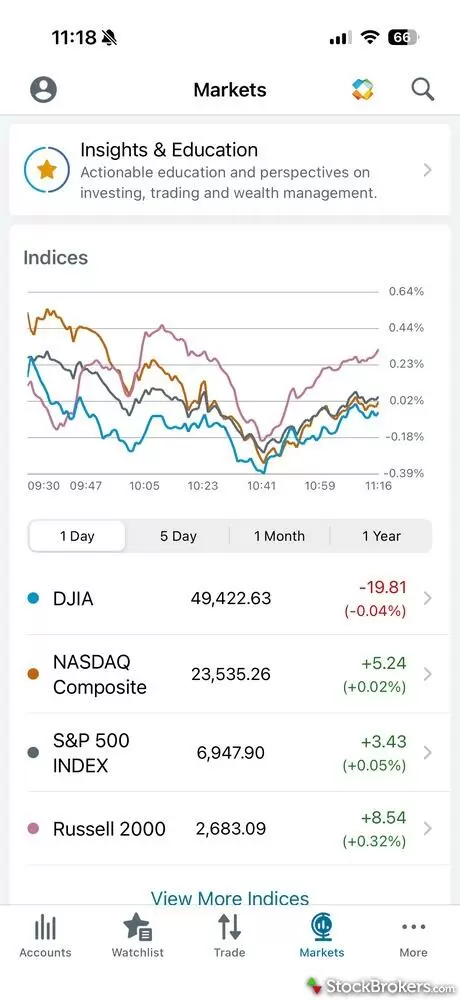
Schwab’s Market Research mobile homepage provides a quick snapshot of daily market performance, with real-time updates on major indices like the S&P 500, Dow, and Nasdaq. Users can also access breaking news headlines, macroeconomic insights, sector performance breakdowns, and even listen to an audio market update—all in one streamlined view.
3. Interactive Brokers - Best for crypto paper trading
| Company | Overall | Minimum Deposit | Stock Trades | Options (Per Contract) |
 Interactive Brokers Interactive Brokers
|
|
$0.00 | $0.00 | $0.65 |
Interactive Brokers (IBKR) earns its spot by providing the most comprehensive simulation of global markets available to retail traders. Through its Trader Workstation (TWS) "Paper Trading" account, users can practice with an incredible range of assets, including stocks, options, futures, cryptocurrencies, and bonds, across 150 global markets. Because IBKR uses the exact same technology for its paper accounts as its institutional-grade live platforms, it is the premier choice for sophisticated investors who need to master complex professional tools before committing real capital.
Professional-grade crypto paper trading: IBKR is a standout for crypto simulation, allowing users to practice trading "spot" cryptocurrencies like Bitcoin and Ethereum alongside crypto futures and ETPs. Unlike many simplified apps, IBKR’s paper trading environment allows you to test how digital assets impact a diversified portfolio. You can use the Risk Navigator to monitor crypto volatility and run "what-if" scenarios, making it the best platform for traders who want to treat crypto as a serious portfolio allocation rather than a speculative bet.
Sophisticated analysis and backtesting: IBKR sets the bar for data-driven practice with the integrated ORATS backtester, which allows you to simulate options strategies using 180 million historical data points. The charting in TWS is equally robust, offering 18 different chart types, including Renko, Kagi, and Point & Figure, and a massive library of indicators. For technical analysts, the ability to adjust data points to the exact penny and save custom templates ensures that your virtual trading reflects the precision required in live, high-stakes environments.
Advanced order types and market insights: The platform’s simulation includes professional order entry tools like "Adaptive Algos" to help you find the best price execution. The "Daily Lineup" feature is a key differentiator, providing an AI-powered summary of world markets, analyst upgrades, and a detailed economic calendar. Whether you’re using the flagship app or the desktop TWS, IBKR provides a high-fidelity environment that bridges the gap between educational theory and global market reality.

Interactive Brokers’ Traders’ Insight delivers expert market commentary from lead strategists, covering global markets, asset classes, and economic trends. This research hub goes beyond static reports by allowing readers to comment and engage with other traders, making it a dynamic community for sharing insights. It’s a valuable resource for anyone looking to stay informed and connect with like-minded investors.
4. E*TRADE - Best for new options traders
| Company | Overall | Minimum Deposit | Stock Trades | Options (Per Contract) |
 E*TRADE E*TRADE
|
|
$0.00 | $0.00 | $0.65 |
E*TRADE earns its spot by offering the Power E*TRADE platform in a full-featured paper trading mode. It provides a modern, widget-based interface that mirrors the live experience, making it an ideal environment for beginners to practice without financial risk.
Robust charting and technical studies: The platform features 19 different chart styles and an expansive library of indicators. While the drawing tools have a learning curve, the ability to easily customize moving averages and volatility bands provides a strong foundation for learning technical analysis and price action.
Integrated earnings and strategy tools: A standout feature is the Earnings Move tool, which visualizes implied moves and historical volatility. Combined with the TradeLab risk-analysis widget, paper traders can evaluate max profit and loss probabilities before executing a virtual trade.
5. TradeStation - Best for automated trading
| Company | Overall | Minimum Deposit | Stock Trades | Options (Per Contract) |
 TradeStation TradeStation
|
|
$0.00 | $0.00 | $0.80 |
TradeStation is built for the serious trader, offering a high-performance simulation mode through its new Titan X platform. It provides a clean, modern interface for practicing with equities, futures, and complex options, with "Launch Pad" templates that help you jump directly into specialized layouts.
Next-level charting and technical indicators: The charting tools feature over 105 indicators that are easy to drag, drop, and modify. Technicians can adjust price points to the exact penny and extend drawing levels seamlessly, while built-in definitions for every indicator turn practice sessions into active learning opportunities.
Sophisticated options and risk tools: The simulation includes an upgraded options chain with over 25 columns and a highly intuitive trade ticket. You can set take-profit and stop-loss orders as dollar amounts or percentages, while the Portfolio Maestro tool provides advanced risk monitoring and Monte Carlo analysis for your virtual portfolio.
Read next
- Best Options Trading Platforms for 2026
- Best Stock Trading Apps for 2026
- Best Brokerage Accounts for 2026
- Best Day Trading Platforms and Apps for 2026
- Best Brokers for Penny Stock Trading of 2026
- Best Trading Platforms for Beginners in 2026
- Best Futures Trading Platforms for 2026
More guides

Find top U.S. forex brokers. From tastyfx to OANDA, explore platforms with strong regulation, great tools, and user-friendly trading.
Steven Hatzakis May 29, 2026
Find the best rollover IRA accounts. Compare Fidelity, Schwab, and E*TRADE for easy transfers, low fees, and smart retirement investing tools.
Andrea Coombes May 15, 2026
Interactive Brokers and Fidelity lead our 2026 ranking of the best free stock trading platforms, tested on the true cost of $0 commissions and hidden fees.
Jessica Inskip September 02, 2026
Find the best crypto trading platform for 2026. We rank eToro, Fidelity, Interactive Brokers, Webull, and Robinhood on fees, security, and coin selection.
Steven Hatzakis May 27, 2026
Discover the best stock brokers of 2026. Compare Schwab, Fidelity, Interactive Brokers, E*TRADE, and more to find the top trading platform for your needs.
Jessica Inskip August 06, 2026
Find the top bank brokerages. From Merrill Edge to Ally, discover brokers that combine banking, investing, and rewards in one account.
Jessica Inskip April 16, 2026
Find the best brokerage for high-net-worth investors. Compare Fidelity, Schwab, Merrill, and more for premium services and tailored investment tools.
Jessica Inskip January 27, 2026
We tested the 5 best futures trading platforms of 2026. Compare commissions, margin rates, and tools for beginners and active traders. Find the right platform for you.
Jessica Inskip September 17, 2026
Find the best Roth IRA accounts. Fidelity, Schwab, and E*TRADE lead with low fees, smart investing tools, and retirement planning support.
Andrea Coombes April 27, 2026
Start investing with ease. Explore the best beginner-friendly trading platforms with low fees, great education, and intuitive apps.
Jessica Inskip August 06, 2026
Explore the best international brokers for U.S. investors. Compare Interactive Brokers, Charles Schwab, and Fidelity for global stock trading access.
Jessica Inskip May 22, 2026
We tested the best options trading platforms for 2026. Compare tastytrade, Fidelity, IBKR, E*TRADE & Schwab on tools, fees, and picks for beginners.
Jessica Inskip September 09, 2026
Discover the best brokers for trade execution. Compare Fidelity, Interactive Brokers, and more for price improvement, speed, and transparency.
Jessica Inskip May 22, 2026
Discover the best day trading platforms. Compare IBKR, Schwab, Fidelity, E*TRADE, and TradeStation for speed, tools, and margin rates.
Jessica Inskip August 03, 2026
Find the best IRA accounts. Compare Fidelity, Schwab, Merrill Edge, E*TRADE, & J.P. Morgan for retirement planning, fees, tools, and account flexibility.
Jessica Inskip March 31, 2026
Find the best penny stock brokers. Compare Fidelity, Firstrade, Schwab, E*TRADE, and TradeStation for OTC access, fees, and tools.
Jessica Inskip August 02, 2026Popular stock broker reviews
Read our Robinhood review and see why it’s a top pick for beginners, with a sleek mobile app, zero commissions, and standout educational tools.
Jessica Inskip September 03, 2026
Read our Webull review and discover its commission-free trading, sleek platforms, paper trading tools, and fractional shares.
Jessica Inskip September 18, 2026
Read our 2026 E*TRADE review to see how powerful research, versatile platforms, and diverse investments make it a top choice for all investors.
Jessica Inskip September 14, 2026
Read our Firstrade review and see why it’s a top choice for options traders, offering $0 contract fees, robust tools, and a growing feature set.
Jessica Inskip May 04, 2026
Read our Charles Schwab review to learn why its platforms, research, and investor resources make it one of the top-ranked brokerages.
Jessica Inskip September 21, 2026
Read our Merrill Edge Self-Directed review and see how it combines powerful investing tools, robust research, and integrated banking benefits.
Jessica Inskip May 04, 2026
Read our eToro review to explore its interactive platform, built-in discussions, and tools for crypto and stock investing.
Jessica Inskip May 20, 2026
Read our Public.com review to learn how its intuitive platform and community-driven features help simplify investing for first-time traders.
Jessica Inskip September 18, 2026
Read our TradeStation review and discover why its pro-level tools, deep customization, and options focus make it a top choice for active traders.
Jessica Inskip September 24, 2026
Read our tastytrade review and discover why it’s the top choice for options traders, with low fees, advanced tools, and a seamless platform.
Jessica Inskip September 21, 2026
Ally Invest scores 3/5 in our 2026 review. See how its $0 stock trades, $0.50 options, strong fixed income tools, and Ally Bank integration stack up.
Jessica Inskip September 14, 2026
Read our Interactive Brokers review and see why it's a top choice for active traders with low costs, cutting-edge platforms, and global reach.
Jessica Inskip July 31, 2026
Fidelity charges $0 stock and ETF trades and won #1 for Research and Education in 2026. See our tested review of its fees, platforms, IRAs, and apps.
Jessica Inskip September 17, 2026
Read our J.P. Morgan Self-Directed Investing review and discover its strengths in research, planning tools, and integration for Chase clients.
Jessica Inskip May 15, 2026About the Editorial Team
Jessica Inskip is Director of Investor Research at StockBrokers.com, bringing 15 years of experience in brokerage and trading strategy. A former FINRA-licensed rep, she held Series 7, 63, 66, and 4 licenses. Jessica focuses on investor education and brokerage industry research, appears regularly on CNBC, Bloomberg, The Schwab Network, Fox Business, and Yahoo! Finance, and hosts the Market MakeHer podcast.
Hannah Smith is a Staff Editor at StockBrokers.com. With a background in SEO and years of experience in digital media, Hannah is focused on creating high-quality, data-driven content that helps investors make informed decisions. With a master's degree in English from North Carolina State University, she brings a strong foundation in writing, research, and editorial strategy to her work.
Steven Hatzakis is the Global Director of Research for ForexBrokers.com. Steven previously served as an Editor for Finance Magnates, where he authored over 1,000 published articles about the online finance industry. Steven is an active fintech and crypto industry researcher and advises blockchain companies at the board level. Over the past 20 years, Steven has held numerous positions within the international forex markets, from writing to consulting to serving as a registered commodity futures representative.
Blain Reinkensmeyer has 25 years of trading experience with over 2,500 trades placed during that time. He heads research for all U.S.-based brokerages on StockBrokers.com and is respected by executives as the leading expert covering the online broker industry. Blain’s insights have been featured in the New York Times, Wall Street Journal, Forbes, and the Chicago Tribune, among other media outlets.