 Charles Schwab
 Fidelity
 Interactive Brokers
 E*TRADE
 Webull
 Robinhood
 TradeStation
 tastytrade
 eToro
eToro Trading 212
 Interactive Investor
 IG
IG Interactive Brokers
 XTB
XTB Hargreaves Lansdown
 Saxo
Saxo Charles Stanley Direct
 CIBC Investor's Edge
 Interactive Brokers
 Moomoo
 Questrade
 Qtrade
 TD Direct Investing
 Wealthsimple
 Finviz
 Stock Rover
 Seeking Alpha
 StockHero
 TipRanks
 TrendSpider
 Trade Ideas
 TraderSync
 TradingView
 Tradervue
 TradeZella
Fidelity vs J.P. Morgan Self-Directed Investing 2026

Written by Jessica Inskip
Director of Investor Research

Edited by Jeff Anberg
Senior Editor

Reviewed by Blain Reinkensmeyer
Managing Partner
Jessica InskipDirector of Investor Research
Jessica Inskip is Director of Investor Research at StockBrokers.com, bringing 15 years of experience in brokerage and trading strategy. Jessica focuses on investor education and brokerage industry research.


 Why you can trust us
Led by Jessica Inskip, Director of Investor Research, the StockBrokers.com research team collects thousands of data points across hundreds of variables. We evaluate features important to every kind of investor, including beginners, casual investors, passive investors, and active traders. We carefully track data on margin rates, trading costs, and fees to rate stock brokers across our proprietary testing categories.
Our researchers open personal brokerage accounts and test all available platforms on desktop, web, and mobile for each broker reviewed on StockBrokers.com. Learn more about how we test.
Fidelity vs J.P. Morgan Self-Directed Investing pits an industry leader against a megabank's brokerage arm. I've spent more than 15 years in retail brokerage, and I tested both hands on. I placed the same trades on each, ran identical stock and fund research, and worked through both education libraries.
For most investors, Fidelity is the stronger choice. It leads on research, education, and retirement, and adds fractional ETFs, recurring auto-investing, and an active trading platform J.P. Morgan doesn't have. J.P. Morgan earns its place if you bank with Chase, because your investing sits in the same app as your checking, savings, and credit card. One is the better all-around broker. The other is the better fit for a Chase loyalist who keeps things simple.
Fidelity vs J.P. Morgan Self-Directed Investing
- Minimum Deposit: $0.00
- Stock Trades: $0.00
- Options (Per Contract): $0.65
Fidelity is a value-driven online broker offering $0 trades, industry-leading research, excellent trading tools and an easy-to-use mobile app. Read full review
- Excellent research and mobile app
- Top-notch education
- Decades of reliable client service
- No dedicated mobile app for active trading
- Minimum Deposit: $0.00
- Stock Trades: $0.00
- Options (Per Contract): $0.65
J.P. Morgan Self-Directed Investing makes it easy for Chase Bank customers to invest and allows access to J.P. Morgan research. On the downside, the broker features are sparse compared to industry leaders. Read full review
- Instant liquidity transfers between Chase checking and investment accounts.
- Visually stunning and informative bond trading experience
- Zero commissions on penny stocks and secondary U.S. Treasurys.
- No streaming real-time quotes.
- No cryptocurrencies, futures, or forex.
- Poor options change experience.
J.P. Morgan Self-Directed Investing vs Fidelity at a glance
Our testing found a clear leader with one real exception. Fidelity wins nearly every category we grade, from research to retirement to active trading. J.P. Morgan Self-Directed Investing answers on banking, since it's part of Chase, and on its solid in-house research. The table shows where each one lands.
| Feature |
 Fidelity Fidelity
|
 J.P. Morgan Self-Directed Investing J.P. Morgan Self-Directed Investing
|
|---|---|---|
| Overall |
|
|
| Mobile Trading Apps |
|
|
| Advanced Trading |
|
|
| Minimum Deposit | $0.00 | $0.00 |
| Stock Trades | $0.00 | $0.00 |
| Options (Per Contract) | $0.65 | $0.65 |
| Futures Trading | No | No |
| Crypto Trading | Yes | No |
Top takeaways for Fidelity in 2026
- The research and education are the deepest I test, and it holds our #1 awards in both.
- It's built for long-term investing, with fractional ETFs, recurring auto-investing, and 25 international markets to J.P. Morgan's none.
- Active Trader Pro gives real active and options tools, where J.P. Morgan has no active platform at all.
- It's the better home for families, with a youth account, custodial accounts, and 529 plans.
- It lists a small set of cryptocurrencies, though neither broker offers futures.
Top takeaways for J.P. Morgan Self-Directed Investing in 2026
- It's part of Chase, so your investing sits in the same app as full FDIC banking, with checking, savings, and cards.
- The research is a real strength, especially fixed income and J.P. Morgan's own analyst reports.
- It offers fractional shares in both stocks and ETFs, plus $0 mutual fund trades.
- The gaps are serious: no active-trading platform, single-leg options only, and no crypto or international markets.
- Closing an IRA costs $75, and a full account transfer is another $75.
J.P. Morgan Self-Directed Investing vs Fidelity: fees and commissions
Both brokers trade stocks for $0, charge $0.65 per options contract, and trade mutual funds with no commission, so the real gaps are account-level fees and margin. We verified the pricing below.
| Feature |
Fidelity
|
J.P. Morgan Self-Directed Investing
|
|---|---|---|
| Stock Trades | $0.00 | $0.00 |
| Mutual Fund Trade Fee | Varies | $0 |
| Options (Per Contract) | $0.65 | $0.65 |
| Options Exercise Fee | $0.00 | $0.00 |
| Options Assignment Fee | $0.00 | $0.00 |
| Futures (Per Contract) | (Not offered) | (Not offered) |
| Broker Assisted Trade Fee | $32.95 | Varies |
| Margin Rate Under $25,000 | 12.575% | 12.25% |
| Bond Trade Fee | $1 per bond | $1 per bond ($10 min, $250 max) |
| IRA Annual Fee | $0.00 | $0.00 |
| Account Transfer Out (Full) | $0.00 | $75.00 |
Where J.P. Morgan Self-Directed Investing wins on cost
J.P. Morgan is a touch cheaper on margin at smaller balances, lending at 12.25% under $25,000 to Fidelity's 12.575%. The edge is small and it flips at higher balances, where Fidelity drops to 8.25% over $1 million against J.P. Morgan's 10%. For a smaller account that carries a modest margin balance, J.P. Morgan costs slightly less.
Where Fidelity wins on cost
Fidelity is better on the fees you pay when you leave or restructure. Closing an IRA is free, and so is a full account transfer out, where J.P. Morgan charges $75 for each. Those are one-time costs, but they're the kind that sting precisely when you're moving money, and Fidelity simply doesn't charge them.
Verdict
Best for a small margin balance: J.P. Morgan Self-Directed Investing.
Best for avoiding account and transfer fees: Fidelity.
For everyday trading this is close to a wash, since both are commission-free where it counts. Fidelity pulls ahead the moment you transfer or close an account.
Fidelity vs J.P. Morgan Self-Directed Investing: range of investments
Both cover the core a long-term investor needs, from stocks and ETFs to mutual funds, bonds, and IRAs. The split is breadth and automation on one side and a simpler, bank-attached lineup on the other.
| Feature |
Fidelity
|
J.P. Morgan Self-Directed Investing
|
|---|---|---|
| Options Trading | Yes | Yes |
| Fractional Shares (Stocks) | Yes | Yes |
| Fractional Shares (ETFs) | Yes | Yes |
| Mutual Funds | Yes | Yes |
| Fixed Income (Treasurys) | Yes | Yes |
| Fixed Income (Corporate Bonds) | Yes | Yes |
| Fixed Income (Municipal Bonds) | Yes | Yes |
| Crypto Trading | Yes | No |
| Crypto Trading - Total Coins | 5 | 0 |
| Futures Trading | No | No |
| Futures Options | No | No |
| Forex Trading | No | No |
| Prediction markets | No | No |
| IPO Access | Yes | No |
| Order Type - After Hours | Yes | No |
| Order Type - 24 hr Extended | No | No |
| Order Type - Broker Assisted | Yes | Yes |
Where Fidelity wins
Fidelity reaches much further for the everyday investor. It automates the long game with recurring auto-investing in stocks and ETFs, which J.P. Morgan doesn't offer, and it trades across 25 international markets to J.P. Morgan's none. It also lists a handful of cryptocurrencies. For families, the youth account, custodial accounts, and 529 plans seal it, none of which J.P. Morgan's self-directed side opens.
Where J.P. Morgan Self-Directed Investing wins
J.P. Morgan covers the essentials cleanly, and that's the point. It offers fractional shares in both stocks and ETFs, a full menu of mutual funds and bonds, and the core IRAs, all inside the Chase ecosystem. For a long-term, goal-focused investor who wants simplicity and stability rather than every asset class, it delivers a capable lineup without the clutter.
Verdict
Best for range, automation, and family accounts: Fidelity.
Best for simple essentials inside Chase: J.P. Morgan Self-Directed Investing.
If you want international markets, crypto, recurring investing, or a 529, only Fidelity delivers. J.P. Morgan fits the investor who wants the basics done well and nothing more.
| Feature |
Fidelity
|
J.P. Morgan Self-Directed Investing
|
|---|---|---|
| Range of Investments |
|
|
Featured Offers
J.P. Morgan Self-Directed Investing vs Fidelity: mobile apps
Both apps score well, and they aim at different lives. Fidelity ships a complete standalone investing app. J.P. Morgan's investing lives inside the Chase app, beside your bank accounts. Our testing compared navigation, quotes, and the depth of each.
| Feature |
Fidelity
|
J.P. Morgan Self-Directed Investing
|
|---|---|---|
| iPhone App | Yes | Yes |
| Android App | Yes | Yes |
| Apple Watch App | Yes | No |
| Stock Alerts | Yes | Yes |
| Mobile Watchlists - Column Customization | Yes | Yes |
| Mobile Watchlists - Create & Manage | Yes | Yes |
| Mobile Watchlists - Column Filtering | Yes | Yes |
Where J.P. Morgan Self-Directed Investing's app wins
J.P. Morgan's advantage is that everything lives together. Because investing sits inside the Chase app, your checking, savings, cards, and portfolio are one login apart, which is a real draw if you already bank there. The markets view is solid too, with a daily market brief, J.P. Morgan strategist insights, and a Treasury yield curve. For a Chase customer, it's the more convenient place to invest.
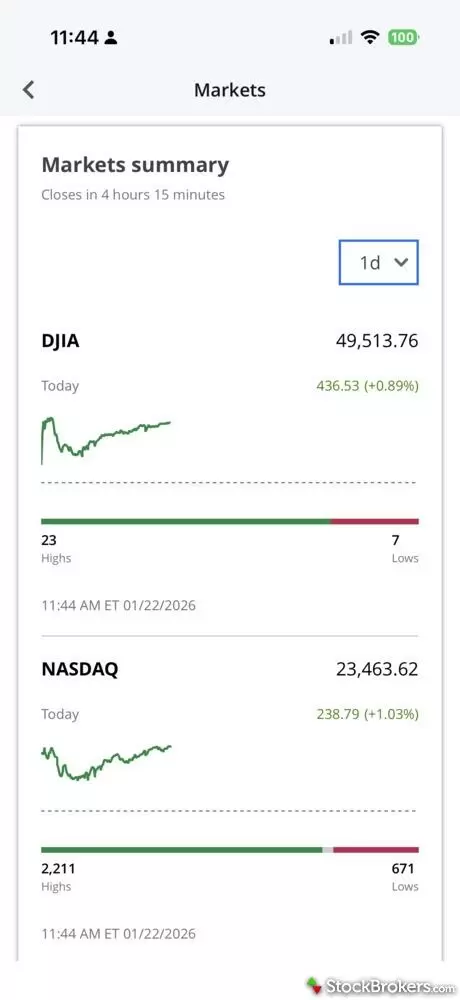
The mobile version of J.P. Morgan's market summary page. You'll get a quick snapshot of market performance – major indices, top movers, and filtered news – all laid out clearly.
Where Fidelity's app wins
Fidelity built the better dedicated investing app, and it earned our #1 Investor App award. Its discover tab blends short-form education and research into a feed made for a phone, recurring buys run in the background, and its quotes stream in real time, where J.P. Morgan's app quotes refresh but don't stream. For someone whose phone time is mostly about investing, Fidelity is the deeper tool.

Fidelity’s mobile app makes learning on the go super easy with its “On Our Radar” videos which are quick social media style clips that cover everything from market trends to investing basics. They're short, smart, and actually fun to watch, making it simple to stay informed without feeling overwhelmed. It’s a great way to pick up insights in just a few minutes.
Verdict
Best for an all-in-one banking and investing app: J.P. Morgan Self-Directed Investing.
Best for a complete dedicated investing app: Fidelity.
If you bank with Chase, J.P. Morgan's app is the convenient choice. For everyone else, Fidelity's app does more and does it better.
| Feature |
Fidelity
|
J.P. Morgan Self-Directed Investing
|
|---|---|---|
| Mobile Trading Apps |
|
|
Fidelity vs J.P. Morgan Self-Directed Investing: trading platforms and tools
This is the biggest difference between the two brokers, particularly for active traders. Fidelity offers Active Trader Pro on desktop and web, a real active trading suite. J.P. Morgan offers a web platform only, with no software aimed at active traders at all.
| Feature |
Fidelity
|
J.P. Morgan Self-Directed Investing
|
|---|---|---|
| Active Trading Platform | Active Trader Pro | No |
| Desktop Trading Platform | Yes | No |
| Web Trading Platform | Yes | Yes |
| Desktop Platform (Mac) | Yes | No |
| Paper Trading | No | No |
| Watchlists - Total Fields | 92 | 20 |
| Charting - Indicators / Studies | 129 | 36 |
| Charting - Drawing Tools | 38 | 10 |
| Charting - Adjust Trades on Chart | Yes | No |
| Charting - Custom Studies | No | No |
| Ladder Trading | No | No |
| Level 2 Quotes - Stocks | Yes | No |
| Trade Hot Keys | Yes | No |
| Trade Ticket - Margin Impact | No | No |
| Trade Ticket - Tax Lot Selection | Yes | Yes |
Where Fidelity wins
Fidelity wins on every active and options measure. Active Trader Pro carries 129 charting studies to J.P. Morgan's 36, adds backtesting through Recognia, and builds multi-leg options with the net Greeks shown right on the ticket. J.P. Morgan tops out at single-leg options and shows no Greeks on its main chain. If you trade options or want any real charting depth, this isn't close.
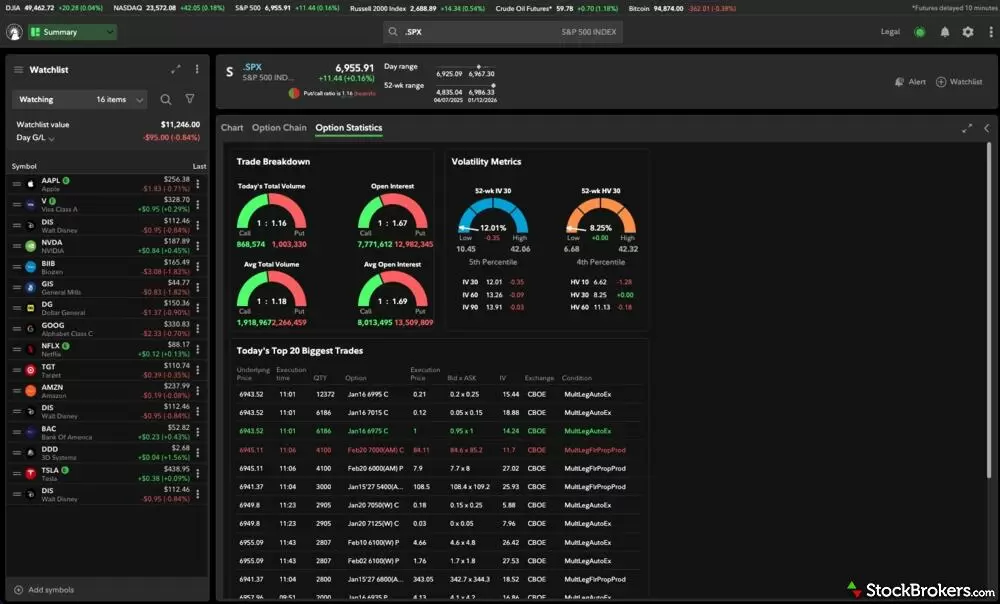
Fidelity’s trading dashboard brings everything together in one place. Here, I’ve linked SPY across all widgets for a seamless view. You can dive into options statistics, volatility indices, and my personal favorite: the trade breakdown activity, which gives great insight into how traders are positioning.
Where J.P. Morgan Self-Directed Investing wins
J.P. Morgan keeps it simple, and for the right investor that's a feature. There's no platform to learn and nothing to configure. You pull a quote, place a buy-and-hold trade, and you're done. For someone who invests in a few ETFs a couple of times a year and would never open an active platform anyway, the stripped-down web experience is enough.
Verdict
Best for active and options traders: Fidelity.
Best for simple, occasional buy-and-hold trades: J.P. Morgan Self-Directed Investing.
Fidelity is the only real platform of the two. J.P. Morgan's simplicity only suits an investor who truly never needs more, and even they get more room to grow at Fidelity.
| Feature |
Fidelity
|
J.P. Morgan Self-Directed Investing
|
|---|---|---|
| Advanced Trading |
|
|
J.P. Morgan Self-Directed Investing vs Fidelity: research
This is the category where J.P. Morgan is closest, because research is its strongest suit. Both run deep research desks, and the split is about quantity versus a clean in-house view. We checked both feature by feature below.
| Feature |
Fidelity
|
J.P. Morgan Self-Directed Investing
|
|---|---|---|
| Research - Stocks | Yes | Yes |
| Screener - Stocks | Yes | Yes |
| Research - ETFs | Yes | Yes |
| Screener - ETFs | Yes | Yes |
| Research - Mutual Funds | Yes | Yes |
| Screener - Mutual Funds | Yes | Yes |
| Research - Fixed Income | Yes | Yes |
| Screener - Fixed Income | Yes | Yes |
| Research - Pink Sheets / OTCBB | Yes | Yes |
| Options Chains - IV | Yes | No |
| Option Chains - Total Greeks | 5 | 0 |
| Strategy Net Greeks | Yes | No |
| Options - Strategy Builder | Yes | No |
Where J.P. Morgan Self-Directed Investing wins
J.P. Morgan punches above its weight on research, and its in-house work is the reason. The J.P. Morgan analyst reports and weekly economic prospects read like the institutional research the bank is known for, and every quote opens with a clean three-bullet summary that tells you the gist before you dig. Its fixed income detailed quote is one of the best I've tested, earning a rare perfect score from me. For a clear expert opinion, it delivers.
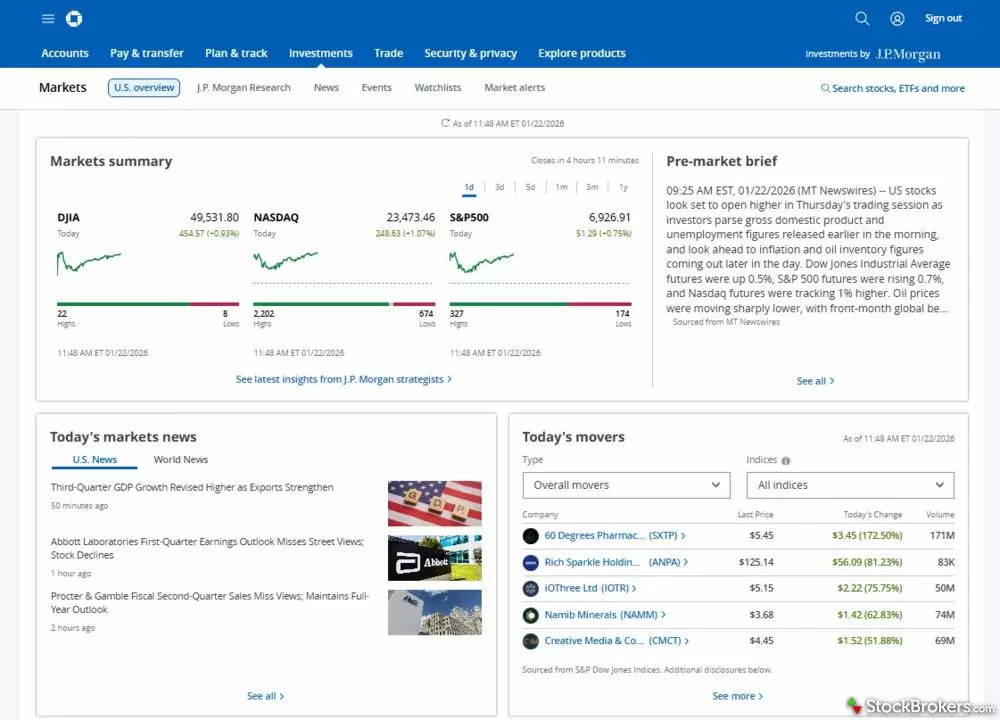
One of J.P. Morgan's standout features is the market research page. It’s among the best I’ve seen for getting an at-a-glance understanding what’s happening in the markets.
Where Fidelity wins
Fidelity has the broader and deeper research library, which is why it holds our #1 Research award. Its economic calendar links every release to a plain explanation of why it matters, its sector view maps all 11 sectors to the business cycle, and its equity summary score consolidates up to seven research firms into one rating. Add deeper screeners and the widest fund research, and Fidelity is the stronger all-around broker for market research.

Fidelity’s economic calendar is hands-down one of the best out there. It's clean, easy to navigate, and packed with useful info. It clearly highlights market-moving events for the week, so you know exactly what to watch. Tap on any item to get more context, making it a great tool for staying ahead of and understanding key economic events.
Verdict
Best for the deepest all-around research: Fidelity.
Best for clean in-house analyst research and fixed income: J.P. Morgan Self-Directed Investing.
This is closer than the overall gap suggests. Fidelity wins on breadth and tools, but J.P. Morgan's own research and fixed income work are a real draw.
| Feature |
Fidelity
|
J.P. Morgan Self-Directed Investing
|
|---|---|---|
| Research |
|
|
Fidelity vs J.P. Morgan Self-Directed Investing: education
Both libraries are strong, and they teach in opposite shapes. Fidelity is the more structured, beginner-friendly experience, with eight courses, polished videos, calculators, progress tracking, and webinars, which is why it holds our #1 Education award. J.P. Morgan counters with writing that's a real pleasure to read, like an article comparing an ETF to a taco and a partnership with Napkin Finance for visual explainers, plus a standout Wealth Plan goal-setting tool. The catch is organization. J.P. Morgan has no courses and no dedicated learning landing page, so you lean on search and need to know what you're after, where Fidelity gives you a clear path.
| Feature |
Fidelity
|
J.P. Morgan Self-Directed Investing
|
|---|---|---|
| Education (Stocks) | Yes | Yes |
| Education (ETFs) | Yes | Yes |
| Education (Options) | Yes | Yes |
| Education (Mutual Funds) | Yes | Yes |
| Education (Fixed Income) | Yes | Yes |
| Videos | Yes | Yes |
| Webinars | Yes | Yes |
Verdict
Best for structured, beginner-friendly learning: Fidelity.
Best for readable articles and goal planning: J.P. Morgan Self-Directed Investing.
If you want a curriculum with courses and calculators, Fidelity is the easier place to learn. If you'd rather read one well-written article at a time and plan around your goals, J.P. Morgan's content holds up, as long as you don't mind hunting for it.
| Feature |
Fidelity
|
J.P. Morgan Self-Directed Investing
|
|---|---|---|
| Education |
|
|
Fidelity and J.P. Morgan Self-Directed Investing: accounts and banking
This is J.P. Morgan's clearest win, and it comes down to the parent. J.P. Morgan Self-Directed Investing is part of Chase, a full FDIC-insured bank, so checking, savings, CDs, mortgages, and debit and credit cards all sit under the same login as your brokerage account. Fidelity offers a cash management account, CDs, and cards, but it isn't a full bank of its own and leans on partner banks for FDIC coverage. Where Fidelity answers is the account lineup for families and savers, with a youth account, custodial accounts, 529 plans, and SEP and SIMPLE IRAs that J.P. Morgan's self-directed side doesn't open.
Verdict
Best for true banking under one roof: J.P. Morgan Self-Directed Investing.
Best for family and education account types: Fidelity.
Final thoughts: J.P. Morgan Self-Directed Investing vs Fidelity
- Minimum Deposit: $0.00
- Stock Trades: $0.00
- Options (Per Contract): $0.65
Fidelity is a value-driven online broker offering $0 trades, industry-leading research, excellent trading tools and an easy-to-use mobile app. Read full review
- Excellent research and mobile app
- Top-notch education
- Decades of reliable client service
- No dedicated mobile app for active trading
- Minimum Deposit: $0.00
- Stock Trades: $0.00
- Options (Per Contract): $0.65
J.P. Morgan Self-Directed Investing makes it easy for Chase Bank customers to invest and allows access to J.P. Morgan research. On the downside, the broker features are sparse compared to industry leaders. Read full review
- Instant liquidity transfers between Chase checking and investment accounts.
- Visually stunning and informative bond trading experience
- Zero commissions on penny stocks and secondary U.S. Treasurys.
- No streaming real-time quotes.
- No cryptocurrencies, futures, or forex.
- Poor options change experience.
For most investors, Fidelity is the clear winner. It holds our #1 Research award, its education and retirement tools are the best I test, and the everyday features fit how real people invest, with fractional ETFs, recurring buys, and a complete app. Add a real active-trading platform in Active Trader Pro, and Fidelity is the broker that meets you at the start and grows with you for decades. For a beginner, a retirement saver, or anyone building wealth for the long haul, that's the easy call.
J.P. Morgan Self-Directed Investing still earns its place, mostly for one kind of investor. If you already bank with Chase, having your investing in the same app as your checking and credit card is a real convenience, and the in-house research is better than its overall standing suggests. If you're a simple, long-term investor who values that integration and won't miss active tools, crypto, or international markets, J.P. Morgan is a reasonable choice. Everyone else should choose Fidelity.
Jessica's take
"J.P. Morgan delivers a well-rounded offering for long-term, goal-focused investors who want simplicity and stability, even if it doesn't cater to active traders. Fidelity is the more versatile choice, one that grows with you whether you're depositing your first $20 or preserving millions."
Jessica Inskip
Director of Investor Research
Overall verdict
Best for most investors: Fidelity.
Best for Chase customers who want banking and investing together: J.P. Morgan Self-Directed Investing.
| Feature |
Fidelity
|
J.P. Morgan Self-Directed Investing
|
Category Winner |
|---|---|---|---|
| Overall |
|
|
Fidelity |
| Range of Investments |
|
|
Fidelity |
| Mobile Trading Apps |
|
|
Fidelity |
| Advanced Trading |
|
|
Fidelity |
| Research |
|
|
Fidelity |
| Education |
|
|
Fidelity |
| Ease of Use |
|
|
Fidelity |
Read next
Popular 1v1 comparisons
- Interactive Brokers vs TradeStation 2026
- Fidelity vs Robinhood in 2026
- Charles Schwab vs Interactive Brokers 2026
- Charles Schwab vs Fidelity 2026
- E*TRADE vs Robinhood 2026
More trading guides
Find the best Roth IRA accounts. Fidelity, Schwab, and E*TRADE lead with low fees, smart investing tools, and retirement planning support.
Andrea Coombes April 27, 2026
Find top U.S. forex brokers. From tastyfx to OANDA, explore platforms with strong regulation, great tools, and user-friendly trading.
Steven Hatzakis May 29, 2026
Discover the best stock brokers of 2026. Compare Schwab, Fidelity, Interactive Brokers, E*TRADE, and more to find the top trading platform for your needs.
Jessica Inskip August 06, 2026
Find the best brokerage for high-net-worth investors. Compare Fidelity, Schwab, Merrill, and more for premium services and tailored investment tools.
Jessica Inskip January 27, 2026
Find the best penny stock brokers. Compare Fidelity, Firstrade, Schwab, E*TRADE, and TradeStation for OTC access, fees, and tools.
Jessica Inskip August 02, 2026
We tested the best options trading platforms for 2026. Compare tastytrade, Fidelity, IBKR, E*TRADE & Schwab on tools, fees, and picks for beginners.
Jessica Inskip September 09, 2026
Practice investing risk-free with the best paper trading platforms. Compare Webull, Schwab, Interactive Brokers, E*TRADE, and more.
Jessica Inskip July 24, 2026
Find the best IRA accounts. Compare Fidelity, Schwab, Merrill Edge, E*TRADE, & J.P. Morgan for retirement planning, fees, tools, and account flexibility.
Jessica Inskip March 31, 2026
We tested the 5 best futures trading platforms of 2026. IBKR wins overall, and TradeStation has the lowest day-trade margins we found. Compare commissions, margins, and micros.
Jessica Inskip October 05, 2026
Discover the best brokers for trade execution. Compare Fidelity, Interactive Brokers, and more for price improvement, speed, and transparency.
Jessica Inskip October 12, 2026
Find the top bank brokerages. From Merrill Edge to Ally, discover brokers that combine banking, investing, and rewards in one account.
Jessica Inskip April 16, 2026
Explore the best international brokers for U.S. investors. Compare Interactive Brokers, Charles Schwab, and Fidelity for global stock trading access.
Jessica Inskip May 22, 2026
Find the best rollover IRA accounts. Compare Fidelity, Schwab, and E*TRADE for easy transfers, low fees, and smart retirement investing tools.
Andrea Coombes May 15, 2026
Start investing with ease. Explore the best beginner-friendly trading platforms with low fees, great education, and intuitive apps.
Jessica Inskip October 05, 2026
Discover the best day trading platforms. Compare IBKR, Schwab, Fidelity, E*TRADE, and TradeStation for speed, tools, and margin rates.
Jessica Inskip October 05, 2026
Interactive Brokers and Fidelity lead our 2026 ranking of the best free stock trading platforms, tested on the true cost of $0 commissions and hidden fees.
Jessica Inskip September 02, 2026
Find the best crypto trading platform for 2026. We rank eToro, Fidelity, Interactive Brokers, Webull, and Robinhood on fees, security, and coin selection.
Steven Hatzakis May 27, 2026Popular broker reviews
Our Robinhood review tests $0 stock and options trades, #1-ranked prediction markets, and AI agent trading, plus where its website research falls short.
Jessica Inskip October 01, 2026
Read our Interactive Brokers review and see why it's a top choice for active traders with low costs, cutting-edge platforms, and global reach.
Jessica Inskip July 31, 2026
Read our 2026 E*TRADE review to see how powerful research, versatile platforms, and diverse investments make it a top choice for all investors.
Jessica Inskip September 29, 2026
Read our Firstrade review and see why it’s a top choice for options traders, offering $0 contract fees, robust tools, and a growing feature set.
Jessica Inskip May 04, 2026
Our eToro review rates the social investing platform 3.0/5. Stock and ETF trades cost $0, crypto trades carry a 1% fee, and the minimum deposit is $50.
Jessica Inskip September 25, 2026
Fidelity charges $0 stock and ETF trades and won #1 for Research and Education in 2026. See our tested review of its fees, platforms, IRAs, and apps.
Jessica Inskip September 30, 2026
Read our tastytrade review and discover why it’s the top choice for options traders, with low fees, advanced tools, and a seamless platform.
Jessica Inskip October 05, 2026
Read our Charles Schwab review to learn why its platforms, research, and investor resources make it one of the top-ranked brokerages.
Jessica Inskip September 30, 2026
Ally Invest scores 3/5 in our 2026 review. See how its $0 stock trades, $0.50 options, strong fixed income tools, and Ally Bank integration stack up.
Jessica Inskip September 14, 2026
Read our Merrill Edge Self-Directed review and see how it combines powerful investing tools, robust research, and integrated banking benefits.
Jessica Inskip September 29, 2026
Read our Webull review and discover its commission-free trading, sleek platforms, paper trading tools, and fractional shares.
Jessica Inskip September 18, 2026
Read our Public.com review to learn how its intuitive platform and community-driven features help simplify investing for first-time traders.
Jessica Inskip September 18, 2026
Read our J.P. Morgan Self-Directed Investing review and discover its strengths in research, planning tools, and integration for Chase clients.
Jessica Inskip May 15, 2026
Read our TradeStation review and discover why its pro-level tools, deep customization, and options focus make it a top choice for active traders.
Jessica Inskip October 07, 2026About the Editorial Team
Jessica Inskip is Director of Investor Research at StockBrokers.com, bringing 15 years of experience in brokerage and trading strategy. A former FINRA-licensed rep, she held Series 7, 63, 66, and 4 licenses. Jessica focuses on investor education and brokerage industry research, appears regularly on CNBC, Bloomberg, The Schwab Network, Fox Business, and Yahoo! Finance, and hosts the Market MakeHer podcast.
Jeff Anberg is a Senior Editor at StockBrokers.com. Along with years of experience in media distribution at a global newsroom, Jeff has a versatile knowledge base encompassing the technology and financial markets. He is a long-time active investor and engages in research on emerging markets like cryptocurrency. Jeff holds a Bachelor’s Degree in English Literature with a minor in Philosophy from San Francisco State University.
Blain Reinkensmeyer has 25 years of trading experience with over 2,500 trades placed during that time. He heads research for all U.S.-based brokerages on StockBrokers.com and is respected by executives as the leading expert covering the online broker industry. Blain’s insights have been featured in the New York Times, Wall Street Journal, Forbes, and the Chicago Tribune, among other media outlets.