 Charles Schwab
 Fidelity
 Interactive Brokers
 E*TRADE
 Webull
 TradeStation
 tastytrade
 eToro
eToro Trading 212
 Interactive Investor
 IG
IG Interactive Brokers
 XTB
XTB Hargreaves Lansdown
 Saxo
Saxo Charles Stanley Direct
 CIBC Investor's Edge
 Interactive Brokers
 Moomoo
 Questrade
 Qtrade
 TD Direct Investing
 Wealthsimple
 Finviz
 Stock Rover
 Seeking Alpha
 StockHero
 TipRanks
 TrendSpider
 Trade Ideas
 TraderSync
 TradingView
 Tradervue
 TradeZella
5 Best 24-Hour Trading Platforms for 2026

Written by Jessica Inskip
Director of Investor Research

Edited by Hannah Smith
Staff Editor

Fact-checked by Joey Shadeck
Research Analyst
Jessica InskipDirector of Investor Research
Jessica Inskip is Director of Investor Research at StockBrokers.com, bringing 15 years of experience in brokerage and trading strategy. Jessica focuses on investor education and brokerage industry research.


 Why you can trust us
Led by Jessica Inskip, Director of Investor Research, the StockBrokers.com research team collects thousands of data points across hundreds of variables. We evaluate features important to every kind of investor, including beginners, casual investors, passive investors, and active traders. We carefully track data on margin rates, trading costs, and fees to rate stock brokers across our proprietary testing categories.
Our researchers open personal brokerage accounts and test all available platforms on desktop, web, and mobile for each broker reviewed on StockBrokers.com. Learn more about how we test.
The best brokers for 24-hour trading are Interactive Brokers, Charles Schwab, and Firstrade. These brokers lead the industry by combining massive overnight asset selections, multi-session order types, and top-tier research tools.
While pre-market and after-hours trading have been around for over a decade, a new trend is emerging: overnight trading. Overnight trading is a session that lets you buy and sell stocks and ETFs between roughly 8:00 p.m. and 4:00 a.m. ET, the hours between after-hours and the next day's pre-market. Combined with pre-market and after-hours, it creates near 24-hour access to U.S. markets, five days a week.
But not all brokerages offer 24-hour access, and the experience varies widely across platforms. So, I’ve reviewed every platform offering 24-hour markets to help you understand what sets them apart and how to choose the right one for your trading style.
Best Brokers for 24-hour Trading
When testing brokers for 24-hour trading, I looked at more than just whether the platform was technically open overnight. I weighed the actual hours of availability, the range of securities you can trade after hours, supported order types, execution quality, costs, platform reliability, and how well each broker educates traders on the unique risks of trading when most of the market is asleep. Here are the best 24-hour markets for 2026.
- Minimum Deposit: $0.00
- Stock Trades: $0.00
- Options (Per Contract): $0.65
Interactive Brokers is a go-to choice for professionals because of its institutional-grade desktop trading platform, high-quality trade executions and low margin rates. Read full review
- 170+ markets to trade.
- IBKR Desktop platform has institutional power and intuitive usability.
- Industry-leading margin rates and competitive interest yields.
- Density of features requires a significant time investment.
- Educational content skips over the basics for true beginners.
- Certain tools lack the curated context needed.
- Minimum Deposit: $0.00
- Stock Trades: $0.00
- Options (Per Contract): $0.65
For most investors, the search for a great broker ends with Charles Schwab. Retaining the #1 Overall ranking in 2026, Schwab continues to set the industry standard. The broker uniquely balances scale with sophistication, offering both simplified mobile tools and the professional-grade thinkorswim platform. From buying a first fractional share to managing a multimillion-dollar estate, Schwab provides a platform tailored to every need, serving as the definitive operating system for modern wealth. Read full review
- thinkorswim is the industry benchmark for professional-grade trading and charting.
- Best in Class Research features actionable daily updates and deep fundamental data.
- Top-tier education with webinars, videos, and courses.
- No spot crypto trading (limited to ETFs and futures).
- "Stock Slices" (fractional shares) are limited to S&P 500 companies.
- Base margin rates are significantly higher than dedicated low-cost competitors.
- Minimum Deposit: $0.00
- Stock Trades: $0.00
- Options (Per Contract): $0.00
Firstrade is a good choice for options traders and self-reliant investors due to its aggressive pricing model that completely eliminates per-contract fees on options. While it lacks asset classes like crypto and futures, it impresses with institutional-grade infrastructure, supporting complex account types like Trusts and Business IRAs and wide international accessibility. Read full review
- $0 options contract fees.
- Streamlined, options-focused mobile app.
- Caters to international investors from over 20 global regions.
- High margin rates.
- No crypto, futures, or forex.
- Gaps in research and lopsided education.
- Minimum Deposit: $0.00
- Stock Trades: $0.00
- Options (Per Contract): $0.00
Webull has evolved past its origins as a low-cost disruptor, solidifying its position as a sophisticated hub for active market participants. It offers a great mobile experience and a fantastic paper trading platform that offers a perfect sandbox to test strategies without risking capital. With AI-powered summaries that slice through market noise and industry-leading paper trading tools for testing strategies, Webull presents a compelling choice for traders. Read full review
- Zero commissions for options contracts.
- Crypto trading has been reintegrated into the main app.
- Phenomenal, award-winning paper trading platform.
- Lack of account types like Inherited IRAs, Trust accounts, and custodial accounts.
- Constructing multi-leg options strategies can feel cumbersome.
- Education is often disorganized and can be confusing for beginners.
- Minimum Deposit: $0.00
- Stock Trades: $0.00
- Options (Per Contract): $0.00
Robinhood is best known for its commission-free trading, modern mobile and desktop platforms, and low-cost access to options, margin, and futures trading. Read full review
- Robinhood Legend offers 90+ technical indicators.
- 3% IRA match on contributions.
- The Investor's Guild explains complex topics.
- Futures trading and 24-hour trading.
- No economic calendars, sector heat maps, or Treasury yield curves.
- No deep fundamental research.
- Legend lacks critical tools.
- No mutual funds, individual bonds, custodial or trust accounts.
Compare trading platforms head-to-head
Use the broker comparison tool to compare over 150 different account features and fees.
Winners Summary
1. Interactive Brokers (IBKR) - Best broker for 24-hour trading
Why Interactive Brokers stands out for 24-hour trading: IBKR offers overnight trading from 8:00 p.m. to 3:50 a.m. ET, Sunday through Friday, on more than 10,000 stocks and ETFs, the widest selection on this list. Known as a favorite among experienced investors and active traders, IBKR brings the same depth and reliability to its overnight access as it does to the rest of its platform. The Overnight + SMART order type lets trades carry from the overnight session into the next day's regular session, running 4:00 a.m. through 8:00 p.m. ET, which creates a near-continuous trading cycle without re-entering orders.
Products and platform: What really sets IBKR apart is the breadth of the product offering. With access to over 10,000 stocks and ETFs for overnight trading, including small and mid caps rarely available elsewhere, IBKR offers one of the widest selections of any brokerage I've tested. The platform's global connection to more markets, venues, and exchanges than any other retail platform gives self-directed investors institutional-level access. IBKR also recently added Forecast Contracts to its extended hours lineup, offering nearly 24/6 access to event-based markets tied to economic, government, and climate outcomes.
Forecast Contracts: Priced between $0.02 and $0.99, these contracts settle at $1.00 for correct predictions and $0 for incorrect ones. I see them as a straightforward way to take positions on market-relevant questions, and they're designed for short-term, event-driven strategies. They're available 24/7, other than periodic maintenance windows, across all IBKR platforms, including a dedicated ForecastTrader interface.
Jessica's take:
"IBKR's research and product breadth are among the most extensive of any broker I've tested, and that depth carries straight into their overnight trading offering."
Jessica Inskip
Director of Investor Research
Bottom line: IBKR's 24-hour trading isn't just an add-on. It's an extension of what the platform already does best, with equities and event contracts available nearly 24 hours a day, six days a week.

Interactive Brokers offers one of the most comprehensive watchlists in the industry, available on both its web and desktop trading platforms. This screenshot highlights the desktop experience, where investors can track real-time quotes, market data, and customizable columns across multiple asset classes.
2. Charles Schwab - Best 24-hour trading platform experience
Why Charles Schwab stands out for 24-hour trading: Schwab offers overnight trading from 8:00 p.m. to 8:00 p.m. ET, Sunday through Friday, on over 1,100 U.S. stocks and ETFs, all traded through thinkorswim. It ranks second on my list, but its best-in-class platforms, education, research, and client experience make it a strong all-around choice. The overnight offering is a natural extension of that strength, with thinkorswim serving as the engine for after-hours access.
Overnight trading: Here's what stood out to me. Schwab's Extended + Overnight (EXTO) orders let a trade stay live across both extended hours and the overnight session via thinkorswim. That means I don't have to keep re-entering an order as the market moves between sessions. You place a trade once, and it continues working throughout the 24-hour cycle, minus a quick five-minute pause each weekday. That's a big deal if you're reacting to news that breaks outside the standard 9:30am to 4:00pm window.
Products and platform: You'll have access to over 1,100 U.S. stocks and ETFs, including names from the S&P 500, Nasdaq 100, and Dow 30. Schwab also makes it easy to know what's eligible. Thinkorswim displays a small overnight icon right in your watchlist, which removes the guesswork. I appreciated that small touch because it's the kind of detail that saves time when you're trying to move quickly. The flagship Schwab Mobile app is also solid for keeping a pulse on the market overnight, with research and real-time quotes built in.
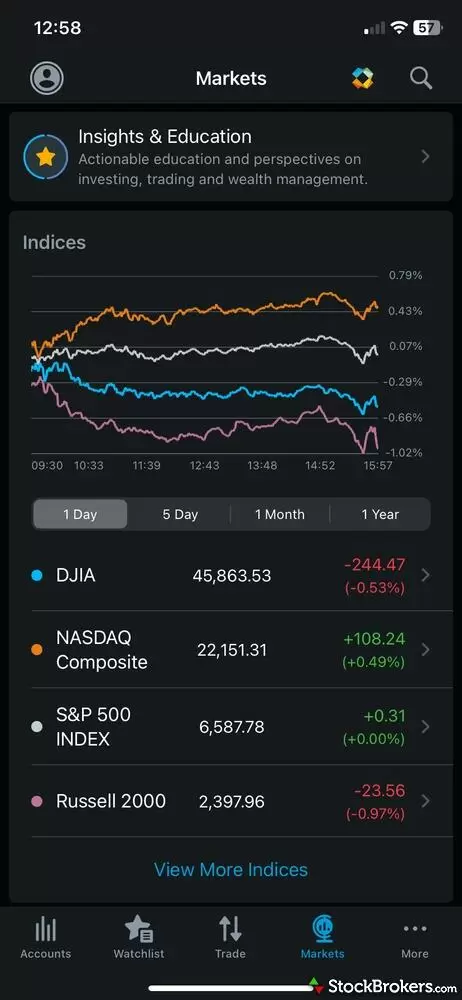
Schwab’s Market Research mobile homepage provides a quick snapshot of daily market performance, with real-time updates on major indices like the S&P 500, Dow, and Nasdaq. Users can also access breaking news headlines, macroeconomic insights, sector performance breakdowns, and even listen to an audio market update—all in one streamlined view.
Bottom line: One educational note worth highlighting is that during overnight sessions, trades are routed through an Alternative Trading System (ATS) instead of a public exchange. These markets often have wider spreads and lower liquidity, which means prices can move more dramatically or fills may be less efficient. It's worth keeping in mind if you're venturing into overnight territory for the first time.
3. Firstrade - Best 24-hour trading discount broker
Why Firstrade stands out for 24-hour trading: Coming in at number three is Firstrade, a brokerage that recently joined the 24-hour trading space with a solid offering. Launched on April 7, 2025, the overnight trading feature gives investors access to over 1,200 stocks and ETFs during off-hours, which is a meaningful entry into the space for a broker known primarily for cost-conscious self-directed investing.
Overnight trading: Unlike some platforms, orders placed during overnight sessions don't carry over into extended or regular trading hours. They're limited to the overnight window only. This structure mirrors how other brokerages like Robinhood, Webull, and E*TRADE currently operate 24-hour trading. For many investors, session-specific trading is still a useful way to respond to late-breaking news, earnings releases after the close, or for international investors who want to trade U.S. markets during their normal business hours.
Products and platform: Beyond 24-hour trading, what I appreciate about Firstrade is the value baked into the rest of the platform. The economic calendar is one of my favorites I've tested. It's drillable, lets you analyze price reactions to past events, and shows expectations versus actuals in a way that's useful. The mobile app is sleek and modern, and the options chain is one of the easiest to use across brokers I've reviewed. If you're an options trader or just getting started, Firstrade also offers a lot of high-quality educational content powered by the Options Industry Council and OptionsPlay.

Firstrade’s economic calendar goes beyond listing events, it adds valuable analysis by showing how past releases have impacted market movements, particularly in currencies. It’s a detailed, data-driven tool that helps investors understand not just what’s happening, but why it matters. A great resource for those who want to connect economic trends with price action.
4. Webull - Best for technical traders
Why Webull stands out: Webull's 24-hour trading offer is geared toward technical and order-flow-focused traders. The platform gives access to overnight trading on a selection of stocks and ETFs, with session-specific orders that don't carry over into extended or regular hours. What I appreciate about Webull beyond the overnight access is the depth of order flow data, large-scale order tracking, and short interest info baked into every quote page.
Tools and platform: The advanced charting on the mobile app is one of the best I've tested, with replay mode, 55+ indicators, and drawing tools that snap to exact prices. I'm also a fan of the AI-powered daily summaries that explain what's moving stocks in plain language. If you lean technical and want strong charting plus order flow insights for overnight trading, Webull is worth a look.
5. Robinhood - Best for beginner traders
Why Robinhood stands out: Robinhood brings 24-hour trading to a sleek, beginner-friendly platform that's hard to beat for ease of use. Overnight trading is offered on a curated list of stocks and ETFs, with session-specific orders that don't carry over into extended or regular hours. I appreciate how Robinhood clearly designates which securities are available in the 24-hour market right on the detailed quote page, so you're never guessing.
Tools and platform: Beyond overnight access, Robinhood's strength is its educational integration and AI-powered Digests, which explain why a stock is moving with supporting macro context and resources. It's exactly how I'd want AI used for self-directed investors. The mobile app is one of the easiest to use across brokers I've tested, with thoughtful contextual education baked into the order entry flow. If you're newer to trading and want a simple way to participate in 24-hour markets, Robinhood is a solid starting point.
When are overnight hours?
| Broker | Overnight sessions | Securities available |
| Interactive Brokers | 8:00 p.m. to 3:50 a.m. ET, Sun. through Fri. | 10,000+ stocks and ETFs |
| Charles Schwab | 8:00 p.m. to 8:00 p.m. ET, Sun. through Fri. | 1,100+ U.S. stocks and ETFs |
| Firstrade | 8:00 p.m. to 4:00 a.m. ET, Sun. through Fri. | 1,200+ stocks and ETFs |
| Webull | 8:00 p.m. to 4:00 a.m. ET, Sun. through Thurs. | 500+ stocks and ETFs |
| Robinhood | 8:00 p.m. to 8:00 p.m. ET, Sun. through Fri. | 900+ stocks and ETFs |
24-hour platform reviews
Read our Webull review and discover its commission-free trading, sleek platforms, paper trading tools, and fractional shares.
Jessica Inskip September 18, 2026
Read our Firstrade review and see why it’s a top choice for options traders, offering $0 contract fees, robust tools, and a growing feature set.
Jessica Inskip May 04, 2026
Read our Robinhood review and see why it’s a top pick for beginners, with a sleek mobile app, zero commissions, and standout educational tools.
Jessica Inskip September 03, 2026
Read our Charles Schwab review to learn why its platforms, research, and investor resources make it one of the top-ranked brokerages.
Jessica Inskip September 21, 2026
Read our Interactive Brokers review and see why it's a top choice for active traders with low costs, cutting-edge platforms, and global reach.
Jessica Inskip July 31, 2026Related guides
Discover the best day trading platforms. Compare IBKR, Schwab, Fidelity, E*TRADE, and TradeStation for speed, tools, and margin rates.
Jessica Inskip August 03, 2026
We tested dozens of platforms to find the eight best stock trading apps for 2026. Compare top picks like Schwab and Fidelity for every investing style.
Jessica Inskip August 06, 2026
Discover the best brokers for trade execution. Compare Fidelity, Interactive Brokers, and more for price improvement, speed, and transparency.
Jessica Inskip May 22, 2026
Learn how after-hours trading works, including pre-market and extended-hours sessions, rules, risks, and which brokers offer access beyond 9:30–4.
Brian Nibley April 17, 2025More guides
Start investing with ease. Explore the best beginner-friendly trading platforms with low fees, great education, and intuitive apps.
Jessica Inskip August 06, 2026
Discover the best brokers for trade execution. Compare Fidelity, Interactive Brokers, and more for price improvement, speed, and transparency.
Jessica Inskip May 22, 2026
Find the best penny stock brokers. Compare Fidelity, Firstrade, Schwab, E*TRADE, and TradeStation for OTC access, fees, and tools.
Jessica Inskip August 02, 2026
Find the best brokerage for high-net-worth investors. Compare Fidelity, Schwab, Merrill, and more for premium services and tailored investment tools.
Jessica Inskip January 27, 2026
Practice investing risk-free with the best paper trading platforms. Compare Webull, Schwab, Interactive Brokers, E*TRADE, and more.
Jessica Inskip July 24, 2026
Find top U.S. forex brokers. From tastyfx to OANDA, explore platforms with strong regulation, great tools, and user-friendly trading.
Steven Hatzakis May 29, 2026
Find the best Roth IRA accounts. Fidelity, Schwab, and E*TRADE lead with low fees, smart investing tools, and retirement planning support.
Andrea Coombes April 27, 2026
Explore the best international brokers for U.S. investors. Compare Interactive Brokers, Charles Schwab, and Fidelity for global stock trading access.
Jessica Inskip May 22, 2026
Discover the best day trading platforms. Compare IBKR, Schwab, Fidelity, E*TRADE, and TradeStation for speed, tools, and margin rates.
Jessica Inskip August 03, 2026
Find the best rollover IRA accounts. Compare Fidelity, Schwab, and E*TRADE for easy transfers, low fees, and smart retirement investing tools.
Andrea Coombes May 15, 2026
Discover the best stock brokers of 2026. Compare Schwab, Fidelity, Interactive Brokers, E*TRADE, and more to find the top trading platform for your needs.
Jessica Inskip August 06, 2026
We tested the 5 best futures trading platforms of 2026. Compare commissions, margin rates, and tools for beginners and active traders. Find the right platform for you.
Jessica Inskip September 17, 2026
Interactive Brokers and Fidelity lead our 2026 ranking of the best free stock trading platforms, tested on the true cost of $0 commissions and hidden fees.
Jessica Inskip September 02, 2026
Find the top bank brokerages. From Merrill Edge to Ally, discover brokers that combine banking, investing, and rewards in one account.
Jessica Inskip April 16, 2026
We tested the best options trading platforms for 2026. Compare tastytrade, Fidelity, IBKR, E*TRADE & Schwab on tools, fees, and picks for beginners.
Jessica Inskip September 09, 2026
Find the best IRA accounts. Compare Fidelity, Schwab, Merrill Edge, E*TRADE, & J.P. Morgan for retirement planning, fees, tools, and account flexibility.
Jessica Inskip March 31, 2026
Find the best crypto trading platform for 2026. We rank eToro, Fidelity, Interactive Brokers, Webull, and Robinhood on fees, security, and coin selection.
Steven Hatzakis May 27, 2026About the Editorial Team
Jessica Inskip is Director of Investor Research at StockBrokers.com, bringing 15 years of experience in brokerage and trading strategy. A former FINRA-licensed rep, she held Series 7, 63, 66, and 4 licenses. Jessica focuses on investor education and brokerage industry research, appears regularly on CNBC, Bloomberg, The Schwab Network, Fox Business, and Yahoo! Finance, and hosts the Market MakeHer podcast.
Hannah Smith is a Staff Editor at StockBrokers.com. With a background in SEO and years of experience in digital media, Hannah is focused on creating high-quality, data-driven content that helps investors make informed decisions. With a master's degree in English from North Carolina State University, she brings a strong foundation in writing, research, and editorial strategy to her work.
Joey Shadeck is the Content Strategist and Research Analyst for StockBrokers.com. He holds dual degrees in Finance and Marketing from Oakland University, and has been an active trader and investor for close to 10 years. An industry veteran, Joey obtains and verifies data, conducts research, and analyzes and validates our content.