 Charles Schwab
 Fidelity
 Interactive Brokers
 E*TRADE
 Webull
 TradeStation
 tastytrade
 eToro
eToro Trading 212
 Interactive Investor
 IG
IG Interactive Brokers
 XTB
XTB Hargreaves Lansdown
 Saxo
Saxo Charles Stanley Direct
 CIBC Investor's Edge
 Interactive Brokers
 Moomoo
 Questrade
 Qtrade
 TD Direct Investing
 Wealthsimple
 Finviz
 Stock Rover
 Seeking Alpha
 StockHero
 TipRanks
 TrendSpider
 Trade Ideas
 TraderSync
 TradingView
 Tradervue
 TradeZella
Interactive Brokers vs TradeStation 2026

Written by Jessica Inskip
Director of Investor Research

Edited by Jeff Anberg
Senior Editor

Reviewed by Blain Reinkensmeyer
Managing Partner
Jessica InskipDirector of Investor Research
Jessica Inskip is Director of Investor Research at StockBrokers.com, bringing 15 years of experience in brokerage and trading strategy. Jessica focuses on investor education and brokerage industry research.


 Why you can trust us
Led by Jessica Inskip, Director of Investor Research, the StockBrokers.com research team collects thousands of data points across hundreds of variables. We evaluate features important to every kind of investor, including beginners, casual investors, passive investors, and active traders. We carefully track data on margin rates, trading costs, and fees to rate stock brokers across our proprietary testing categories.
Our researchers open personal brokerage accounts and test all available platforms on desktop, web, and mobile for each broker reviewed on StockBrokers.com. Learn more about how we test.
Interactive Brokers vs TradeStation is a matchup of two platforms serious traders respect, and the right answer depends on what you trade and how.
Interactive Brokers is the broader and cheaper of the two, and the better pick for most. It has the lowest margin at a flat 6.83%, reaches 36 international markets, and carries deeper research and education. But TradeStation has a loyal following for a reason, built on the deepest charting here and EasyLanguage, its strategy-automation language. Interactive Brokers is the all-around active broker. TradeStation is the systematic trader's tool.
Interactive Brokers vs TradeStation
- Minimum Deposit: $0.00
- Stock Trades: $0.00
- Options (Per Contract): $0.65
Interactive Brokers is a go-to choice for professionals because of its institutional-grade desktop trading platform, high-quality trade executions and low margin rates. Read full review
- 170+ markets to trade.
- IBKR Desktop platform has institutional power and intuitive usability.
- Industry-leading margin rates and competitive interest yields.
- Density of features requires a significant time investment.
- Educational content skips over the basics for true beginners.
- Certain tools lack the curated context needed.
- Minimum Deposit: $0.00
- Stock Trades: $0.00
- Options (Per Contract): $0.80
TradeStation is a brokerage best known for its highly customizable trading platforms, advanced options and futures capabilities, and powerful tools designed for active and experienced traders. Read full review
- New TITAN X platform.
- Tools for futures and options.
- "Why is it Moving?" and "Hot Lists" tools on price action.
- Not a good choice for beginners or casual investors.
- Annual IRA maintenance fees and steep option exercise charges.
- No spot cryptocurrency trading, fractional shares, or robo-advisory services.
TradeStation vs Interactive Brokers at a glance
Our testing found two capable active trading platforms with a clear gap in breadth. Interactive Brokers wins on range, cost, research, and global access. TradeStation answers with deep charting, strategy automation, and a modern new platform in TITAN X. The table shows where each one lands.
| Feature |
 Interactive Brokers Interactive Brokers
|
 TradeStation TradeStation
|
|---|---|---|
| Overall |
|
|
| Mobile Trading Apps |
|
|
| Advanced Trading |
|
|
| Minimum Deposit | $0.00 | $0.00 |
| Stock Trades | $0.00 | $0.00 |
| Options (Per Contract) | $0.65 | $0.80 |
| Futures Trading | Yes | Yes |
| Crypto Trading | Yes | No |
Top takeaways for Interactive Brokers in 2026
- It has the lowest margin in this matchup, a flat 6.83% at every balance against TradeStation's 12.5% on smaller accounts.
- The range is far wider, with 36 international markets, crypto, forex, and bonds that TradeStation doesn't offer.
- Trader Workstation is a professional-grade platform with net Greeks, algos, and portfolio risk tools.
- The research and education run deeper, with hundreds of courses on IBKR Campus.
- It's friendlier on fees, with $0 account transfers and no IRA fees.
Top takeaways for TradeStation in 2026
- Its charting is deeper, with 294 indicators to Interactive Brokers' 155.
- EasyLanguage lets you code, backtest, and automate your own strategies, a real draw for systematic traders.
- TITAN X is a clean, modern platform with a redesigned options chain and net Greeks on the ticket.
- TradeStation MCP connects the platform to Claude for AI-assisted trading, which is new this year.
- The ancillary costs add up, with a $35 IRA fee, and $125 account transfers, and there's no crypto, forex, or international access. Some pricing is also tiered, making it more expensive for less active traders, such as the $0.80 per-contract options fee that scales all the way down to $0 if you trade more than 10,000 contracts.
TradeStation vs Interactive Brokers: fees and commissions
Both brokers trade stocks for $0, so the real gaps are margin, the surcharges around options, and the account fees you only meet at the edges. We verified the pricing below.
| Feature |
Interactive Brokers
|
TradeStation
|
|---|---|---|
| Stock Trades | $0.00 | $0.00 |
| Mutual Fund Trade Fee | $14.95 | $14.95 |
| Options (Per Contract) | $0.65 | $0.80 |
| Options Exercise Fee | $0.00 | $14.95 |
| Options Assignment Fee | $0.00 | $5.95 |
| Futures (Per Contract) | $0.85 | $1.75 |
| Broker Assisted Trade Fee | Varies | $25 |
| Margin Rate Under $25,000 | 6.83% | 11.75% |
| Bond Trade Fee | Varies | $14.95 + $5 per bond |
| IRA Annual Fee | $0.00 | $35.00 |
| Account Transfer Out (Full) | $0.00 | $125.00 |
Where Interactive Brokers wins on cost
Interactive Brokers is cheaper almost everywhere it counts. Its margin is a flat 6.83% at every balance, where TradeStation starts at 12.5% and only reaches 7.5% above $500,000. Options run $0.65 a contract with free exercise and assignment, against TradeStation's $0.80 for the base-tier plus a $14.95 exercise and $5.95 assignment fee. That commission does scale all the way down to $0 per contract, the more that you trade. IBKR also charges nothing to transfer an account out or hold an IRA, where TradeStation charges $125 to transfer and a $35 annual IRA fee.
Where TradeStation wins on cost
TradeStation's pricing is built for the high-volume active trader rather than the buy-and-hold investor. Its margin falls to 7.5% at higher balances, options contracts are zero-commission if you trade more than 10,000, and it offers order-liquidity rebates that can offset costs for traders who add volume to the market. For a high-balance trader who routes a lot of flow, the gap with IBKR narrows.
Verdict
Best for low costs across the board: Interactive Brokers.
Best for high-volume traders who capture rebates: TradeStation.
For nearly everyone, Interactive Brokers is the cheaper broker on margin, options, and account fees alike. TradeStation only closes the gap for a high-balance, high-volume trader.
Interactive Brokers vs TradeStation: range of investments
Both cover the active trading core of stocks, ETFs, options, and futures. The difference is everything around that core, where Interactive Brokers reaches far beyond what TradeStation offers.
| Feature |
Interactive Brokers
|
TradeStation
|
|---|---|---|
| Options Trading | Yes | Yes |
| Fractional Shares (Stocks) | Yes | No |
| Fractional Shares (ETFs) | Yes | No |
| Mutual Funds | Yes | Yes |
| Fixed Income (Treasurys) | Yes | No |
| Fixed Income (Corporate Bonds) | Yes | No |
| Fixed Income (Municipal Bonds) | Yes | No |
| Crypto Trading | Yes | No |
| Crypto Trading - Total Coins | 11 | 0 |
| Futures Trading | Yes | Yes |
| Futures Options | Yes | Yes |
| Forex Trading | Yes | No |
| Prediction markets | Yes | No |
| IPO Access | No | No |
| Order Type - After Hours | Yes | Yes |
| Order Type - 24 hr Extended | Yes | No |
| Order Type - Broker Assisted | Yes | Yes |
Where Interactive Brokers wins
Interactive Brokers trades almost anything, almost anywhere. It reaches 36 international markets, adds crypto, forex, and a full bond desk, and offers fractional shares that TradeStation doesn't. For a trader who wants global reach or any asset class beyond US stocks, options, and futures, IBKR is the only one of the two that delivers.
Where TradeStation wins
TradeStation keeps a tight focus on the active trader essentials, and serves them well. It covers stocks, ETFs, options, futures, and futures options, the assets most US-based active and systematic traders actually use, plus the core IRAs and entity accounts. If your trading lives entirely in those products, the narrower lineup will serve you just fine.
Verdict
Best for breadth and global access: Interactive Brokers.
Best for a focused US active trading core: TradeStation.
If you want crypto, forex, international markets, or bonds, only Interactive Brokers offers them. TradeStation fits the trader whose world is US stocks, options, and futures and nothing else.
| Feature |
Interactive Brokers
|
TradeStation
|
|---|---|---|
| Range of Investments |
|
|
Featured Offers
TradeStation vs Interactive Brokers: mobile apps
Both apps are built for traders, and they split on depth versus simplicity. Interactive Brokers packs professional tools into its flagship app. TradeStation keeps its app clean and fast. Our testing compared charting, order entry, and market data on each.
| Feature |
Interactive Brokers
|
TradeStation
|
|---|---|---|
| iPhone App | Yes | Yes |
| Android App | Yes | Yes |
| Apple Watch App | Yes | No |
| Stock Alerts | Yes | Yes |
| Mobile Watchlists - Column Customization | Yes | Yes |
| Mobile Watchlists - Create & Manage | Yes | Yes |
| Mobile Watchlists - Column Filtering | Yes | Yes |
Where TradeStation's app wins
TradeStation's app is the easier one to move around. Charting is a highlight, with drawings that snap to exact prices and a single tap to add several moving averages at once. The "why is it moving" explainer from Benzinga gives a quick, plain read on any price move. For a trader who wants a fast price pulse and a clean trade ticket, it gets out of the way.

TradeStation’s mobile app adds real context to market moves with its “Why Is It Moving?” feature, shown here for GOOGL. Instead of just seeing the price, you get quick, relevant insights explaining what's driving the action, whether it’s earnings, analyst calls, or broader news. It’s a powerful way to stay informed without digging through headlines.
Where Interactive Brokers's app wins
Interactive Brokers puts professional tools on a phone, which is why it took our #1 mobile honors. Its options chain leads with options statistics and implied-volatility data, the connections feature surfaces related products and trade ideas, and the order ticket carries conditional orders and algos most apps don't attempt. An AI news overview sums up what's moving a stock in a few lines. For research and serious order entry on the go, it goes deeper.

Interactive Brokers’ flagship mobile app puts professional-grade tools at your fingertips with its fully-loaded Toolbox feature. Investors can access AI-powered trade ideas, options strategies, tax optimization tools, auto-investing, crypto trading, and market scanners, all in one place. This mobile experience makes it easy to manage sophisticated strategies on the go, rivaling many desktop platforms.
Verdict
Best for depth and research on the go: Interactive Brokers.
Best for clean charting and a fast trade: TradeStation.
Interactive Brokers is the more capable mobile app. TradeStation is the more approachable one for charting and quick trades.
| Feature |
Interactive Brokers
|
TradeStation
|
|---|---|---|
| Mobile Trading Apps |
|
|
TradeStation vs Interactive Brokers: trading platforms and tools
This is the heart of the matchup, since both are serious active trading platforms. TradeStation offers TITAN X, its modern new flagship. Interactive Brokers offers Trader Workstation plus the friendlier IBKR Desktop. The split is charting and strategy automation against professional breadth.
| Feature |
Interactive Brokers
|
TradeStation
|
|---|---|---|
| Active Trading Platform | IBKR Desktop and Trader Workstation (TWS) | TITAN X |
| Desktop Trading Platform | Yes | Yes |
| Web Trading Platform | Yes | Yes |
| Desktop Platform (Mac) | Yes | Yes |
| Paper Trading | Yes | Yes |
| Watchlists - Total Fields | 659 | 341 |
| Charting - Indicators / Studies | 155 | 294 |
| Charting - Drawing Tools | 85 | 45 |
| Charting - Adjust Trades on Chart | Yes | Yes |
| Charting - Custom Studies | No | Yes |
| Ladder Trading | Yes | Yes |
| Level 2 Quotes - Stocks | Yes | Yes |
| Trade Hot Keys | Yes | Yes |
| Trade Ticket - Margin Impact | Yes | No |
| Trade Ticket - Tax Lot Selection | Yes | Yes |
Where TradeStation wins
TradeStation is where the systematic trader feels at home. Its charting goes deeper than IBKR's, with 294 indicators to 155 and twice the study customizations, and TITAN X gives it a clean, modern interface with a redesigned options chain and net Greeks on the ticket. The real differentiator is EasyLanguage, TradeStation's coding language for building, backtesting, and automating your own strategies, which has earned it a loyal following among systematic traders for decades.
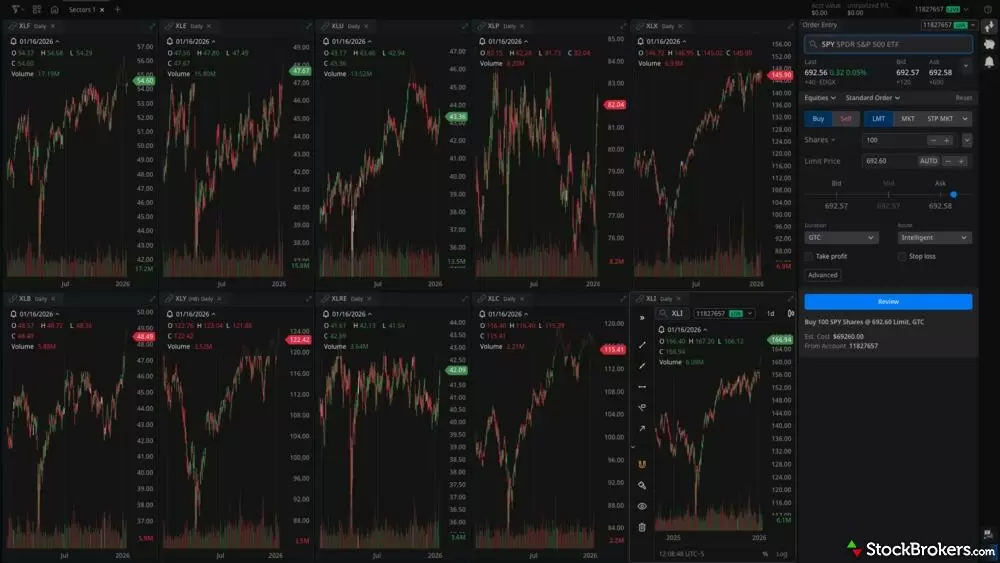
TradeStation's TITAN X Sector View displays the indices for all 11 GICS sectors in a predefined layout. On the right, the trade ticket shows a quote, applicable buying power, and advanced trade settings for SPY.
Where Interactive Brokers wins
Interactive Brokers brings more professional firepower overall. Trader Workstation pairs net Greeks with a one-click delta-neutral builder, full algorithmic order types, a risk navigator, and a watchlist with 659 fields to TradeStation's 341. It also offers paper trading and advanced backtesting through ORATS, and IBKR Desktop gives newer active traders a less overwhelming way in. For sheer breadth of professional tools, TWS is the deeper machine.

Interactive Brokers’ MultiSort Screener takes stock screening to the next level by letting users assign custom weightings to each selection criteria. Beyond traditional filters like P/E ratio or dividend yield, investors can prioritize what matters most, whether it’s earnings growth, valuation, or analyst ratings. This advanced screening tool helps surface results that truly match your personal investment strategy.
Verdict
Best for professional breadth and risk tools: Interactive Brokers.
Best for charting and strategy automation: TradeStation.
Both are excellent platforms. IBKR is the deeper all-around toolkit, and TradeStation is the one for a trader who codes and automates strategies in EasyLanguage.
| Feature |
Interactive Brokers
|
TradeStation
|
|---|---|---|
| Advanced Trading |
|
|
Interactive Brokers vs TradeStation: research
This is the widest gap on the page. Interactive Brokers runs one of the deeper research desks I test, while TradeStation keeps research lean and technical. We checked both feature by feature below.
| Feature |
Interactive Brokers
|
TradeStation
|
|---|---|---|
| Research - Stocks | Yes | Yes |
| Screener - Stocks | Yes | Yes |
| Research - ETFs | Yes | Yes |
| Screener - ETFs | Yes | Yes |
| Research - Mutual Funds | Yes | No |
| Screener - Mutual Funds | Yes | No |
| Research - Fixed Income | Yes | No |
| Screener - Fixed Income | Yes | No |
| Research - Pink Sheets / OTCBB | Yes | Yes |
| Options Chains - IV | Yes | Yes |
| Option Chains - Total Greeks | 5 | 5 |
| Strategy Net Greeks | Yes | Yes |
| Options - Strategy Builder | Yes | Yes |
Where Interactive Brokers wins
Interactive Brokers has far more to work with. It carries the widest set of third-party research providers I've tested, a full bond scanner, deep fundamentals on every quote, and a multi-sort screener that lets you weight the factors that matter most. Its connections tool ties any stock to related products, themes, and trade ideas. For data depth and screening, it isn't close.
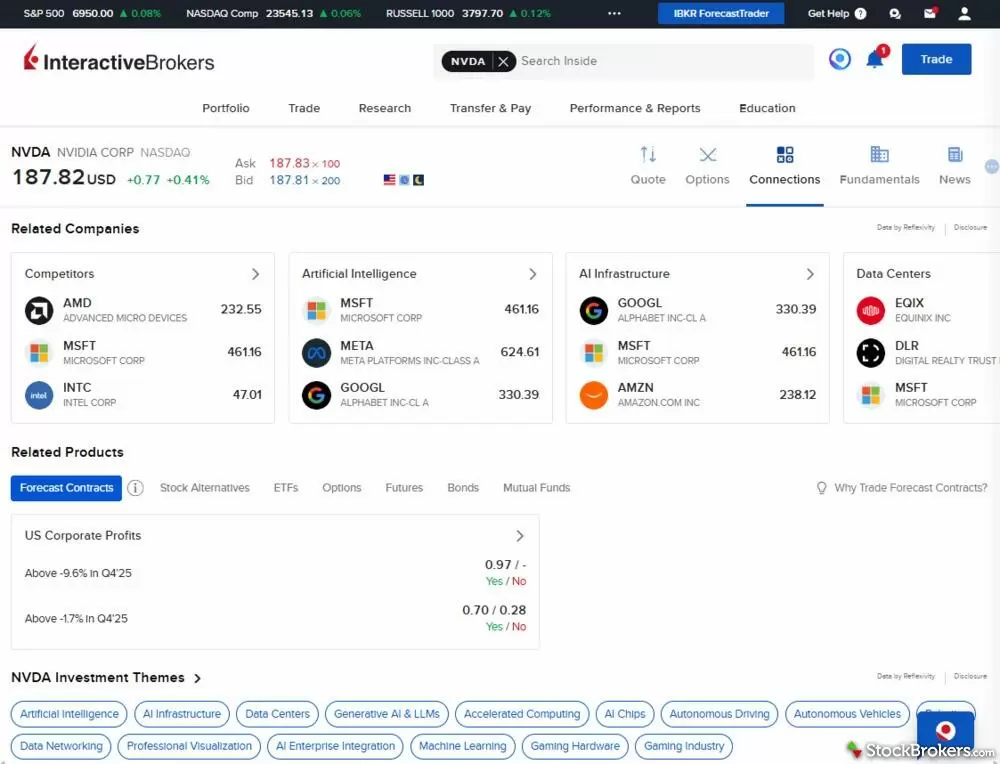
Interactive Brokers’ Connections tab, shown here for NVIDIA (NVDA), gives investors a 360° contextual research view by linking the selected stock to related competitors, thematic sectors like AI infrastructure and data centers, and tradable products such as Forecast Contracts and ETFs. Connections helps traders uncover peers, trends, and broader market relationships beyond just the price quote.
Where TradeStation wins
TradeStation's research is technical and scanner-driven, which suits its audience. Its in-platform scanners run on the same engine as its strategies, so you can hunt for chart patterns and technical setups with real precision, and its daily Insights give a clean read on what moved the market across stocks, options, and futures. What it lacks is the fundamental side, with no fixed income, mutual fund, or economic-calendar research to speak of.
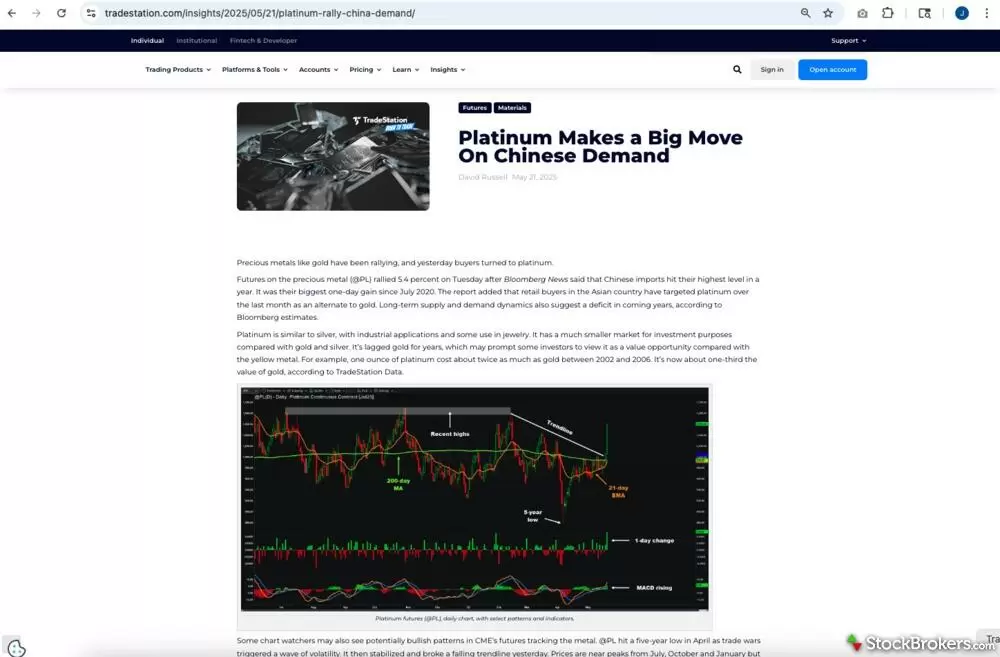
TradeStation’s Traders Insight blog delivers actionable market commentary from a trader’s point of view, covering a wide range of asset classes and strategies. This post focuses on commodities and even includes screenshots from the TradeStation platform to help visualize the analysis.
Verdict
Best for deep fundamental research and screening: Interactive Brokers.
Best for technical scanning and chart-pattern setups: TradeStation.
Interactive Brokers wins broadly on data and providers. TradeStation's research is narrow but truly useful for the technical trader hunting setups.
| Feature |
Interactive Brokers
|
TradeStation
|
|---|---|---|
| Research |
|
|
Interactive Brokers vs TradeStation: education
Both teach toward serious traders, but they cover very different ground. Interactive Brokers runs one of the broadest libraries I test through its IBKR Campus, with hundreds of courses, many of them CFA-accredited, spanning everything from the basics to advanced macro and fixed income. TradeStation goes narrow and deep, with strong options and technical-analysis Master Classes aimed squarely at advanced traders, but no beginner, retirement, or fundamental content to speak of, and a layout that takes some hunting. One is the place to learn broadly. The other sharpens an already-advanced trader.
| Feature |
Interactive Brokers
|
TradeStation
|
|---|---|---|
| Education (Stocks) | Yes | Yes |
| Education (ETFs) | Yes | No |
| Education (Options) | Yes | Yes |
| Education (Mutual Funds) | Yes | No |
| Education (Fixed Income) | Yes | No |
| Videos | Yes | Yes |
| Webinars | Yes | Yes |
Verdict
Best for broad learning from the basics up: Interactive Brokers.
Best for advanced options and strategy master classes: TradeStation.
If you want range and a clear path, IBKR Campus is the deeper library. If you're already advanced and want sharp options and technical sessions, TradeStation's Master Classes deliver, as long as you don't mind the layout.
| Feature |
Interactive Brokers
|
TradeStation
|
|---|---|---|
| Education |
|
|
Interactive Brokers and TradeStation: ease of use
Neither platform is built for simplicity, but Interactive Brokers is the easier of the two to settle into, a full star ahead in our testing. Trader Workstation has a steep learning curve, yet its clear labeling makes the climb manageable, and IBKR Desktop gives newer active traders a friendlier middle ground. TradeStation's TITAN X eases onboarding with a launchpad of layout templates and video guides, which is a thoughtful touch for a brand-new platform. The friction shows up elsewhere, since some tools still live on TradeStation's legacy platforms, the mobile trade ticket can be clunky, and applying for options still meant downloading and emailing a form.
Verdict
Best for settling in faster: Interactive Brokers.
Best for guided onboarding to a new platform: TradeStation.
Final thoughts: TradeStation vs Interactive Brokers
- Minimum Deposit: $0.00
- Stock Trades: $0.00
- Options (Per Contract): $0.65
Interactive Brokers is a go-to choice for professionals because of its institutional-grade desktop trading platform, high-quality trade executions and low margin rates. Read full review
- 170+ markets to trade.
- IBKR Desktop platform has institutional power and intuitive usability.
- Industry-leading margin rates and competitive interest yields.
- Density of features requires a significant time investment.
- Educational content skips over the basics for true beginners.
- Certain tools lack the curated context needed.
- Minimum Deposit: $0.00
- Stock Trades: $0.00
- Options (Per Contract): $0.80
TradeStation is a brokerage best known for its highly customizable trading platforms, advanced options and futures capabilities, and powerful tools designed for active and experienced traders. Read full review
- New TITAN X platform.
- Tools for futures and options.
- "Why is it Moving?" and "Hot Lists" tools on price action.
- Not a good choice for beginners or casual investors.
- Annual IRA maintenance fees and steep option exercise charges.
- No spot cryptocurrency trading, fractional shares, or robo-advisory services.
For most active traders, Interactive Brokers is the one I'd point to. It took our #1 Active Traders award for good reason, pairing the lowest margin around at a flat 6.83% with 36 international markets, the widest asset range I test, and far deeper research and education. If you trade actively, lean on margin, or want global reach and every asset class in one account, IBKR is the more complete home.
TradeStation earns its place with a specific trader. It took our #1 Innovation award this year for the TradeStation MCP connection with Claude, and its real strength is strategy building, with EasyLanguage coding, deep charting, and a modern platform in TITAN X. If you're a systematic trader who builds, backtests, and automates your own strategies in US stocks, options, and futures, TradeStation is worth it. Most other active traders will get more from Interactive Brokers.
Jessica's take
"Interactive Brokers truly has a solution for almost every type of investor, with a range of investments among the broadest of any broker we cover. TradeStation goes the other way, with an entire platform geared toward the active trader. One does it all. The other is built for one job."
Jessica Inskip
Director of Investor Research
Overall verdict
Best for most active traders: Interactive Brokers.
Best for systematic and strategy-driven traders: TradeStation.
| Feature |
Interactive Brokers
|
TradeStation
|
Category Winner |
|---|---|---|---|
| Overall |
|
|
Interactive Brokers |
| Range of Investments |
|
|
Interactive Brokers |
| Mobile Trading Apps |
|
|
Interactive Brokers |
| Advanced Trading |
|
|
Interactive Brokers |
| Research |
|
|
Interactive Brokers |
| Education |
|
|
Interactive Brokers |
| Ease of Use |
|
|
Interactive Brokers |
Read next
Popular 1v1 comparisons
- Charles Schwab vs Fidelity 2026
- Charles Schwab vs Interactive Brokers 2026
- E*TRADE vs Robinhood 2026
- Fidelity vs J.P. Morgan Self-Directed Investing 2026
- Fidelity vs Robinhood in 2026
More trading guides
Start investing with ease. Explore the best beginner-friendly trading platforms with low fees, great education, and intuitive apps.
Jessica Inskip August 06, 2026
Find the best crypto trading platform for 2026. We rank eToro, Fidelity, Interactive Brokers, Webull, and Robinhood on fees, security, and coin selection.
Steven Hatzakis May 27, 2026
We tested the best options trading platforms for 2026. Compare tastytrade, Fidelity, IBKR, E*TRADE & Schwab on tools, fees, and picks for beginners.
Jessica Inskip September 09, 2026
Discover the best stock brokers of 2026. Compare Schwab, Fidelity, Interactive Brokers, E*TRADE, and more to find the top trading platform for your needs.
Jessica Inskip August 06, 2026
Find the best Roth IRA accounts. Fidelity, Schwab, and E*TRADE lead with low fees, smart investing tools, and retirement planning support.
Andrea Coombes April 27, 2026
Practice investing risk-free with the best paper trading platforms. Compare Webull, Schwab, Interactive Brokers, E*TRADE, and more.
Jessica Inskip July 24, 2026
We tested the 5 best futures trading platforms of 2026. Compare commissions, margin rates, and tools for beginners and active traders. Find the right platform for you.
Jessica Inskip September 17, 2026
Find the best rollover IRA accounts. Compare Fidelity, Schwab, and E*TRADE for easy transfers, low fees, and smart retirement investing tools.
Andrea Coombes May 15, 2026
Find the best brokerage for high-net-worth investors. Compare Fidelity, Schwab, Merrill, and more for premium services and tailored investment tools.
Jessica Inskip January 27, 2026
Explore the best international brokers for U.S. investors. Compare Interactive Brokers, Charles Schwab, and Fidelity for global stock trading access.
Jessica Inskip May 22, 2026
Find the best penny stock brokers. Compare Fidelity, Firstrade, Schwab, E*TRADE, and TradeStation for OTC access, fees, and tools.
Jessica Inskip August 02, 2026
Discover the best day trading platforms. Compare IBKR, Schwab, Fidelity, E*TRADE, and TradeStation for speed, tools, and margin rates.
Jessica Inskip August 03, 2026
Interactive Brokers and Fidelity lead our 2026 ranking of the best free stock trading platforms, tested on the true cost of $0 commissions and hidden fees.
Jessica Inskip September 02, 2026
Find the top bank brokerages. From Merrill Edge to Ally, discover brokers that combine banking, investing, and rewards in one account.
Jessica Inskip April 16, 2026
Find top U.S. forex brokers. From tastyfx to OANDA, explore platforms with strong regulation, great tools, and user-friendly trading.
Steven Hatzakis May 29, 2026
Find the best IRA accounts. Compare Fidelity, Schwab, Merrill Edge, E*TRADE, & J.P. Morgan for retirement planning, fees, tools, and account flexibility.
Jessica Inskip March 31, 2026
Discover the best brokers for trade execution. Compare Fidelity, Interactive Brokers, and more for price improvement, speed, and transparency.
Jessica Inskip May 22, 2026Popular broker reviews
Our eToro review rates the social investing platform 3.0/5. Stock and ETF trades cost $0, crypto trades carry a 1% fee, and the minimum deposit is $50.
Jessica Inskip September 25, 2026
Read our J.P. Morgan Self-Directed Investing review and discover its strengths in research, planning tools, and integration for Chase clients.
Jessica Inskip May 15, 2026
Read our Merrill Edge Self-Directed review and see how it combines powerful investing tools, robust research, and integrated banking benefits.
Jessica Inskip September 25, 2026
Read our Firstrade review and see why it’s a top choice for options traders, offering $0 contract fees, robust tools, and a growing feature set.
Jessica Inskip May 04, 2026
Read our Robinhood review and see why it’s a top pick for beginners, with a sleek mobile app, zero commissions, and standout educational tools.
Jessica Inskip September 03, 2026
Read our 2026 E*TRADE review to see how powerful research, versatile platforms, and diverse investments make it a top choice for all investors.
Jessica Inskip September 14, 2026
Read our Public.com review to learn how its intuitive platform and community-driven features help simplify investing for first-time traders.
Jessica Inskip September 18, 2026
Ally Invest scores 3/5 in our 2026 review. See how its $0 stock trades, $0.50 options, strong fixed income tools, and Ally Bank integration stack up.
Jessica Inskip September 14, 2026
Read our Charles Schwab review to learn why its platforms, research, and investor resources make it one of the top-ranked brokerages.
Jessica Inskip September 21, 2026
Read our tastytrade review and discover why it’s the top choice for options traders, with low fees, advanced tools, and a seamless platform.
Jessica Inskip September 21, 2026
Read our TradeStation review and discover why its pro-level tools, deep customization, and options focus make it a top choice for active traders.
Jessica Inskip September 24, 2026
Fidelity charges $0 stock and ETF trades and won #1 for Research and Education in 2026. See our tested review of its fees, platforms, IRAs, and apps.
Jessica Inskip September 17, 2026
Read our Webull review and discover its commission-free trading, sleek platforms, paper trading tools, and fractional shares.
Jessica Inskip September 18, 2026
Read our Interactive Brokers review and see why it's a top choice for active traders with low costs, cutting-edge platforms, and global reach.
Jessica Inskip July 31, 2026About the Editorial Team
Jessica Inskip is Director of Investor Research at StockBrokers.com, bringing 15 years of experience in brokerage and trading strategy. A former FINRA-licensed rep, she held Series 7, 63, 66, and 4 licenses. Jessica focuses on investor education and brokerage industry research, appears regularly on CNBC, Bloomberg, The Schwab Network, Fox Business, and Yahoo! Finance, and hosts the Market MakeHer podcast.
Jeff Anberg is a Senior Editor at StockBrokers.com. Along with years of experience in media distribution at a global newsroom, Jeff has a versatile knowledge base encompassing the technology and financial markets. He is a long-time active investor and engages in research on emerging markets like cryptocurrency. Jeff holds a Bachelor’s Degree in English Literature with a minor in Philosophy from San Francisco State University.
Blain Reinkensmeyer has 25 years of trading experience with over 2,500 trades placed during that time. He heads research for all U.S.-based brokerages on StockBrokers.com and is respected by executives as the leading expert covering the online broker industry. Blain’s insights have been featured in the New York Times, Wall Street Journal, Forbes, and the Chicago Tribune, among other media outlets.