 Charles Schwab
 Fidelity
 Interactive Brokers
 E*TRADE
 Webull
 Robinhood
 TradeStation
 tastytrade
 eToro
eToro Trading 212
 Interactive Investor
 IG
IG Interactive Brokers
 XTB
XTB Hargreaves Lansdown
 Saxo
Saxo Charles Stanley Direct
 CIBC Investor's Edge
 Interactive Brokers
 Moomoo
 Questrade
 Qtrade
 TD Direct Investing
 Wealthsimple
 Finviz
 Stock Rover
 Seeking Alpha
 StockHero
 TipRanks
 TrendSpider
 Trade Ideas
 TraderSync
 TradingView
 Tradervue
 TradeZella
Fidelity Review

Written by Jessica Inskip
Director of Investor Research

Edited by John Bringans
Managing Editor

Reviewed by Blain Reinkensmeyer
Managing Partner
Jessica InskipDirector of Investor Research
Jessica Inskip is Director of Investor Research at StockBrokers.com, bringing 15 years of experience in brokerage and trading strategy. Jessica focuses on investor education and brokerage industry research.


Fidelity is best for investors who research before buying and want stocks, ETFs, bonds, and retirement accounts in one place. I have tested it for years, and for this review I went asset by asset to find where it excels or falls short. I ran NVDA through the stock quote page and screened ETFs before breaking down QQQ. I built spreads off the options chain on the web and in the app, then priced a 4.375% Treasury note down to its option-adjusted spread.
That option-adjusted spread is institutional-grade analysis handed to a retail investor, and few brokers let me recommend the same firm to a teenager and a trustee. Our 2026 Annual Awards named Fidelity #1 for Bond Investing, Retirement Accounts, and Youth Investors. Single-leg options trades are simple, but putting together spreads on the phone is not.
Stocks, funds, and bonds are where Fidelity is strongest for buy-and-hold investors. If you build spreads from your phone or need futures, you will be happier with a specialist.
-
Minimum Deposit:
$0.00 -
Stock Trades:
$0.00 -
Options (Per Contract):
$0.65
| Range of Investments | |
| Mobile Trading Apps | |
| Advanced Trading | |
| Research | |
| Education | |
| Ease of Use | |
| Customer Service |
Check out StockBrokers.com's picks for the best stock brokers in 2026.
| #1 Research | Winner |
| #1 Education | Winner |
| #1 Beginners | Winner |
| #1 Retirement Accounts | Winner |
| #1 Investor App | Winner |
| #1 Stock Trading Platform | Winner |
| #1 Bond Investing | Winner |
| #1 Youth Investors | Winner |
| #1 Small Business Owners | Winner |
| 2026 | #2 |
| 2025 | #3 |
| 2024 | #1 |
| 2023 | #1 |
| 2022 | #1 |
| 2021 | #2 |
| 2020 | #2 |
| 2019 | #2 |
| 2018 | #1 |
| 2017 | #2 |
| 2016 | #1 |
| 2015 | #2 |
| 2014 | #2 |
| 2013 | #5 |
| 2012 | #7 |
| 2011 | #8 |
 Why you can trust us
Led by Jessica Inskip, Director of Investor Research, the StockBrokers.com research team collects thousands of data points across hundreds of variables. We evaluate features important to every kind of investor, including beginners, casual investors, passive investors, and active traders. We carefully track data on margin rates, trading costs, and fees to rate stock brokers across our proprietary testing categories.
Our researchers open personal brokerage accounts and test all available platforms on desktop, web, and mobile for each broker reviewed on StockBrokers.com. Learn more about how we test.
Table of Contents
Pros and cons
PROS
- #1 for Research and Education in the StockBrokers.com 2026 Annual Awards.
- Stock quote pages that rank analyst reports by accuracy.
- $0 online Treasuries, $1 per bond, and Treasury auction access.
- Accounts for every life stage, from a teen-owned Youth Account to trusts.
CONS
- Multi-leg options orders on the mobile app are tedious.
- No futures, futures options, forex, or paper trading.
- Margin starts at 12.575% for balances under $25,000.
My top takeaways for Fidelity in 2026:
- For stock and ETF investors: NVDA's Equity Summary Score (8.7, bullish) and QQQ's premium or discount to NAV put the research a buyer needs directly on the quote page.
- For options traders: The web chain's new Trade Analyzer makes Fidelity a credible place to price a spread, but building that spread on the app is still a chore.
- For income investors: $0 online Treasuries, a yields table broken out by credit tier, and a CD ladder builder make Fidelity the first place I would build an income portfolio.
- For retirement savers: The Fidelity Retirement Score works as an ongoing check-up tied to your account, and it tells you what to change if you are off track.
Asset classes reviewed: We reviewed Fidelity for stock, ETF, options, and crypto trading, along with bonds and fixed income. Fidelity does not offer futures or futures options; our guide to the best futures trading platforms covers the brokers that do.
Fidelity fees
Fidelity charges $0 for online stock and ETF trades, $0.65 per options contract, $0 for online Treasuries, and $1 per secondary bond; crypto carries a built-in spread instead of a commission, and futures are not offered.
There is no minimum deposit to open a brokerage account. Mutual fund trade costs vary by fund, and broker-assisted trades cost $32.95.
Account fees: Leaving costs nothing. Full and partial transfers out are $0, and IRAs carry no annual or closure fee. Payment for order flow, the practice of routing orders to market makers in exchange for payment, is now part of the picture, and that is a change from prior years, when Fidelity did not accept it. Through its affiliate National Financial Services, Fidelity Brokerage Services receives up to $0.0008 per share on marketable equity orders and up to $0.003 per share on non-marketable orders routed to a wholesale market maker.
Margin rates: Borrowing is where Fidelity stops feeling generous. At the time of my testing, margin started at 12.575% under $25,000 and stayed above 10.8% until balances reached $500,000, where it dropped to 8.5%, then 8.25% above $1,000,000. The schedule mostly rewards large accounts.
Fidelity account types
Fidelity can hold an investor's entire financial life, from a 13-year-old's first account to a trust or a small business. What it will not do is open an account for someone living outside the United States. That is a separate question from investing abroad, since a U.S. Fidelity account already reaches 25 international markets once international trading is enabled.
Retirement accounts: Every IRA type is available, including traditional, Roth, rollover, SEP, SIMPLE, inherited, and custodial. Limited margin in IRAs lets you trade with unsettled funds without actually borrowing, and because Fidelity also runs employer plans, your workplace account may already be here. Our full Fidelity IRA review covers the details.
Retirement planning: The Fidelity Retirement Score is the retirement tool I would start with, because it is not a one-time calculator. Enter your age, income, savings, and contributions, and the score stays attached to your account with a clear path to improve it; non-customers can use it too. Social Security, RMD (required minimum distribution), and Roth conversion calculators sit alongside it.
Kids and teens: The Fidelity Youth Account is truly innovative. Teens aged 13 to 17 own and manage it, with a parent holding oversight rather than ownership, so it is neither a custodial nor a joint account. Teens can exchange gift cards for cash to save or invest and receive scheduled allowances. Traditional UTMA/UGMA custodial accounts, 529 plans, and a Roth IRA for Kids cover the rest.
Business and managed accounts: The Fidelity Account for Businesses is built for legal or professional corporations and professional associations, and self-employed owners can open a self-employed 401(k). Investment clubs, trusts, estates, and Fidelity Charitable Giving Accounts are available as well. If you would rather not pick investments yourself, Fidelity Go has a $10 minimum and charges no advisory fee under $25,000 and 0.35% a year at $25,000 and above.
Account maintenance: Beneficiaries, margin, authorized users, conversions, and recurring distributions can all be handled online, or you will find the exact steps to follow, and quick actions for trading, transfers, and bill pay sit on the positions page. The tax center holds your forms and prep resources but skips wash sales and index option tax treatment.
Planning tools: The 45 calculators and tools are excellent and hard to find, buried under Why Fidelity, then Insights & Tools, then Calculators & Tools. The capital gains and tax deferral calculator showed my tax impact as soon as I entered my bracket, state, market value, and cost basis. Fidelity should put that shelf where investors will look for it.
Cash management: There is no FDIC-insured checking or savings account at Fidelity, but its Cash Management Account, a brokerage account that works like checking, comes with a debit card and bill pay, and Fidelity reimburses ATM fees charged by other institutions worldwide. Uninvested cash in the account is eligible for FDIC coverage through program banks. If you want a true bank account, you will still need a bank.
One of the best for high net worth
We analyzed online brokers' offerings for clients with over $1 million of liquid, investable assets. See our guide to the Best Brokerage Firms for High Net Worth Individuals.
Stock trading
For researching and buying individual stocks, Fidelity is one of the best brokers I have tested. Online stock trades cost $0, including OTC and penny stocks, and you can buy fractional shares, reach 25 international markets, and request IPO shares. The main gap is in available trading hours. While extended-hours sessions are supported, overnight trading is not.
Reaching those 25 markets means dealing in currency. International Trading lets you hold and exchange 16 currencies to settle trades on foreign exchanges, with Fidelity FOREX, LLC acting as principal at a marked-up rate, so the markup is the cost to watch. What you cannot do is trade currencies as their own asset, because there is no retail forex account here.
Stock research and the NVDA quote page
For all but the most advanced traders, the web stock quote page is about as good as web research gets. On the NVDA quote page, the Analyst Ratings tab led with the Equity Summary Score from LSEG StarMine, which combines the opinions of up to seven independent research firms into one 1-to-10 score (8.7, bullish), then ranked each firm's reports by relative accuracy so you can see whose calls have held up.
The dividend widget scores Strength (yield against the market median), Sustainability (the payout ratio), and Growth (dividend growth against the market median). Dear Fidelity: add free cash flow per share against the annual dividend, and you would have the perfect dividend widget. The implied-price slider I criticized last cycle is gone, replaced by trailing EPS, P/E, and EPS growth compared with the industry, plus the five-year average P/E. On the app, I was glad to find the payout ratio, though one line explaining why it matters would help.
Finding stock ideas
Ideas start before you open the stock screener. There are two in particular that I like: orders by Fidelity customers, shown as a buy/sell ratio, and a daily bullish and bearish pick that explains its reasoning. The screener's themes are actually thematic (cybersecurity, robotics and AI), though it still loads in an older design than the quote pages it feeds. Legacy and redesigned pages coexist across the site, and this is where it shows most.
Charting and execution for active stock traders
Active stock traders get a capable toolkit with a clear ceiling. Active Trader Pro is Fidelity's downloadable platform (it runs on both Windows and Mac), and the charting carries 129 indicators and 38 drawing tools. Execution tools include Level 2 quotes (the order book beyond the best bid and ask), hot keys, tax-lot selection on the ticket, which lets you choose which shares you sell, and a wash sale indicator in the positions view, the flag that tells you a loss will be disallowed.
The ceiling is customization. There are only five study customizations, no custom studies, no price ladder, and no margin impact on the ticket. Basic trade-idea backtesting is here, but advanced backtesting is not. Watchlists support 92 fields on the web.
The 38 drawing tools come with a catch I hit immediately. When I placed a support line, I could not snap it to a specific price, and Fibonacci extensions behaved the same way, which matters if you draw levels precisely.
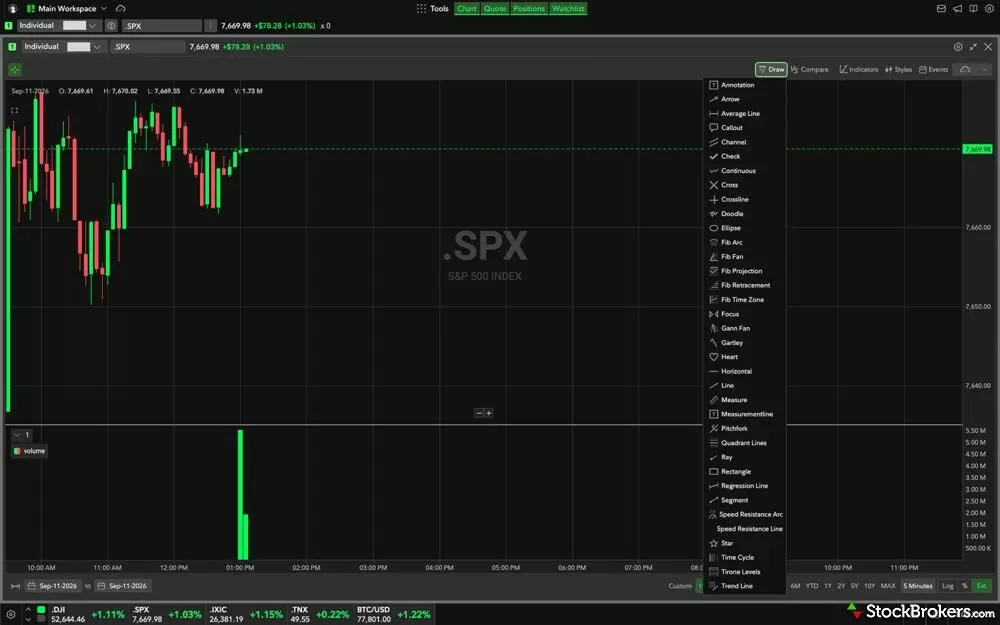
Fidelity's downloadable platform puts its drawing tools in one Draw menu, shown here over a five-minute chart of the S&P 500 index. Past the trend lines and rectangles, the list includes Fibonacci retracements, Gann fans, pitchforks, and Gartley patterns. The ceiling I hit was in the indicators, which allow five study customizations and no custom studies.
Trading stocks on the Fidelity app
Sleek, modern, and incredibly easy to navigate, Fidelity's app puts everything behind five bottom buttons: Home, Investing, Transact, Planning, and Discover. Discover is the tab I would point a newer investor to, with short-form lessons you scroll through like a social feed. The watchlist is where it feels thin, with 11 columns that skip ex-dividend dates, earnings dates, and valuation.
Walking through Fidelity's mobile order ticket
StockBrokers.com co-founder Blain Reinkensmeyer walks through the Fidelity mobile order ticket, from the quote screen to a placed order.
Market context: calendars and commentary
The economic calendar is my favorite, full stop. I have it bookmarked and use it every day. Powered by Econoday, it reads a week at a time like an email calendar, flags market-moving releases, and pairs each event with the consensus range, prior reading, and a "Why investors care" explanation. The earnings calendar adds a market-cap column, which matters because cap-weighted indices move with their biggest names. What is missing is an economic calendar on the Fidelity mobile app, which currently only offers the earnings calendar.

Fidelity’s economic calendar is hands-down one of the best out there. It's clean, easy to navigate, and packed with useful info. It clearly highlights market-moving events for the week, so you know exactly what to watch. Tap on any item to get more context, making it a great tool for staying ahead of and understanding key economic events.
For commentary, the Quarterly Market Update is worth your time. The late-April 2026 edition, "Uncertainty persists as markets reprice risk," was a four-minute read and provided top-tier analysis.
Learning to invest in stocks
Those looking for the most basic beginner-friendly stock education may find it difficult to navigate to where they need to be. The Basics of Stock Investing collection opens with an article on equity, and I could not find one in that section that explains what a stock is. The dividend section lists "What is a dividend" next to a video titled "What are dividends," with nothing to tell them apart. Past the basics, a strong IPO series and walkthroughs of Fidelity's own screener build the bridge from learning to doing that I look for.
The advanced education is the opposite story. Fidelity's Technical Indicator Guide was my personal bible when I worked on a trade desk, and it is still the reference I would hand a technical trader who wants to learn the tools properly.
Beyond stock basics, the Learning Center is one of the best organized I test, and its Life Events topics (changing jobs, getting married, inheriting money) are the most useful. Live courses carry progress tracking and quizzes, and a save button on every article feeds a read-later library I lean on constantly. The writing can be jargon-heavy, so expect to look up a few terms.

Fidelity’s Learning Center is a robust educational hub covering everything from financial essentials and major life events to advanced trading strategies and market insights. It also features specialized content like the “Women Talk Money” series and a calendar of live and on-demand events.
Research-first stock investors should start here. Traders who need a price ladder or custom indicators will outgrow it.
ETF trading
Recurring investments are the reason I recommend Fidelity to new ETF investors. ETF trades cost $0 online, and scheduled purchases, combined with fractional shares and dividend reinvestment, let a beginner build a diversified portfolio from small, regular contributions.
ETF research and the QQQ quote page
The QQQ quote page is as comprehensive as the stock page. Its Overview shows the expense ratio (0.18% on QQQ), indicative intraday value (the real-time estimate of what the basket is worth), premium or discount to NAV with a three-month rolling average, the 30-day SEC yield, median bid/ask spread, and tracking error. The fund profile then answers what the fund holds and how it has performed against its benchmark, and I am a big fan of a broker that asks the questions for you and then answers them.
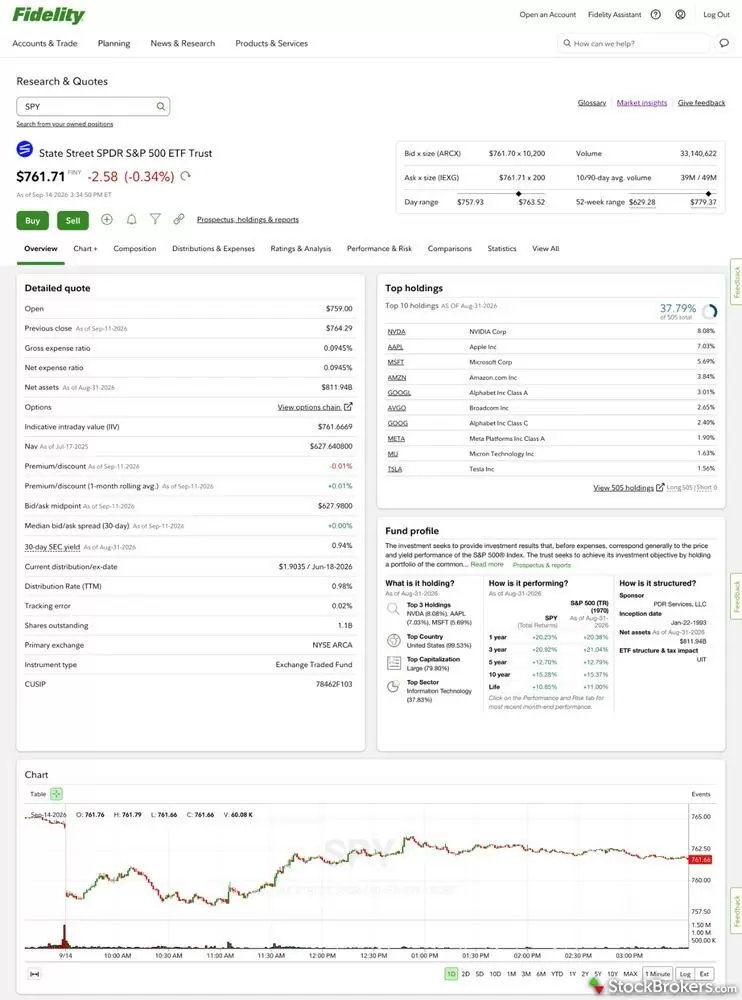
On SPY's quote page, the Fund profile asks three questions and answers each one: what the fund holds, how it has performed, and how it is structured. The performance column puts SPY's returns next to the S&P 500's for one, three, five, and 10 years and for the life of the fund. On the left, the Detailed quote panel lists the fund data I check before buying an ETF, including the 0.0945% expense ratio and 0.02% tracking error.
On the app, the ETF page is lighter but still useful. NAV return against market return, valuation metrics, and the top 10 holdings show what an ETF owns and how it has tracked, while the deeper analysis stays on the web.
Two extras earn their place. The Portfolio Fundamentals widget reports fund-level metrics such as P/E ratios and cash flow growth for the fund itself, which is granularity I rarely get without building it myself, and the website's portfolio risk tools add Sharpe ratio, alpha, and beta, so you can judge what your mix is doing rather than only what it holds.
Finding ETFs: the screener and built-in education
The ETF screener is holistic and approachable, especially for someone who does not know where to begin. It starts with a question (what type of ETF are you looking for?), offers presets that include a newer Digital Assets bucket for crypto ETFs, and teaches as you go. You'll find answers on what an ETF is, the risks, and the top five mistakes people make investing in ETFs. Experienced investors can build a screen from scratch, down to tax considerations.
Mutual funds: Fund investors also get a dedicated mutual fund screener and the same research depth, minus downloadable reports. Trade costs vary by fund, so check before you buy.
Sector and business-cycle exposure
The Sectors tab is where I linger when choosing sector ETFs. Fidelity maps each sector to the business cycle (early, mid, late, or recession), which not every broker does, and adds weight recommendations from both CFRA and Argus, while asset allocation and correlation tools show whether your funds are as diversified as they look.
This is where I would build a first ETF portfolio. Investors who would rather have the funds picked for them can use Fidelity Go, covered under account types.
Options trading
Single-leg traders and the options-curious will do well at Fidelity, while multi-leg traders working from a phone will be frustrated. Contracts cost $0.65 each, exercise and assignment cost $0, a dime buyback program waives the fee on closing low-priced short options, and strategies can run up to four legs, including spreads inside IRAs.
The web options chain and Trade Analyzer
The redesigned web chain is a real step up from the legacy version. On AAPL, the top of the chain was built for options traders: the put/call ratio (0.51, bullish), the earnings and ex-dividend dates, and IV30 against HV30, which compares the market's expected 30-day volatility with what the stock has done over the last 30 days. An expandable Volatility Indexes widget adds 52-week IV and HV percentiles.
The chain shows all five Greeks, and the new Trade Analyzer takes up to four single legs or one multi-leg strategy and returns estimated max gain, max loss, break-even, and probability of profit before you preview the order. That is exactly what the legacy chain was missing. The thinkorswim and tastytrade crowd have their reasons to stay put, but for the intermediate trader this is a good chain now.
Building spreads in Active Trader Pro
Spreads belong on the desktop, and Active Trader Pro is where Fidelity handles them properly. Its chain takes more than 25 data columns, including all the Greeks, and clicking a bid or ask prepopulates the ticket. Turn on multi-select, pick an ask for the long leg and a bid for the short leg, and the strategy assembles beneath the chain with per-leg data, net Greeks, and a probability of profit. A calculator expands to model that probability against price targets, dates, and implied volatility.
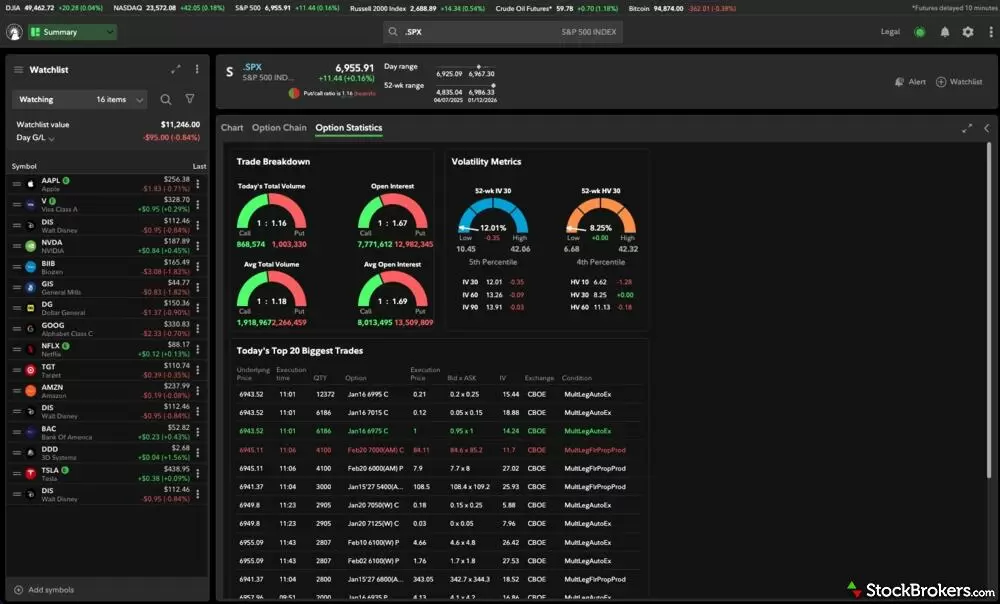
Fidelity’s trading dashboard brings everything together in one place. Here, I’ve linked SPY across all widgets for a seamless view. You can dive into options statistics, volatility indices, and my personal favorite: the trade breakdown activity, which gives great insight into how traders are positioning.
Trading options on the Fidelity app
Single-leg options trades are excellent on the Fidelity app, and anything more is tedious.
Single-leg orders: Trading off the mobile chain is as simple as it gets. The chain shows calls, puts, or both with all the Greeks and implied volatility, and it flags days to expiration and earnings as you scroll. Tap an ask and the ticket prefills, and you can change the strike, action, or expiration from a drop-down. The one flaw is that the underlying quote does not stay pinned, so I kept scrolling back up to check it.
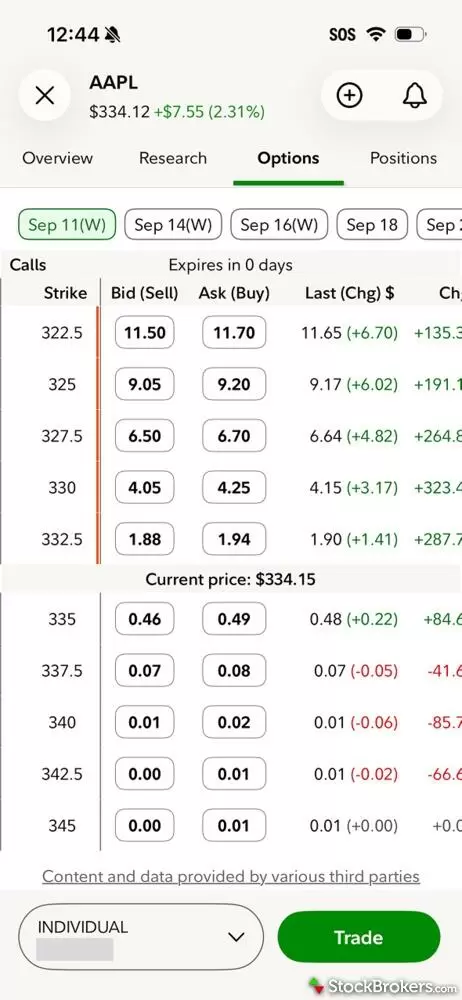
The Fidelity app's AAPL options chain flagged the September 11 weekly calls as expiring in 0 days. A Current price row divides the in-the-money strikes from the out-of-the-money ones, and every bid and ask doubles as a button. Tap an ask and the order ticket prefills with that contract.
Multi-leg orders: This is where the app falls apart. I tapped Transact, selected my first leg from the chain, and then had to rebuild the strategy on the ticket, where the long leg I had already populated disappeared. I could see each leg's bid and ask but not the Greeks, which keeps the app off my short list of options trading apps. Price your spreads on the web chain or in Active Trader Pro instead.
Jessica's take
"Executing a standard single-leg trade is straightforward, but I prefer using the multi-leg tool even for single contracts. I simply enable 'multi-select' on the chain and click just one contract to build the ticket at the bottom of the screen."
Jessica Inskip
Director of Investor Research
Options education and strategy ideas
Fidelity teaches options far better than it generates options ideas. Education is split into a basics page and a Beyond the Basics page, and as someone who trades and teaches options, I think that is the right order: foundation first, strategies second. Start with Trading Options: A Beginner's Series. The subsequent titles look like they jump straight to strategies, but the first video is a good introduction. The Trading Strategy Desk adds a four-week virtual course and one-on-one coaching sessions.
Idea generation is thinner. The Cboe LiveVol scanner lets you hunt for high options volume or imploding and exploding implied volatility, while OptionsPlay's income and trading strategy ideas sit behind a subscription. When I ran AAPL through the Option Strategy Builder, the outlook was still only up, flat, or down, with no volatility view to route you toward premium-selling strategies. A simplified builder has to be education-heavy to earn its simplicity, and this one is not: beginners do not learn enough, and intermediate traders do not get enough information.
With no paper trading, options education also fails my application test, because nothing lets you practice the strategy you just learned. Single-leg traders and options learners have a strong home here, while spread traders who work from a phone should compare our options trading platforms guide first.
Crypto trading
Fidelity offers direct trading in five coins, which suits a small, established crypto allocation next to your stocks and funds far better than active crypto trading. The coins do not sit in your brokerage account. Fidelity Crypto accounts, along with the custody and trading inside them, are provided by Fidelity Digital Assets, National Association, a national trust bank. There is no separate commission; instead, a spread of about 1% is built into each buy and sell, so a round trip costs roughly 2% before the price moves at all.
Coins and transfers: The five coins are Bitcoin, Ethereum, Solana, Litecoin, and the Fidelity Digital Dollar (FIDD) stablecoin, and a Crypto IRA is available. You can move coins in and out of your account, and the ability to send them to a wallet you control is what separates owning crypto from owning exposure to it.
Research and alternatives: Crypto gets its own tab on the Research & Quotes hub, and I found the crypto research solid; the Learning Center's Crypto 101 topic covers the basics. If you would rather own a fund, the ETF screener's Digital Assets preset is the faster route. Active altcoin traders will be better served by a dedicated crypto broker.
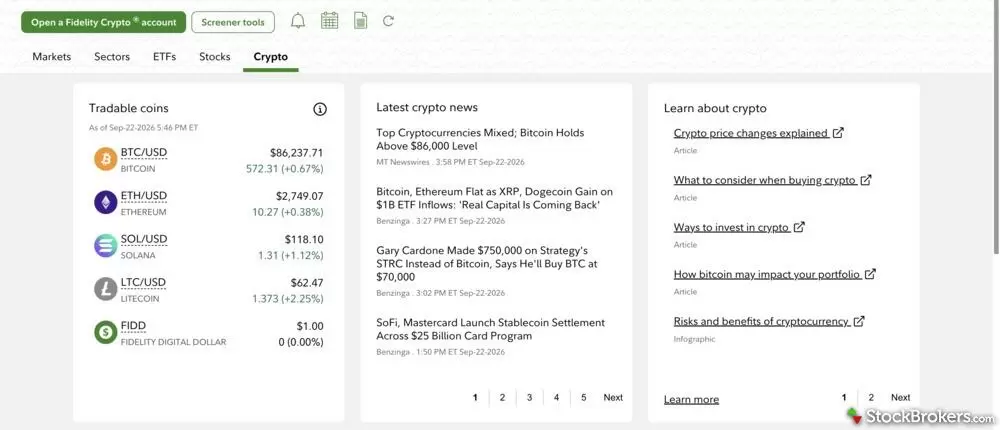
The Crypto tab on Fidelity's Research & Quotes hub opens with the five coins you can trade, including the Fidelity Digital Dollar stablecoin at $1.00. Crypto news from MT Newswires and Benzinga fills the middle column. The right column links to articles and an infographic on the basics, such as how crypto prices move and what to consider before buying.
Bonds and fixed income
No broker I have tested makes buying bonds and CDs online better than Fidelity does. U.S. Treasuries cost $0 online, secondary bonds carry a $1 per bond markup or markdown, primary Treasury auctions are open to you, and the inventory tops 100,000 new-issue and secondary bonds and CDs (more than 150,000 with depth of book).
Bond research and the Treasury quote page
For fixed income investors, the bond quote page is best-in-class. On the 4.375% Treasury note maturing May 15, 2036, it showed bid and ask prices and yields, the $1,000 minimum, depth of book, a third-party price to sanity-check your quote, and whether the bond was trading flat, meaning without accrued interest.
Then come the analytics I like most: current yield, duration and convexity to worst, and option-adjusted duration, convexity, and spread (the yield spread left after accounting for any embedded options), each paired with contextual education. The fixed income education goes past the basics too, into convexity and duration risk.
Finding bonds and building CD ladders
The yields table is the part other brokers should copy. It breaks corporates and munis out by credit tier from AAA to BBB, adds Treasuries, STRIPS, and agencies, and spans maturities from three months to 30-plus years. One complaint I have is that clicking a yield still drops you into an older search results page before the redesigned bond detail, and that detour is where someone new to bonds is most likely to get lost.
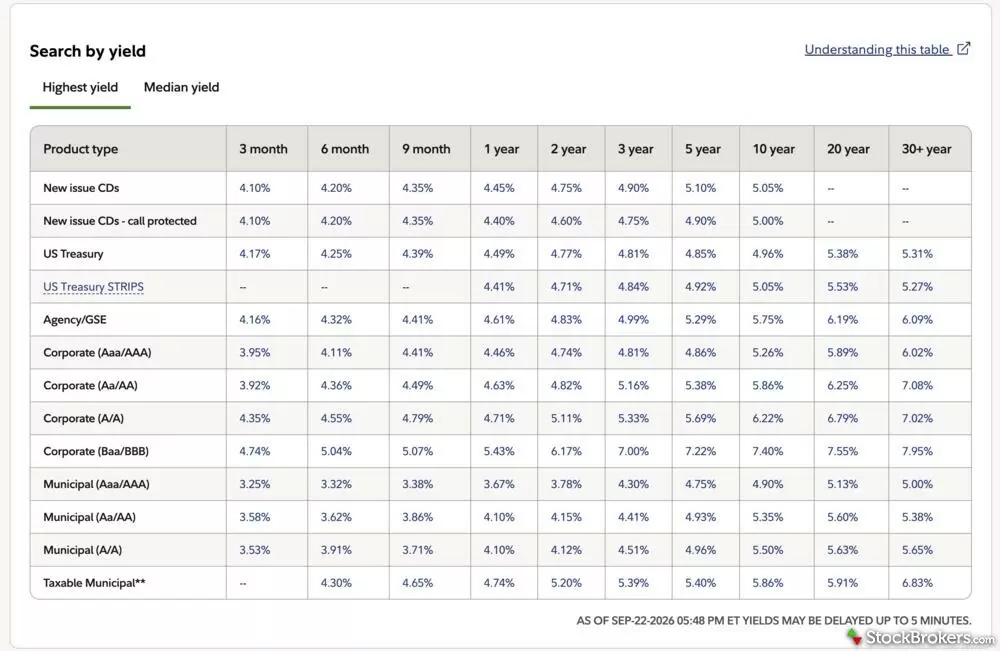
Fidelity's Search by yield table lists the highest yield for each bond and CD type at every maturity, and a second tab switches it to median yields. On September 22, 2026, the 10-year column showed AAA corporates at 5.26% and BBB corporates at 7.40%. Each yield links into Fidelity's bond search, which still opens on the older results page.
The CD ladder builder is still my favorite tool here, though I would like to see a Treasury ladder option inside it. The fixed income dashboard adds a cash-flow view and taxable versus tax-exempt analysis, and a tax-equivalent yield calculator shows what a muni's tax-free yield is worth at your bracket. It is a bond geek's world, and income investors should start here.
Customer service
To score customer service, StockBrokers.com partners with customer experience research firm Confero to conduct phone tests from locations throughout the United States. In our 2026 testing, 132 customer service tests were conducted over six weeks, with wait times logged for each call.
Representatives were asked for help as prospective customers across account opening, trading tools, apps, crypto, and active trading. Here are the results for Fidelity.
- Average connection time: Under a minute
- Average Net Promoter Score: 9.2 / 10
- Average professionalism score: 8.9 / 10
- Overall score: 9.08 / 10
- Ranking: 2nd of 11
Final thoughts
-
Minimum Deposit:
$0.00 -
Stock Trades:
$0.00 -
Options (Per Contract):
$0.65
| Range of Investments | |
| Mobile Trading Apps | |
| Advanced Trading | |
| Research | |
| Education | |
| Ease of Use | |
| Customer Service |
Check out StockBrokers.com's picks for the best stock brokers in 2026.
| #1 Research | Winner |
| #1 Education | Winner |
| #1 Beginners | Winner |
| #1 Retirement Accounts | Winner |
| #1 Investor App | Winner |
| #1 Stock Trading Platform | Winner |
| #1 Bond Investing | Winner |
| #1 Youth Investors | Winner |
| #1 Small Business Owners | Winner |
| 2026 | #2 |
| 2025 | #3 |
| 2024 | #1 |
| 2023 | #1 |
| 2022 | #1 |
| 2021 | #2 |
| 2020 | #2 |
| 2019 | #2 |
| 2018 | #1 |
| 2017 | #2 |
| 2016 | #1 |
| 2015 | #2 |
| 2014 | #2 |
| 2013 | #5 |
| 2012 | #7 |
| 2011 | #8 |
Fidelity is the broker I would hand to a research-first stock, ETF, or bond investor who wants every account under one roof, and its #1 finish for Bond Investing in our 2026 Annual Awards matches what I saw on the Treasury quote page.
The gaps are specific. Stock education needs a real on-ramp, crypto suits a small allocation rather than active trading, and options fall short on the phone and in strategy discovery, with no paper trading to practice on. Long-term investors should open the account; spread traders should keep shopping.
Fidelity Star Ratings
| Feature |
 Fidelity Fidelity
|
|---|---|
| Overall |
|
| Range of Investments |
|
| Mobile Trading Apps |
|
| Advanced Trading |
|
| Research |
|
| Customer Service |
|
| Education |
|
| Ease of Use |
|
StockBrokers.com Review Methodology
Why you should trust us
Jessica Inskip is Director of Investor Research at StockBrokers.com, bringing 15 years of experience in brokerage and trading strategy. A former FINRA-licensed rep, she held Series 7, 63, 66, and 4 licenses. Jessica focuses on investor education and brokerage industry research, appears regularly on CNBC, Bloomberg, The Schwab Network, Fox Business, and Yahoo! Finance, and hosts the Market MakeHer podcast.
Blain Reinkensmeyer, co-founder of StockBrokers.com, has been investing and trading for over 25 years. After having placed over 2,500 trades in his late teens and early 20s, he became one of the first in digital media to review online brokerages. Today, Blain is widely respected as a leading expert on finance and investing, specifically the U.S. online brokerage industry. Blain has been quoted in The New York Times, The Wall Street Journal, Forbes, and Fast Company, among others. Blain created the original scoring rubrics for StockBrokers.com and oversees all testing and rating methodologies.
How we tested
- We used our own brokerage accounts for testing.
- We collected thousands of data points across the brokers we review.
- We tested each online broker's website, desktop platforms, and mobile app, where applicable.
- We maintained strict editorial independence; brokers cannot pay for inclusion or a higher rating.
Our research team meticulously collected data on every feature of importance to a wide range of customer profiles, including beginners, casual investors, passive investors, and active traders. We carefully track variables like margin rates, trading costs, fees, and platform features and use them to help rate brokers across a range of categories measuring ease of use, range of investments, research, education, and more.
At StockBrokers.com, our reviewers use a variety of computing devices to evaluate platforms and tools. Our reviews and data collection were conducted using the following devices chosen to reflect the everyday hardware our readers are likely to be using rather than top-tier configurations: iPhone SE running the latest iOS version, MacBook Pro M1 with 8 GB RAM running the current MacOS, and a Dell Vostro 5402 laptop i5 with 8 GB RAM running Windows 11 Pro.
Each broker was evaluated and scored on over 200 different variables across seven key categories: Range of Investments, Platforms & Tools, Research, Mobile Trading, Education, Ease of Use, and Overall. Learn more about how we test.
Trading platforms tested in 2026
We tested 14 online trading platforms in 2026:
Read next
Read our 2026 E*TRADE review to see how powerful research, versatile platforms, and diverse investments make it a top choice for all investors.
Jessica Inskip September 29, 2026
Read our Charles Schwab review to learn why its platforms, research, and investor resources make it one of the top-ranked brokerages.
Jessica Inskip September 30, 2026
Our Robinhood review tests $0 stock and options trades, #1-ranked prediction markets, and AI agent trading, plus where its website research falls short.
Jessica Inskip October 01, 2026
Read our Merrill Edge Self-Directed review and see how it combines powerful investing tools, robust research, and integrated banking benefits.
Jessica Inskip September 29, 2026More Guides
Start investing with ease. Explore the best beginner-friendly trading platforms with low fees, great education, and intuitive apps.
Jessica Inskip October 05, 2026
Discover the best stock brokers of 2026. Compare Schwab, Fidelity, Interactive Brokers, E*TRADE, and more to find the top trading platform for your needs.
Jessica Inskip August 06, 2026
Find the best penny stock brokers. Compare Fidelity, Firstrade, Schwab, E*TRADE, and TradeStation for OTC access, fees, and tools.
Jessica Inskip August 02, 2026
Explore the best international brokers for U.S. investors. Compare Interactive Brokers, Charles Schwab, and Fidelity for global stock trading access.
Jessica Inskip May 22, 2026
We tested the 5 best futures trading platforms of 2026. Compare commissions, margin rates, and tools for beginners and active traders. Find the right platform for you.
Jessica Inskip October 05, 2026
We tested the best options trading platforms for 2026. Compare tastytrade, Fidelity, IBKR, E*TRADE & Schwab on tools, fees, and picks for beginners.
Jessica Inskip September 09, 2026
Find the best IRA accounts. Compare Fidelity, Schwab, Merrill Edge, E*TRADE, & J.P. Morgan for retirement planning, fees, tools, and account flexibility.
Jessica Inskip March 31, 2026
Find the top bank brokerages. From Merrill Edge to Ally, discover brokers that combine banking, investing, and rewards in one account.
Jessica Inskip April 16, 2026
Find the best Roth IRA accounts. Fidelity, Schwab, and E*TRADE lead with low fees, smart investing tools, and retirement planning support.
Andrea Coombes April 27, 2026
Discover the best day trading platforms. Compare IBKR, Schwab, Fidelity, E*TRADE, and TradeStation for speed, tools, and margin rates.
Jessica Inskip October 05, 2026
Discover the best brokers for trade execution. Compare Fidelity, Interactive Brokers, and more for price improvement, speed, and transparency.
Jessica Inskip May 22, 2026
Find the best brokerage for high-net-worth investors. Compare Fidelity, Schwab, Merrill, and more for premium services and tailored investment tools.
Jessica Inskip January 27, 2026
Find top U.S. forex brokers. From tastyfx to OANDA, explore platforms with strong regulation, great tools, and user-friendly trading.
Steven Hatzakis May 29, 2026
Interactive Brokers and Fidelity lead our 2026 ranking of the best free stock trading platforms, tested on the true cost of $0 commissions and hidden fees.
Jessica Inskip September 02, 2026
Find the best rollover IRA accounts. Compare Fidelity, Schwab, and E*TRADE for easy transfers, low fees, and smart retirement investing tools.
Andrea Coombes May 15, 2026
Find the best crypto trading platform for 2026. We rank eToro, Fidelity, Interactive Brokers, Webull, and Robinhood on fees, security, and coin selection.
Steven Hatzakis May 27, 2026
Practice investing risk-free with the best paper trading platforms. Compare Webull, Schwab, Interactive Brokers, E*TRADE, and more.
Jessica Inskip July 24, 2026About Fidelity
Headquartered in Boston, Massachusetts, Fidelity Investments was founded in 1946 and has grown into one of the world's largest asset managers. As of early 2026, Fidelity managed $7 trillion in assets under management and oversaw $17.9 trillion in assets under administration. Its brokerage is a member of FINRA and SIPC.
About the Editorial Team
Jessica Inskip is Director of Investor Research at StockBrokers.com, bringing 15 years of experience in brokerage and trading strategy. A former FINRA-licensed rep, she held Series 7, 63, 66, and 4 licenses. Jessica focuses on investor education and brokerage industry research, appears regularly on CNBC, Bloomberg, The Schwab Network, Fox Business, and Yahoo! Finance, and hosts the Market MakeHer podcast.
John Bringans is the Managing Editor of StockBrokers.com. An experienced media professional, John has a decade of editorial experience with a background that includes key leadership roles at global newsroom outlets. He holds a Bachelor’s Degree in English Literature from San Francisco State University, and conducts research on forex and the financial services industry while assisting in the production of content.
Blain Reinkensmeyer has 25 years of trading experience with over 2,500 trades placed during that time. He heads research for all U.S.-based brokerages on StockBrokers.com and is respected by executives as the leading expert covering the online broker industry. Blain’s insights have been featured in the New York Times, Wall Street Journal, Forbes, and the Chicago Tribune, among other media outlets.