 Charles Schwab
 Fidelity
 Interactive Brokers
 E*TRADE
 Webull
 Robinhood
 TradeStation
 tastytrade
 eToro
eToro Trading 212
 Interactive Investor
 IG
IG Interactive Brokers
 XTB
XTB Hargreaves Lansdown
 Saxo
Saxo Charles Stanley Direct
 CIBC Investor's Edge
 Interactive Brokers
 Moomoo
 Questrade
 Qtrade
 TD Direct Investing
 Wealthsimple
 Finviz
 Stock Rover
 Seeking Alpha
 StockHero
 TipRanks
 TrendSpider
 Trade Ideas
 TraderSync
 TradingView
 Tradervue
 TradeZella
Best Trading Journals for 2026

Written by David Rodeck
Contributing Writer

Fact-checked by Steven Hatzakis
Director of Online Broker Research

Edited by Jeff Anberg
Senior Editor
David RodeckContributing Writer
David Rodeck is a financial writer based in New York City. He specializes in making investing, trading, and retirement planning understandable.

 Why you can trust us
Led by Jessica Inskip, Director of Investor Research, the StockBrokers.com research team collects thousands of data points across hundreds of variables. We evaluate features important to every kind of investor, including beginners, casual investors, passive investors, and active traders. We carefully track data on margin rates, trading costs, and fees to rate stock brokers across our proprietary testing categories.
Our researchers open personal brokerage accounts and test all available platforms on desktop, web, and mobile for each broker reviewed on StockBrokers.com. Learn more about how we test.
The best trading journal in 2026 is Tradervue, which stands out for its powerful trade analytics, detailed performance reporting, and multi-asset support, making it ideal for traders who want to turn their trade history into actionable insights.
Tradervue stands out in a category that deserves more attention. Trading journals are among the most underutilized tools by beginner stock traders. A good journal goes beyond imported trades and simple profit/loss tracking, providing the data necessary to expose costly habits, prove which strategies work, and ensure focused execution. The best trading journals provide powerful tools for identifying and exploiting market opportunities.
In this guide, I review the best trading journal software available today for analyzing stocks, options, futures, forex, and cryptocurrency trades. I'll also detail the essential information you need to turn your journal into a system for optimizing your results.
Best Trading Journals for 2026
A top-tier stock trading journal should offer seamless trade import from your broker, customizable performance reports, and allow you to easily tag emotional or strategic notes. Whether you are a dedicated professional trading multiple asset classes or a focused beginner looking to build profitable habits, the platforms below offer a blend of power, usability, and data security.
I’ve evaluated these trading journal platforms based on their auto-import capabilities, depth of performance metrics, visualization tools, pricing structures, and overall user experience.
- Free version: Yes
- Monthly Pricing: $29.95/month
- Annual Pricing: $323.46/year
Tradervue isn’t the easiest to use, but it’s got a great feature: It automatically generates charts around entry and exit points, sparing you from having to take screenshots while navigating rapidly moving markets. Read full review
- Powerful analytics with the journal
- Clean design with helpful chatbot
- Active user community
- Pricey for a trading journal
- Dashboard can feel cluttered at first
- Free version is very limited
- Free version: No
- Monthly Pricing: $29.95/mo
- Annual Pricing: $312.60/yr
TraderSync has a crisp design and can import trades from over 900 brokers. It’s an excellent choice for casual traders who use several brokers and trade several instruments. A free account that doesn’t allow importing trades is available by chat request. Read full review
- Well-designed and easy to use
- Creates ongoing insights based on historical trading data
- Offers a live chat with human support
- No free version
- Costly monthly subscription
- No community engagement
- Free version: No
- Monthly Pricing: Starts at $29.00
- Annual Pricing: Starts at $288.00
TradeZella has a Discord channel where you can share ideas and strategies with other investors. It's an excellent choice if you are looking for help or insights from others about your trading strategy. Read full review
- Powerful analytics and trade review tools
- Clean interface with a user-friendly design
- Strong library of trading education
- No free plan or trial
- Limited broker integration, no direct trading
- No dedicated mobile app
- Free version: Yes
- Monthly Pricing: Free
- Annual Pricing: Free
Stonk Journal is free (donations are accepted), attractive, and a great tool for beginning traders. Trade importing isn’t supported, but manually entered trades can include setups, target prices, stop-losses, notes, and confidence levels.
- Stonk Journal is completely free and powered solely by user donations
- Though free, Stonk Journal is well-designed and offers actual analysis
- Takes only 15 seconds to register with your name and email
- Stonk Journal doesn't offer as many features as paid alternatives
- You have to upload trades one at a time
- There's no option for syncing with your brokerage account
- Free version: Yes
- Monthly Pricing: $29.95/mo
- Annual Pricing: $169.00/yr
Trademetria’s default view is basic but easily customizable with reports and widgets. The premium pricing is reasonable and allows importing of up to 500 trades a month; beyond that, you’ll need the Pro plan.
- Supports stocks, options, forex, futures, cryptocurrency, and CFDs
- The dashboard is easy to customize
- Premium pricing is reasonable
- Trademetria's free version only lets you import 30 trades a month
Top picks for trading journals
1. Tradervue – Best trading journal
Tradervue is one of the most popular trading journals around, and it’s no surprise why. I found it offered the most well-rounded package, balancing cost with features. While Tradervue provides a very basic free version, you need to pay to unlock its full capabilities.
- Supports: Stocks, options, futures, forex
- Free version: Yes
- Pricing: Free (30 stock trades/month), Silver ($29.95/mo), Gold ($49.95/mo)
- Mobile apps: No
Well-designed platform. I was impressed by how easy it was to get started. I uploaded thousands of trades from a spreadsheet, and it was seamless. Tradervue uploaded everything to my journal and began generating insights. Tradervue also syncs with over 80 brokers, including Interactive Brokers, Charles Schwab, and Fidelity. After syncing, current and future trades are automatically uploaded to the journal.
Extensive analysis. Once I uploaded my trades into the Tradervue platform, it immediately generated a wide range of charts, stats, and insights to help guide my future performance.
David's take:
"I appreciated its exit analysis tool, which showed the efficiency of my trades compared to what I theoretically could have gotten with better exit timing (the closer to 100%, the better). Initially, I found all this data a little overwhelming, but I quickly got the hang of the platform."
David Rodeck
Contributing Writer
Active community. Tradervue runs an active message board where its users share ideas, questions, and results. You can also invite people to mentor you, so they can see your trade history and give feedback. This social network was another valuable feature for an overall excellent trading journal.

The Tradervue community lets you see interactions and gather insights with other traders.
2. TraderSync – Best for high-powered analysis
TraderSync was by far the most expensive trading journal in this roundup, but like everything, you often get what you pay for. I found that TraderSync delivered the deepest analysis and guidance out of the top trading journals, especially through its AI assistant.
- Supports: Stocks, options, futures, forex, cryptocurrency
- Free version: No
- Pricing: Pro ($29.95/mo), Premium ($49.95/mo), Elite ($79.95/mo). Paid tiers are 13% off if you pay for a year up-front.
- Mobile apps: iOS, Android
Easy to get started. Despite its power, TraderSync is another trading journal that’s easy to dive into. I liked how simple it was to join as a new user. I didn’t need to put down a credit card for a 7-day trial. However, it should be noted there is no free version after the trial ends. From there, you can sync up with over 900 brokers or upload an Excel sheet of your trades to start tracking, taking notes, and generating insights from the platform.
In-depth reports and insights. I was amazed by the amount of analysis I got from TraderSync. It went beyond the usual stats found with every trading journal, like win % and profit factor. It also generated in-depth reports based on time, sector, trading volume, and entry price. The reports showed clear, actionable data to help my performance, such as that I was significantly more profitable trading in the morning than in the afternoon.
AI assistant. TraderSync provides an AI assistant along with its trading journal. You can ask questions about past trades and for new strategies. With a Premium subscription, you get AI insights automatically without asking. At $79.95 per month, it’s pricey, but worth the cost for serious investors.

The TraderSync AI Insights tool automatically generates commentary about specific trades.
3. TradeZella – Best for community insights
If you’re looking for help and insights from others about your trading strategy, TradeZella is well worth considering.
- Supports: Stocks, options, forex, futures, cryptocurrency
- Free version: No
- Pricing: Basic ($29/mo), Premium ($49/mo)
- Mobile apps: No
Fun interface and platform. TradeZella feels more fun and upbeat than the typical trading journal. When I first joined, the onboarding process asked me to rate my knowledge using categories like “Ninja” and “Monk Mode.” It was quick to upload my trades, and I really enjoyed the bright color scheme. It presented my data and insights in a visually friendly way. For example, giving my portfolio a “Zella Score” with areas for improvement. TradeZella also offers extensive educational resources.
AI trading companion. In 2026, TradeZella added Zella AI, a chatbot that reviews your past trades and offers blunt, specific feedback along with a step-by-step plan for what to work on next. It flagged patterns for me, like overtrading on losing days and performing better on longer holds, and it can design and backtest a custom strategy based on your goals. You can also run AI agents that automatically review your sessions and log the results in your journal. AI usage runs on monthly credits, with 500 for Basic and 1,000 for Premium.
Shared community strategies. TradeZella has an active community of investors who share ideas and strategies through its Discord channel. You can also grant others, including mentors, access to your trading journal and results. If you’re looking for strategies, users share Playbooks, which set rules and guidelines for futures trading sessions, along with their performance to show how the strategy performed.
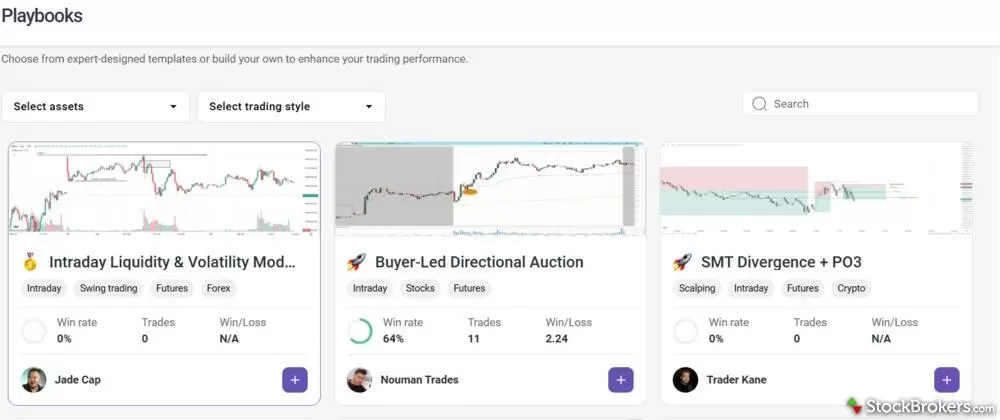
TradeZella's playbooks allow you to view other traders' strategies and see their success rates.
Trade replay and backtesting. Out of the TradeZella trading journal tools, I was most impressed by their trade replay and backtesting. You can slowly review and analyze your past trades on a chart, making notes about mistakes and ideas along the way. You can also create hypothetical strategies to backtest how they would have performed under historical market conditions. It’s a nice additional level of analysis not found in other trading journals.
Overall, I really liked TradeZella, but it’s just a shame you can’t try it without paying upfront. There is no free version or trial.
4. Stonk Journal – Best free trading journal
Stonk Journal is a completely free trading journal. They are powered solely by user donations and don’t offer paid subscriptions. For a free tool, I was pleasantly surprised at what was offered. It took 15 seconds to register with my name and email.
- Supports: Stocks, options, forex, futures, crypto
- Free version: Yes
- Pricing: Donation-supported
- Mobile apps: No
User experience. When I logged in, I was impressed by Stonk Journal’s clean, sleek interface. While some other free trade journals are little more than an Excel spreadsheet, Stonk Journal offers a nice design and some actual analysis. I was able to quickly jot down notes about trading sessions and keep them organized.
Basic trade analysis. As soon as I uploaded my trades, the Stonk Journal platform provided some instant analysis about my performance. For example, it showed my average win hold time versus average loss hold time, and that I tended to exit my winners sooner than my losers. I might have been holding on to unprofitable trades too long, trying to make my money back.
Now, you don’t get a ton of insight. It’s not like the top-paid trading journals, which go much deeper into your performance, including some that offer AI-generated insights. But for Stonk Journal’s free price tag, I thought it was fair.
Slow trade uploads. I did find it very frustrating that I had to upload my trades one at a time. There was no way to upload a spreadsheet of past trades, and there was definitely no option to auto-sync with a brokerage account. That could be a real hassle if you want to log many trades from your daily sessions.
5. Trademetria – Best for affordability and user-friendly design
Trademetria is a little more low-frills than some of the other trading journals, but it makes up for it in terms of affordability and ease of use.
- Supports: Stocks, options, forex, futures, cryptocurrency, and CFDs (contracts for difference)
- Free version: Yes
- Pricing: Free, Basic ($19.95/mo), Pro ($29.95/mo)
- Mobile apps: No
User-friendly platform. Trademetria’s design is clean and presents data efficiently. While the default view starts off basic, I found it easy to customize my dashboard with reports and widgets, such as an economic calendar and a scrolling ticker. From there, I could quickly start seeing data and insights about my past trades.
Affordable. Trademetria stood out as a decent trading journal for those who want more analysis and functionality than a completely free Stonk Journal, but didn’t want to pay the higher prices of the other top options.
Trademetria’s most expensive Pro plan was about what you’d pay for the cheapest plans at other top options like TraderSync and TradeZella, while the Basic plan offered a decent list of tools at an even lower price. Just note that with a Basic plan, you’ll have to manually upload all your trades. Only Trademetria’s Pro plan offers auto-sync.
Reasonable analysis. I found that at its bargain price point, Trademetria still offered decent analysis for a trading journal. It even included a basic AI analytics tool, though not nearly as powerful as TraderSync.
Bonus pick: Build your own trading journal using Excel
Online trading journals are convenient because they have most of the features traders could ever want. But, if you’re comfortable with Excel, you can easily create a trading journal of your own.
To get you started, here’s a free trading journal excel spreadsheet template to use, which includes all of the basics alongside a handful of advanced data points. Check out our full guide to using this Excel stock journal template to help get you started.
- Supports: Anything and everything
- Free version: Yes
- Pricing: Free, minus the cost of Microsoft Excel
Trading journal pricing comparison
Here's a summary of the pricing for the best trading journals.
| Company | Overall | Free version | Monthly Pricing | Annual Pricing |
 Tradervue Tradervue
|
|
Yes | $29.95/month | $323.46/year |
 TraderSync TraderSync
|
|
No | $29.95/mo | $312.60/yr |
 TradeZella TradeZella
|
|
No | Starts at $29.00 | Starts at $288.00 |
 Stonk Journal Stonk Journal
|
|
Yes | Free | Free |
 Trademetria Trademetria
|
|
Yes | $29.95/mo | $169.00/yr |
Free trading journal comparison
Here's a comparison of the best trading journals that offer a free version.
| Company | Overall | Free version | Free version limitations |
|---|---|---|---|
| Tradervue | Best trading journal | Yes | 30 stock trades/month |
| Stonk Journal | Best free trading journal | Yes | No auto-sync, no AI-generated insights |
| Trademetria | Best for affordability and user-friendly design | Yes | No auto-sync, no AI analytics |
StockBrokers.com Review Methodology
Why you should trust us
David Rodeck, a contributing writer for StockBrokers.com, has over a decade of writing experience specializing in investing, trading, and retirement planning. Before becoming a full-time writer, David was a financial advisor and passed the Series 6 and CFP exams. He has written for AARP, Kiplinger Magazine, Forbes Advisor, and Investopedia.
Blain Reinkensmeyer, co-founder of StockBrokers.com, has been investing and trading for over 25 years. After having placed over 2,000 trades in his late teens and early 20s, he became one of the first in digital media to review online brokerages. Today, Blain is widely respected as a leading expert on finance and investing, specifically the U.S. online brokerage industry. Blain has been quoted in The New York Times, The Wall Street Journal, Forbes, and Fast Company, among others. Blain created the original scoring rubrics for StockBrokers.com and oversees all testing and rating methodologies.
How we tested
- We used paid trading tool accounts for testing.
- We collected dozens of data points across the tools we review.
- We tested each tool’s website, desktop platforms, and mobile app, where applicable.
- We maintained strict editorial independence; trading tools cannot pay for a higher rating.
Our researchers thoroughly test a wide range of popular trading tools' features, such as trading journals and screeners, charting providers, and educational resources. We also evaluate the overall design of each tool’s mobile experience and look for a fluid user experience moving between mobile and desktop tools.
At StockBrokers.com, our reviewers use a variety of devices to evaluate trading tools. Our reviews and data collection are conducted using the following devices: iPhone SE running iOS 17.5.1, MacBook Pro M1 with 8 GB RAM running the current MacOS, and a Dell Vostro 5402 laptop i5 with 8 GB RAM running Windows 11 Pro.
Each trading tool was evaluated and scored across three key categories: Ease of Use, Features, and Cost. Learn more about how we test.
Trading tools tested in 2026
We tested 11 trading tools and service providers for stock traders in 2026:
Trading journal reviews
Read our Tradervue review and discover its powerful trade analysis tools, detailed reports, and active community for improving your investment strategies.
David Rodeck August 18, 2026
Track trades, analyze performance, and improve strategies with TradeZella. Read our full review to see if it's worth the cost.
David Rodeck July 01, 2026
Read our TraderSync review to see how this AI-powered trading journal helps track trades, spot patterns, and improve performance for active traders.
David Rodeck August 14, 2026Related guides

Discover the best free and paid stock screeners. Compare TradingView, Finviz, Yahoo Finance, and more to find the right tool for stock filtering and analysis.
Blain Reinkensmeyer September 14, 2026
Discover 20 top stock trading books, from investing classics like The Intelligent Investor to modern guides on analysis and trading strategies.
Sam Levine, CFA, CMT May 04, 2026
Download a free trading journal spreadsheet in Excel or Google Sheets to track profits, losses, and lessons learned. Build better trading habits today.
Blain Reinkensmeyer September 17, 2026
Start investing with ease. Explore the best beginner-friendly trading platforms with low fees, great education, and intuitive apps.
Jessica Inskip October 05, 2026More guides

Find the best penny stock brokers. Compare Fidelity, Firstrade, Schwab, E*TRADE, and TradeStation for OTC access, fees, and tools.
Jessica Inskip August 02, 2026
Discover the best stock brokers of 2026. Compare Schwab, Fidelity, Interactive Brokers, E*TRADE, and more to find the top trading platform for your needs.
Jessica Inskip August 06, 2026
Find the best rollover IRA accounts. Compare Fidelity, Schwab, and E*TRADE for easy transfers, low fees, and smart retirement investing tools.
Andrea Coombes May 15, 2026
Explore the best international brokers for U.S. investors. Compare Interactive Brokers, Charles Schwab, and Fidelity for global stock trading access.
Jessica Inskip May 22, 2026
Find the best brokerage for high-net-worth investors. Compare Fidelity, Schwab, Merrill, and more for premium services and tailored investment tools.
Jessica Inskip January 27, 2026
Discover the best brokers for trade execution. Compare Fidelity, Interactive Brokers, and more for price improvement, speed, and transparency.
Jessica Inskip October 12, 2026
Interactive Brokers and Fidelity lead our 2026 ranking of the best free stock trading platforms, tested on the true cost of $0 commissions and hidden fees.
Jessica Inskip September 02, 2026
Discover the best day trading platforms. Compare IBKR, Schwab, Fidelity, E*TRADE, and TradeStation for speed, tools, and margin rates.
Jessica Inskip October 05, 2026
Find top U.S. forex brokers. From tastyfx to OANDA, explore platforms with strong regulation, great tools, and user-friendly trading.
Steven Hatzakis May 29, 2026
We tested the best options trading platforms for 2026. Compare tastytrade, Fidelity, IBKR, E*TRADE & Schwab on tools, fees, and picks for beginners.
Jessica Inskip September 09, 2026
Find the top bank brokerages. From Merrill Edge to Ally, discover brokers that combine banking, investing, and rewards in one account.
Jessica Inskip April 16, 2026
Find the best crypto trading platform for 2026. We rank eToro, Fidelity, Interactive Brokers, Webull, and Robinhood on fees, security, and coin selection.
Steven Hatzakis May 27, 2026
Find the best IRA accounts. Compare Fidelity, Schwab, Merrill Edge, E*TRADE, & J.P. Morgan for retirement planning, fees, tools, and account flexibility.
Jessica Inskip March 31, 2026
Practice investing risk-free with the best paper trading platforms. Compare Webull, Schwab, Interactive Brokers, E*TRADE, and more.
Jessica Inskip July 24, 2026
Find the best Roth IRA accounts. Fidelity, Schwab, and E*TRADE lead with low fees, smart investing tools, and retirement planning support.
Andrea Coombes April 27, 2026
Start investing with ease. Explore the best beginner-friendly trading platforms with low fees, great education, and intuitive apps.
Jessica Inskip October 05, 2026
We tested the 5 best futures trading platforms of 2026. Compare commissions, margin rates, and tools for beginners and active traders. Find the right platform for you.
Jessica Inskip October 05, 2026About the Editorial Team
David Rodeck is a financial writer based in New York City. He specializes in making investing, trading, and retirement planning understandable. David’s work has appeared in AARP, Kiplinger, Forbes Advisor, and Investopedia. Before writing full-time, David was a financial advisor and passed the Series 6 and CFP exams.
Steven Hatzakis is the Global Director of Research for ForexBrokers.com. Steven previously served as an Editor for Finance Magnates, where he authored over 1,000 published articles about the online finance industry. Steven is an active fintech and crypto industry researcher and advises blockchain companies at the board level. Over the past 20 years, Steven has held numerous positions within the international forex markets, from writing to consulting to serving as a registered commodity futures representative.
Jeff Anberg is a Senior Editor at StockBrokers.com. Along with years of experience in media distribution at a global newsroom, Jeff has a versatile knowledge base encompassing the technology and financial markets. He is a long-time active investor and engages in research on emerging markets like cryptocurrency. Jeff holds a Bachelor’s Degree in English Literature with a minor in Philosophy from San Francisco State University.