 Charles Schwab
 Fidelity
 Interactive Brokers
 E*TRADE
 Webull
 TradeStation
 tastytrade
 eToro
eToro Trading 212
 Interactive Investor
 IG
IG Interactive Brokers
 XTB
XTB Hargreaves Lansdown
 Saxo
Saxo Charles Stanley Direct
 CIBC Investor's Edge
 Interactive Brokers
 Moomoo
 Questrade
 Qtrade
 TD Direct Investing
 Wealthsimple
 Finviz
 Stock Rover
 Seeking Alpha
 StockHero
 TipRanks
 TrendSpider
 Trade Ideas
 TraderSync
 TradingView
 Tradervue
 TradeZella
Stock Rover Review

Written by David Rodeck
Contributing Writer

Fact-checked by Joey Shadeck
Research Analyst

Edited by Hannah Smith
Staff Editor
David RodeckContributing Writer
David Rodeck is a financial writer based in New York City. He specializes in making investing, trading, and retirement planning understandable.

Stock Rover is an online investment research and portfolio analysis platform. It specializes in offering highly detailed reports on thousands of investments, along with one of the more powerful screeners on the market today.
As part of my review, I tested Stock Rover's screeners and portfolio analysis tools through multiple subscription tiers while reading multiple reports on my target investments. I was very impressed by the level of detail and analysis, but also found that it could be overwhelming at times for non-financial experts. The platform has grown noticeably more sophisticated since I last reviewed it in 2025, reflecting an apparent shift toward more professional investors.
-
Free version:
Yes -
Monthly Pricing:
Starts at $34.00/mo -
Annual Pricing:
Starts at $348.00/yr
| Ease of Use | |
| Features | |
| Cost |
Stock Rover pros and cons
PROS
- Excellent screener; over 800 criteria for filtering thousands of stocks, ETFs, mutual funds, and crypto.
- Most paid plans have a 14-day free trial. There is also a free version with restricted functionality.
- Trade and portfolio analysis tools include charting, dividend income forecasts, options support, and Monte Carlo simulations.
- Premium Plus includes research reports on thousands of stocks, while Ultimate and Ultimate Pro include fund reports.
- Stock Rover publishes weekly ideas for screener strategies and stock ratings.
CONS
- The platform has a learning curve due to all the information, research, and tools.
- Paid subscriptions are not cheap, with Premium starting at $34/month.
- Stock Rover provides global market and index data, but its in-depth stock research and screening remain focused on U.S. and Canadian securities.
Overall summary
| Feature |
 Stock Rover Stock Rover
|
|---|---|
| Overall |
|
| Features |
|
| Ease of Use |
|
| Cost |
|
| Free version | Yes |
| Monthly Pricing | Starts at $34.00/mo |
| Annual Pricing | Starts at $348.00/yr |
Cost and plans
Stock Rover costs will depend on your subscription level. The platform offers three paid options, each with a discount if you enroll for a year or two rather than monthly:
| Plan | Price (Monthly) | Price (Yearly) | Price (Two years) |
|---|---|---|---|
| Premium | $17.99 | $179.99 | $319.99 |
| Premium Plus | $27.99 | $279.99 | $479.99 |
| Ultimate | $99.99 | $948.99 | $1,656.99 |
| Ultimate Pro | $199.99 | $1,788.99 | $3,096.99 |
Stock Rover also offers a Free plan with limited capabilities. When you first enroll, you get a 14-day free trial period to test out all the plans. There were a couple of features I appreciated about the trial.
First, I didn’t need to provide my credit card information, which made the enrollment process a breeze. All I needed was my name and email. Second, the trial account lets you switch between all four account options, ranging from Free to Ultimate Pro. Only Ultimate Pro doesn't offer a 14-day free trial. I liked being able to flip back and forth to see which plan truly fit my style before I committed to a purchase.
Free plan
Stock Rover’s free plan lets you track the performance of your portfolio. On the dashboard, you can view price charts, market news, and comparisons against the broader market. You can also access more detailed information about specific stocks and funds, including news, financial data, analyst ratings, and performance compared to similar peers.
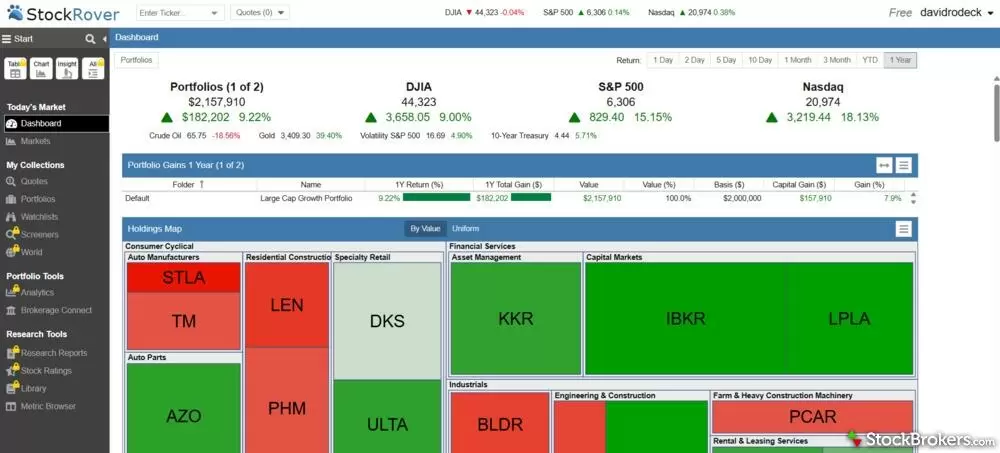
With a free subscription to Stock Rover you can easily view your portfolio to track pricing and the broader market.
With a free account, you have limited access to Stock Rover’s charting tool. Additionally, you can’t use Stock Rover’s screener or other portfolio analysis tools. The free plan also has ads.
If you’re looking to collect ongoing market news and financial data, the free plan could be a nice option, but it doesn’t offer much for hands-on portfolio research.
Premium
The Premium subscription opens up access to Stock Rover’s investment research tools. First, you can use the screener with over 400 metrics and five years of data.
You can also access Stock Rover’s portfolio analysis and research tools, including correlation analysis of investments in your portfolio, dividend income predictions, suggestions for portfolio rebalancing, and Monte Carlo Simulations.
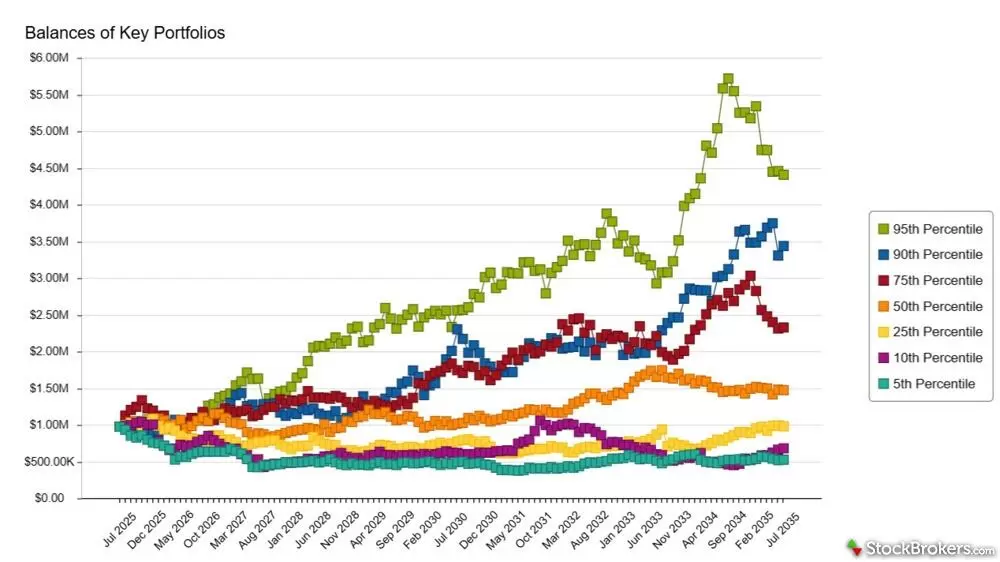
With Stock Rover's Premium plan you can conduct Monte Carlo Simulations to view the probability of different investment outcomes.
I found these tools helpful, especially for a larger portfolio with many investments. For example, the correlation analysis identified several stocks that were highly correlated, meaning their historical prices followed very similar patterns. Two had a score of 0.82 over the past three months, close to the maximum of 1 for perfect correlation. That potentially created unnecessary volatility in my portfolio, which could be mitigated through increased diversification.
The Premium plan doesn't include any of Stock Rover’s detailed investment reports. It’s a better fit for DIY investors willing to put in the research themselves.
Premium Plus
The Premium Plus plan nearly doubles the screener metrics available, going up to 700 and 10 years of fundamentals for historical data.
These criteria bring in more professional advice and feedback. For example, you can screen based on analyst ratings and predictions, such as a minimum number of analysts who give a stock a Strong Buy rating.
With the Premium Plus subscription, you can write in a goal or target equation, and the platform suggests screeners. For example, I started writing in “1 month return versus industry”, and it gave me ideas. I thought this would help if I had a strategy in mind, but I wasn’t quite sure what screener was appropriate.
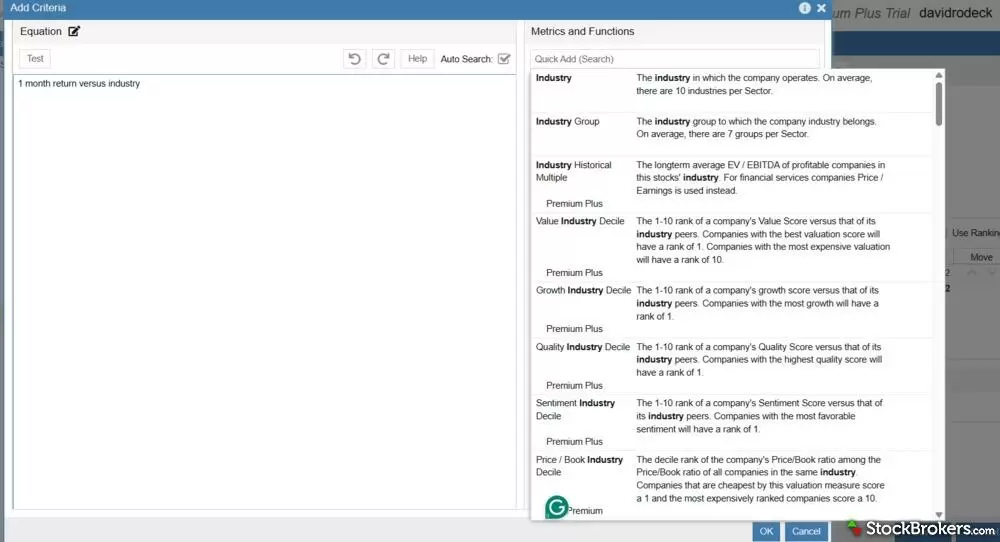
Stock Rover's equation screener lets you enter in an equation and get results on possible investment ideas.
The Premium Plus plan also includes Stock Rover’s research reports on over 7,000 stocks. When I tested in 2025, you had to buy a separate subscription to get access to the reports. I have mixed feelings about this change. I found the reports included tons of valuable information, but if I wanted to use Stock Rover’s excellent screener at full capacity, I’d be annoyed having to cover the higher monthly subscription to pay for the reports too.
Ultimate
The Ultimate plan unlocks nearly all of Stock Rover's capabilities. It includes over 800 metrics that can span over 20 years of fundamental historical data. It also includes reports for ETFs and mutual funds, on top of individual stocks.
The scale is where Ultimate stands out. You can run up to 120 screeners at once. I actually ran into a usability headache while testing because I built up so many screeners under Ultimate that when I switched back to a lower-cost plan, I had to delete some before Stock Rover would let me add more screens. A long-term subscriber probably wouldn’t run into this issue, but it’s worth keeping in mind if you spend significant time building out a higher-tier account and later decide to downgrade.
Ultimate also adds dedicated options tools. You can pull up an options chain for a stock to compare contracts across different expiration dates, chart individual contracts, and track options within your portfolio. This adds another layer of research for investors who trade options.
Ultimate Plus
Stock Rover designed Ultimate Plus for professional investors and wealth advisors. It builds on Ultimate's capabilities by adding even higher limits, including the option to run over 300 screeners with 5000 rows across 30 brokerages at once.
As an individual trader, I felt I had more than enough with Ultimate, but I could see how if I were managing accounts for multiple clients, that extra firepower would be worth it.
Features
Stock Rover packs a ton of information and investment research tools into its platform. While it’s primarily known for its screener, you also receive many other valuable features depending on your subscription tier.
Screener
Stock Rover’s screener is available for all paid subscriptions. The more expensive the plan, the more criteria you have available.
I was impressed with the sheer volume of possible screeners. I also liked how Stock Rover gave clear definitions for each one, including examples of possible ranges to target, such as 15.1% as a sample target range for a 5-year EPS Growth Estimate.
While I appreciated the volume of financial information, I found the screener a little clunky to use. For example, after creating a list of target investments, I set them up in a table format to view everything. From there, it puzzled me how to return to the screener itself to refine my search. Eventually, I was able to retrace my steps, but the troubleshooting took time.
If you want suggestions, Stock Rover has an Investor Library of prebuilt screeners with strategies such as Bargain Hunter, which targets mid- and large-cap stocks with show signs of growth at a reasonable price, or the Buffetology Screener, which filters using Warren Buffett’s long-time investing principles.
Stock Rover truly felt like the most powerful screener I’ve used, especially with the prebuilt strategies, but I also found it one of the most challenging to navigate. There’s just so much going on compared to a typical screener.
Portfolio analysis tools
You can sync your broker and existing portfolio directly to Stock Rover for analysis. I found the process quicker and easier than on other platforms; all I had to do was log in to my Robinhood account, and the real-time data was available.
I believe these tools provided valuable insights into my strategy. For example, I liked being able to forecast my future investment income, based on a target portfolio. I can see that coming in handy if I were trying to live off my investments, such as in retirement.
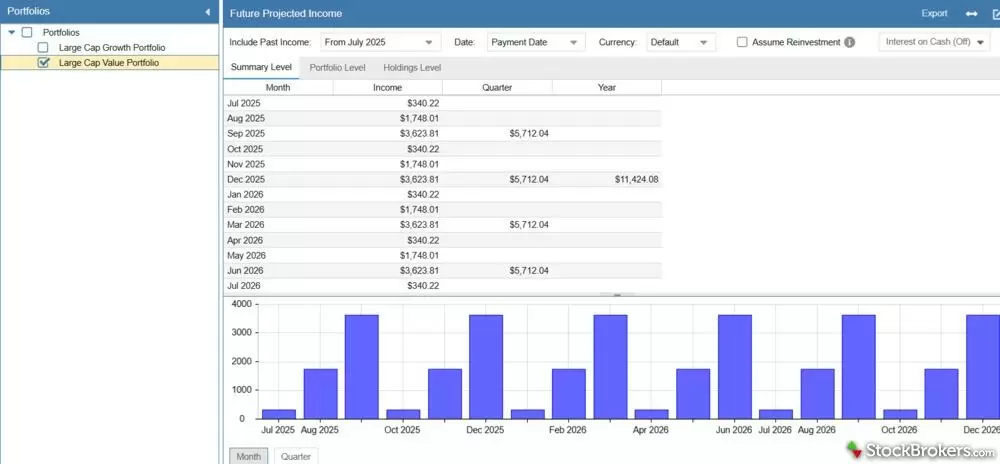
Stock Rover lets you calculate future projected incomes for value and growth.
Stock Rover also shows how your portfolio stacks up against the broader market. Once you build a portfolio or upload your current holdings, the platform gives you a detailed analysis comparing your performance with benchmarks such as the S&P 500 or Russell 2000. I liked being able to quickly see how my historical performance and risk compared with the broader market before putting a new portfolio into action.
Watchlists, alerts, and warningsYou can set up investment watchlists on your Stock Rover account, which will track performance, news, ratings, and other information about investments you have an eye on.
On each paid subscription plan you can also receive Investor Warnings about each investment. This feature called my attention to factors I don’t usually consider when buying stocks. For example, one stock I was researching warned me that the Goodwill on the balance sheet was high, possibly from overpaying for recent acquisitions, and this could be a drag on future earnings.
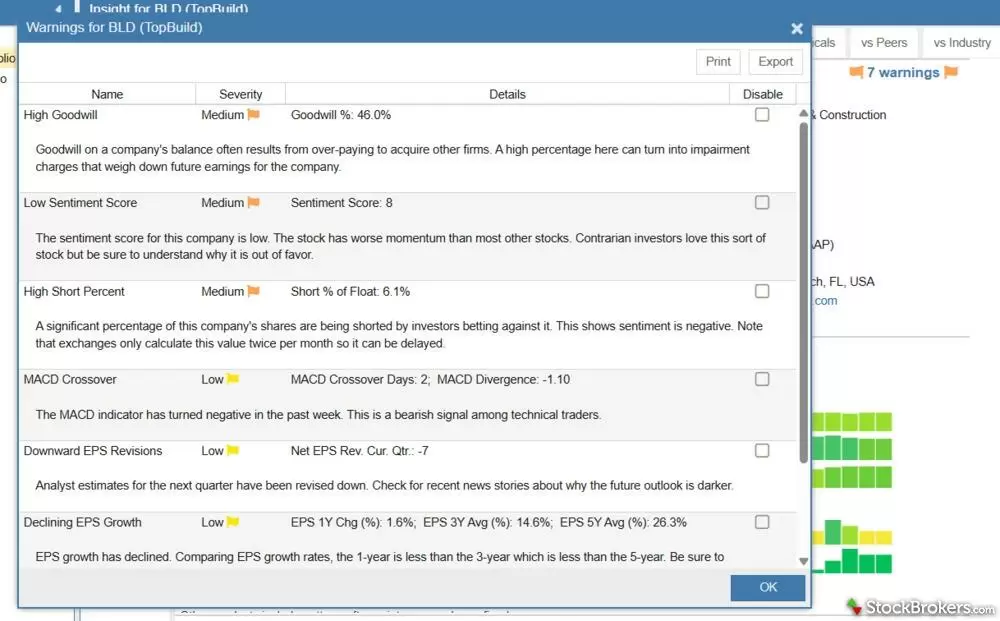
Stock Rover gives you warnings and explanations when an investment is low or high risk.
You can also set up text or email alerts when a target investment meets or falls below a specific criterion, such as a price change, volume, or dividend yield.
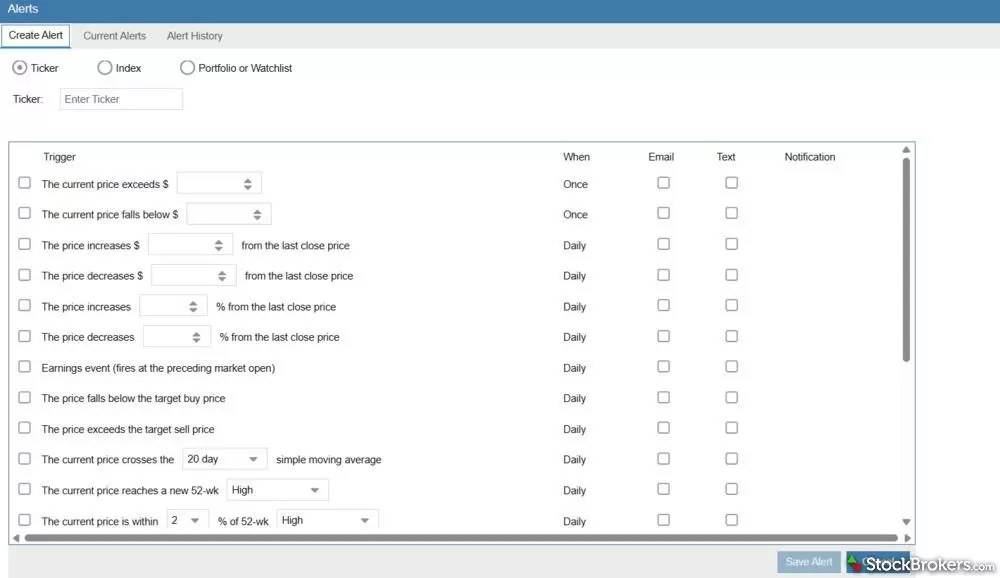
Stock Rover lets you set up email or text alerts for price increases or decreases.
Market news, stock ratings, and research reports
Stock Rover offers a wealth of information to users, including those on the free plan. The dashboard brings up market news and performance, and you can access the financial information for each stock and fund, along with ratings from Stock Rover itself.
I appreciated that Stock Rover provides weekly ideas for investors, including screeners that could be worth using.
For Premium Plus subscriptions and up, Stock Rover includes its Research Reports. These detailed, multi-page reports cover financials, valuation, risk, analyst consensus, and Stock Rover’s own ratings of an investment. I found them similar in depth and quality to Morningstar research. You’re paying more for Stock Rover than for a standalone Morningstar subscription, but you also get the screeners and portfolio analysis tools.
Charting
Stock Rover also provides charting, including a stripped-down version on the free account. The higher your tier, the more capabilities you can get.
The charts provided some interesting information. For example, I appreciated being able to plot the market price of a stock relative to its earnings per share, a type of fundamental analysis that can indicate whether an investment is under- or overvalued.
I also liked being able to add both benchmarks and screens to my charts to compare their performance against individual investments. In 2026, Stock Rover also added the ability to plot analyst ratings directly on charts, providing another layer of context. Overall, I thought the charting tool was effective and coordinated well with Stock Rover’s other research features.
Ease of use
Stock Rover does have a learning curve for new users. There’s a lot of information and different features to sort through, and moving from section to section didn’t always feel intuitive to me.
For example, the screen would get crowded at times with all the different information from the screener tables, charts, insights, and my portfolios. There were multiple times during my Stock Rover review where I felt lost and couldn’t figure out how to retrace my steps.
I would find a prebuilt screener that looked appealing, but after clicking around for more information, I sometimes struggled to find my way back to it. Other tools were easier to use, such as charting and portfolio analysis, while the research reports were simple to pull up.
While Stock Rover has training videos, it would be nice if it provided more on-screen guidance within the platform itself.
Premium and Premium Plus subscribers get email support, while Ultimate and Ultimate Pro subscribers also get phone support. Stock Rover is challenging enough for beginners that I can see that phone support being useful. I don’t usually feel like I need a demo to figure out an investment platform for a review, but Stock Rover was challenging enough that I would have appreciated one.
Final thoughts
Is Stock Rover worth it?
Stock Rover provides a ton of information and deep research capabilities, especially with its screener. However, the platform is not cheap and comes with a challenging learning curve. Stock Rover is targeting serious investors and professionals, and for those who want one of the most powerful screeners on the market, plus detailed research reports and portfolio analysis tools, it can be worth the cost.
Alternatives to Stock Rover
For an alternative, Finviz is also a powerful screener, and the platform is more visually pleasing and easier to learn. At $39.50 per month, its cost is comparable to Stock Rover’s Premium plan which doesn't include the reports. On the other hand, if you just want the basics, Yahoo Finance and TradingView both offer decent screeners for free, though with fewer metrics than Stock Rover.
FAQs
Who is Stock Rover best for?
Stock Rover is best for more experienced investors familiar with using screeners and portfolio analysis tools. They are better equipped to navigate all the tools and detailed financial information provided by Stock Rover. Beginner investors might find the platform overwhelming.
Is Stock Rover free?
Stock Rover offers a free plan with limited features, such as basic charting and market news. The free plan does not include the screener or the portfolio analysis tools. Stock Rover also offers a 14-day free trial to test out the paid plans.
How does Stock Rover compare to Seeking Alpha?
In a Stock Rover vs. Seeking Alpha comparison, the two platforms serve different research styles. While Stock Rover is built for investors who want to run their own analysis using screeners, portfolio tools, and financial data, Seeking Alpha centers more on written analysis and proprietary research, including first-hand insights from the investment experts who contribute to its publication, its Quant Ratings, and an active community of investors who share ideas.
The are also pricing differences between the two. Stock Rover charges by tier, from a free plan up to Ultimate Pro, with its screener and portfolio analysis included on paid plans. Seeking Alpha's Premium plan renews at $299 per year and focuses on research reports, ratings, and article access rather than screening and portfolio construction.
| Stock Rover | Seeking Alpha | |
|---|---|---|
| Entry price (paid) | Premium at $17.99/month | Premium at $299/year |
| Free plan | Yes, limited features | Yes, limited articles |
| Stock screener | Up to 800+ metrics on paid plans | Screening with Quant Ratings |
| Portfolio analysis | Correlation, rebalancing, Monte Carlo | Portfolio alerts and holdings ratings |
| Research reports | Included on Premium Plus and up | Analyst articles and Quant reports |
| Main draw | Screening and portfolio tools | Analyst research and community |
Stock Rover is best for
- Investors who want to screen and filter thousands of securities themselves.
- Users who want portfolio analysis tools such as correlation and rebalancing.
- DIY investors comfortable doing their own research.
Seeking Alpha is best for
- Investors who want written analysis and analyst opinion.
- Users who value a community sharing investment ideas.
- Readers who want proprietary ratings alongside research articles.
Does Stock Rover have a mobile app?
Stock Rover doesn' have a native app. Instead, you access it through your mobile browser, where it offers a mobile experience built for phones and a full desktop experience that also runs on tablets and phones. The mobile experience covers your dashboard, ticker search, and core research, and lets you view and edit portfolios, watchlists, and screeners. The desktop experience gives you the full tool set, though it isn't optimized for smaller phone screens.
What brokers can you connect Stock Rover to?
Stock Rover connects to over 1,000 brokers, including:
- Ally Invest
- Charles Schwab
- Citi Self Invest
- eToro
- E*TRADE
- Fidelity
- Interactive Brokers
- J.P. Morgan Self-Directed Investing
- Merrill Edge
- Public.com
- Robinhood
- tastytrade
- TradeStation
- Wealthsimple
Through the platform, you can search for your brokerage. It will tell you if and how to connect.
StockBrokers.com Review Methodology
Why you should trust us
David Rodeck, a contributing writer for StockBrokers.com, has over a decade of writing experience specializing in investing, trading, and retirement planning. Before becoming a full-time writer, David was a financial advisor and passed the Series 6 and CFP exams. He has written for AARP, Kiplinger Magazine, Forbes Advisor, and Investopedia.
Blain Reinkensmeyer, co-founder of StockBrokers.com, has been investing and trading for over 25 years. After having placed over 2,000 trades in his late teens and early 20s, he became one of the first in digital media to review online brokerages. Today, Blain is widely respected as a leading expert on finance and investing, specifically the U.S. online brokerage industry. Blain has been quoted in The New York Times, The Wall Street Journal, Forbes, and Fast Company, among others. Blain created the original scoring rubrics for StockBrokers.com and oversees all testing and rating methodologies.
How we tested
- We used paid trading tool accounts for testing.
- We collected dozens of data points across the tools we review.
- We tested each tool’s website, desktop platforms, and mobile app, where applicable.
- We maintained strict editorial independence; trading tools cannot pay for a higher rating.
Our researchers thoroughly test a wide range of popular trading tools' features, such as trading journals and screeners, charting providers, and educational resources. We also evaluate the overall design of each tool’s mobile experience and look for a fluid user experience moving between mobile and desktop tools.
At StockBrokers.com, our reviewers use a variety of devices to evaluate trading tools. Our reviews and data collection are conducted using the following devices: iPhone SE running iOS 17.5.1, MacBook Pro M1 with 8 GB RAM running the current MacOS, and a Dell Vostro 5402 laptop i5 with 8 GB RAM running Windows 11 Pro.
Each trading tool was evaluated and scored across three key categories: Ease of Use, Features, and Cost. Learn more about how we test.
Trading tools tested in 2026
We tested 11 trading tools and service providers for stock traders in 2026:
Read next
TipRanks uses AI and big data to rate stocks and spot ideas. Read our review to learn its pros, cons, pricing, and if it’s right for your portfolio.
David Rodeck May 15, 2026
Read our Seeking Alpha review covering stock ratings, screeners, portfolio tools, pricing, pros and cons, and how it compares for different investors.
David Rodeck August 26, 2026
TradingView has a free plan plus paid tiers from $14.95/mo. Our hands-on review covers pricing, charting, screeners, and whether TradingView is worth it in 2026.
David Rodeck August 19, 2026
Read our Finviz review and see how it delivers advanced filtering, interactive heat maps, and in-depth financial visualizations.
David Rodeck August 25, 2026Trading tool guides
Learn to trade stocks step by step: open a broker account, practice with a simulator, and place your first trade. A beginner's guide from a 25-year trader.
Blain Reinkensmeyer August 26, 2026
TradingView, StockCharts, and Yahoo Finance offer the best free stock charts. Compare features, fees, and free vs. paid tiers for the top 5 tools of 2026.
Blain Reinkensmeyer June 04, 2026
We tested the best trading journals of 2026. See why Tradervue tops our list, plus top picks for free journals, mobile apps, and every asset class.
David Rodeck August 25, 2026
Discover the best free and paid stock screeners. Compare TradingView, Finviz, Yahoo Finance, and more to find the right tool for stock filtering and analysis.
Blain Reinkensmeyer September 14, 2026
Download a free trading journal spreadsheet in Excel or Google Sheets to track profits, losses, and lessons learned. Build better trading habits today.
Blain Reinkensmeyer September 17, 2026
Compare the best AI trading platforms, apps, and bots for 2026. We tested Trade Ideas, TrendSpider, and more to find the top AI stock trading tools for every type of investor.
Steven Hatzakis August 12, 2026Other guides
Explore the best international brokers for U.S. investors. Compare Interactive Brokers, Charles Schwab, and Fidelity for global stock trading access.
Jessica Inskip May 22, 2026
Find the best Roth IRA accounts. Fidelity, Schwab, and E*TRADE lead with low fees, smart investing tools, and retirement planning support.
Andrea Coombes April 27, 2026
Find the best brokerage for high-net-worth investors. Compare Fidelity, Schwab, Merrill, and more for premium services and tailored investment tools.
Jessica Inskip January 27, 2026
We tested the best options trading platforms for 2026. Compare tastytrade, Fidelity, IBKR, E*TRADE & Schwab on tools, fees, and picks for beginners.
Jessica Inskip September 09, 2026
Discover the best day trading platforms. Compare IBKR, Schwab, Fidelity, E*TRADE, and TradeStation for speed, tools, and margin rates.
Jessica Inskip August 03, 2026
Practice investing risk-free with the best paper trading platforms. Compare Webull, Schwab, Interactive Brokers, E*TRADE, and more.
Jessica Inskip July 24, 2026
Discover the best brokers for trade execution. Compare Fidelity, Interactive Brokers, and more for price improvement, speed, and transparency.
Jessica Inskip May 22, 2026
Find the top bank brokerages. From Merrill Edge to Ally, discover brokers that combine banking, investing, and rewards in one account.
Jessica Inskip April 16, 2026
Start investing with ease. Explore the best beginner-friendly trading platforms with low fees, great education, and intuitive apps.
Jessica Inskip August 06, 2026
Find the best IRA accounts. Compare Fidelity, Schwab, Merrill Edge, E*TRADE, & J.P. Morgan for retirement planning, fees, tools, and account flexibility.
Jessica Inskip March 31, 2026
Find the best rollover IRA accounts. Compare Fidelity, Schwab, and E*TRADE for easy transfers, low fees, and smart retirement investing tools.
Andrea Coombes May 15, 2026
Find the best penny stock brokers. Compare Fidelity, Firstrade, Schwab, E*TRADE, and TradeStation for OTC access, fees, and tools.
Jessica Inskip August 02, 2026
Interactive Brokers and Fidelity lead our 2026 ranking of the best free stock trading platforms, tested on the true cost of $0 commissions and hidden fees.
Jessica Inskip September 02, 2026
We tested the 5 best futures trading platforms of 2026. Compare commissions, margin rates, and tools for beginners and active traders. Find the right platform for you.
Jessica Inskip September 17, 2026
Discover the best stock brokers of 2026. Compare Schwab, Fidelity, Interactive Brokers, E*TRADE, and more to find the top trading platform for your needs.
Jessica Inskip August 06, 2026
Find top U.S. forex brokers. From tastyfx to OANDA, explore platforms with strong regulation, great tools, and user-friendly trading.
Steven Hatzakis May 29, 2026
Find the best crypto trading platform for 2026. We rank eToro, Fidelity, Interactive Brokers, Webull, and Robinhood on fees, security, and coin selection.
Steven Hatzakis May 27, 2026About the Editorial Team
David Rodeck is a financial writer based in New York City. He specializes in making investing, trading, and retirement planning understandable. David’s work has appeared in AARP, Kiplinger, Forbes Advisor, and Investopedia. Before writing full-time, David was a financial advisor and passed the Series 6 and CFP exams.
Joey Shadeck is the Content Strategist and Research Analyst for StockBrokers.com. He holds dual degrees in Finance and Marketing from Oakland University, and has been an active trader and investor for close to 10 years. An industry veteran, Joey obtains and verifies data, conducts research, and analyzes and validates our content.
Hannah Smith is a Staff Editor at StockBrokers.com. With a background in SEO and years of experience in digital media, Hannah is focused on creating high-quality, data-driven content that helps investors make informed decisions. With a master's degree in English from North Carolina State University, she brings a strong foundation in writing, research, and editorial strategy to her work.