 Charles Schwab
 Fidelity
 Interactive Brokers
 E*TRADE
 Webull
 TradeStation
 tastytrade
 eToro
eToro Trading 212
 Interactive Investor
 IG
IG Interactive Brokers
 XTB
XTB Hargreaves Lansdown
 Saxo
Saxo Charles Stanley Direct
 CIBC Investor's Edge
 Interactive Brokers
 Moomoo
 Questrade
 Qtrade
 TD Direct Investing
 Wealthsimple
 Finviz
 Stock Rover
 Seeking Alpha
 StockHero
 TipRanks
 TrendSpider
 Trade Ideas
 TraderSync
 TradingView
 Tradervue
 TradeZella
Webull vs Robinhood 2026

Written by Jessica Inskip
Director of Investor Research

Edited by Jeff Anberg
Senior Editor

Reviewed by Blain Reinkensmeyer
Managing Partner
Jessica InskipDirector of Investor Research
Jessica Inskip is Director of Investor Research at StockBrokers.com, bringing 15 years of experience in brokerage and trading strategy. Jessica focuses on investor education and brokerage industry research.


 Why you can trust us
Led by Jessica Inskip, Director of Investor Research, the StockBrokers.com research team collects thousands of data points across hundreds of variables. We evaluate features important to every kind of investor, including beginners, casual investors, passive investors, and active traders. We carefully track data on margin rates, trading costs, and fees to rate stock brokers across our proprietary testing categories.
Our researchers open personal brokerage accounts and test all available platforms on desktop, web, and mobile for each broker reviewed on StockBrokers.com. Learn more about how we test.
Webull vs Robinhood is a contest between two brokers built for the same person: the self-directed trader who wants a slick app and no commissions. The split comes down to temperament. Webull is the power tool, loaded with order-flow data, paper trading, and real charting depth for the active or technical trader. Robinhood is the calmer, simpler app, easier to learn and cheaper to borrow against. Both trade stocks, options, and crypto for $0, so the real question is how much screen you actually want in front of you.
I've spent more than 15 years in retail brokerage, and I ran both through the same hands-on tests. I built the same options spread on each, charted the same stock, and pushed identical trades through both order tickets. Read on for my in-depth testing and comparison of each broker.
Webull vs Robinhood
- Minimum Deposit: $0.00
- Stock Trades: $0.00
- Options (Per Contract): $0.00
Webull has evolved past its origins as a low-cost disruptor, solidifying its position as a sophisticated hub for active market participants. It offers a great mobile experience and a fantastic paper trading platform that offers a perfect sandbox to test strategies without risking capital. With AI-powered summaries that slice through market noise and industry-leading paper trading tools for testing strategies, Webull presents a compelling choice for traders. Read full review
- Zero commissions for options contracts.
- Crypto trading has been reintegrated into the main app.
- Phenomenal, award-winning paper trading platform.
- Lack of account types like Inherited IRAs, Trust accounts, and custodial accounts.
- Constructing multi-leg options strategies can feel cumbersome.
- Education is often disorganized and can be confusing for beginners.
- Minimum Deposit: $0.00
- Stock Trades: $0.00
- Options (Per Contract): $0.00
Robinhood is best known for its commission-free trading, modern mobile and desktop platforms, and low-cost access to options, margin, and futures trading. Read full review
- Robinhood Legend offers 90+ technical indicators.
- 3% IRA match on contributions.
- The Investor's Guild explains complex topics.
- Futures trading and 24-hour trading.
- No economic calendars, sector heat maps, or Treasury yield curves.
- No deep fundamental research.
- Legend lacks critical tools.
- No mutual funds, individual bonds, custodial or trust accounts.
Robinhood vs Webull at a glance
Our testing put these two closer than almost any pair we review, separated by a single spot in the rankings. Robinhood takes the edge on ease of use and polish, while Webull answers with deeper data, more tools, and a wider tradeable lineup. The table lays out the category splits.
| Feature |
 Webull Webull
|
 Robinhood Robinhood
|
|---|---|---|
| Overall |
|
|
| Mobile Trading Apps |
|
|
| Advanced Trading |
|
|
| Minimum Deposit | $0.00 | $0.00 |
| Stock Trades | $0.00 | $0.00 |
| Options (Per Contract) | $0.00 | $0.00 |
| Futures Trading | Yes | Yes |
| Crypto Trading | Yes | Yes |
Top takeaways for Webull in 2026
- The order-flow analytics are the real standout, with position-cost distribution and large-order tracking that Robinhood doesn't attempt.
- Webull won our #1 Paper Trading award, so you can practice with virtual money before risking real cash.
- It carries more to trade, with 50 cryptocurrencies plus bonds and forex that Robinhood doesn't offer.
- Active trader essentials are here too: Level 2 quotes, conditional orders, and short selling.
- The weak spots are education, which is broad but hard to read, and an interface whose labeling can confuse you.
Top takeaways for Robinhood in 2026
- It's the simplest app in this matchup and the fastest to learn, which is why it scores a full star higher for ease of use.
- Borrowing is cheaper, with margin starting at 5.75% against Webull's flat 8.74%.
- Its investing education is the most readable of any broker I test, even without courses or calculators.
- The IRA match and a cash-back card add perks Webull doesn't offer.
- The trade-offs are real: no paper trading, no Level 2, no conditional orders, and thinner market data.
Robinhood vs Webull: fees and commissions
Stocks and options trade for $0 at both brokers, with no exercise or assignment fees either. We verified the rest of the pricing below, because that's where the small gaps live.
| Feature |
Webull
|
Robinhood
|
|---|---|---|
| Stock Trades | $0.00 | $0.00 |
| Mutual Fund Trade Fee | N/A | N/A |
| Options (Per Contract) | $0.00 | $0.00 |
| Options Exercise Fee | $0.00 | $0.00 |
| Options Assignment Fee | $0.00 | $0.00 |
| Futures (Per Contract) | $1.25 | $0.75 |
| Broker Assisted Trade Fee | N/A | N/A |
| Margin Rate Under $25,000 | 8.74% | 5.75% |
| Bond Trade Fee | .10% per bond | N/A |
| IRA Annual Fee | $0.00 | $0.00 |
| Account Transfer Out (Full) | $75.00 | $100.00 |
Where Robinhood wins on cost
Robinhood's margin starts at 5.75% and falls from there, while Webull charges a flat 8.74% no matter your balance. If you ever carry a margin position, that gap shows up every month. Robinhood is also cheaper on futures, at $0.75 per contract to Webull's $1.25.
Where Webull wins on cost
Moving your account out costs $75 at Webull against $100 at Robinhood, whether it's a partial or full transfer. More important, Webull lets you buy individual bonds and Treasuries, priced around a tenth of a percent per bond. Robinhood doesn't sell them at all, so there's no fee to compare because there's no product.
Verdict
Best for margin and futures traders: Robinhood.
Best for a cheaper exit and bond access: Webull.
For the stock-and-options trader, this is a wash. Both are free where it counts. The fee picture only tilts once you borrow, trade futures, or want to hold bonds.
Webull vs Robinhood: range of investments
Both brokers cover the modern basics and skip the old-school ones. You get stocks, ETFs, options, crypto, futures, fractional shares, IPO access, and prediction markets at each. Neither sells mutual funds, and neither opens a 529, custodial, or business account.
| Feature |
Webull
|
Robinhood
|
|---|---|---|
| Options Trading | Yes | Yes |
| Fractional Shares (Stocks) | Yes | Yes |
| Fractional Shares (ETFs) | Yes | Yes |
| Mutual Funds | No | No |
| Fixed Income (Treasurys) | Yes | No |
| Fixed Income (Corporate Bonds) | Yes | No |
| Fixed Income (Municipal Bonds) | No | No |
| Crypto Trading | Yes | Yes |
| Crypto Trading - Total Coins | 50 | 22 |
| Futures Trading | Yes | Yes |
| Futures Options | No | No |
| Forex Trading | Yes | No |
| Prediction markets | Yes | Yes |
| IPO Access | Yes | Yes |
| Order Type - After Hours | Yes | Yes |
| Order Type - 24 hr Extended | No | Yes |
| Order Type - Broker Assisted | No | No |
Where Webull wins
Webull simply has more to trade. Webull lists 50 cryptocurrencies to Robinhood's 22, and it adds two asset classes Robinhood doesn't carry at all: individual bonds, including Treasuries and corporates with a real bond screener, and forex. For a trader who wants one app to reach across more of the market, Webull is the broader tent.
Where Robinhood wins
Robinhood's strengths are in its retirement details and the small perks. Robinhood offers inherited IRAs and limited margin inside an IRA, neither of which Webull supports, and its robo-advisor runs cheaper at 0.25% a year against Webull's 0.43%. It also pairs investing with an IRA match and a cash-back card. On prediction markets, both brokers offer them, but Robinhood took our #1 award in the category.
Verdict
Best for the widest tradeable lineup: Webull.
Best for retirement perks and a cleaner account experience: Robinhood.
If you want bonds, forex, or a deep crypto bench, Webull is the only one that delivers. If your priorities are IRA flexibility and a cheaper robo, Robinhood edges ahead.
Featured Offers
Robinhood vs Webull: mobile apps
This is where each broker shows its personality. Both are app-first companies, but they design for opposite users. Robinhood strips everything down. Webull packs the screen with data. Our testing compared navigation, charting, and the depth of market information on each.
| Feature |
Webull
|
Robinhood
|
|---|---|---|
| iPhone App | Yes | Yes |
| Android App | Yes | Yes |
| Apple Watch App | Yes | Yes |
| Stock Alerts | Yes | Yes |
| Mobile Watchlists - Column Customization | No | Yes |
| Mobile Watchlists - Create & Manage | Yes | Yes |
| Mobile Watchlists - Column Filtering | Yes | Yes |
Where Robinhood's app wins
You can open Robinhood, find a stock, and place a trade without ever wondering what a button means. The options chain is clean, the AI digests give you a quick read on why a stock is moving, and recurring buys run in the background. For someone who checks in a few times a week, nothing here gets in the way.

Robinhood’s mobile options chain features a clean, simplified layout, with percent breakeven shown by default for each contract. While this may appeal to short-term traders, it lacks key metrics, like the Greeks or probability of profit, that serious options traders often rely on. It’s a sleek experience, but one that leans more toward speculation than in-depth strategy analysis.
Where Webull's app wins
Webull surfaces order-flow distribution, position-cost data, Level 2 quotes, and options statistics right on the phone, plus an AI summary that actually explained why volume was hitting the bid on a stock that was up. Charting is deep, with more than 55 indicators and a replay mode that time-lapses a chart. It earns its higher mobile rating on sheer capability.

Webull’s mobile app blends social media with investing, and the “Most Popular” feed is a perfect example. You can quickly see which stocks are being talked about most, along with real comments from individual investors. It’s a unique way to tap into market sentiment and stay connected to what the Webull community is watching.
Verdict
Best for new and casual investors: Robinhood.
Best for technical and data-driven traders: Webull.
Neither app is the place for a multi-leg options trade. Both bury the per-leg detail I want. For everything else, the choice is calm versus data.
Webull vs Robinhood: trading platforms and tools
Webull gives you a downloadable desktop platform plus its web trader. Robinhood gives you its website and Robinhood Legend, a browser-based active-trader platform. Both stop short of true pro depth, since neither offers backtesting, and they make very different trade-offs on what they do include.
| Feature |
Webull
|
Robinhood
|
|---|---|---|
| Active Trading Platform | N/A | Robinhood Legend |
| Desktop Trading Platform | Yes | No |
| Web Trading Platform | Yes | Yes |
| Desktop Platform (Mac) | Yes | No |
| Paper Trading | Yes | No |
| Watchlists - Total Fields | 35 | 34 |
| Charting - Indicators / Studies | 52 | 90 |
| Charting - Drawing Tools | 19 | 26 |
| Charting - Adjust Trades on Chart | Yes | Yes |
| Charting - Custom Studies | Yes | No |
| Ladder Trading | Yes | Yes |
| Level 2 Quotes - Stocks | Yes | Yes |
| Trade Hot Keys | Yes | Yes |
| Trade Ticket - Margin Impact | No | Yes |
| Trade Ticket - Tax Lot Selection | No | Yes |
Where Webull wins
Webull brings the things an active trader reaches for and Robinhood skips entirely: paper trading to rehearse a strategy, Level 2 quotes, conditional orders like OCO and OTO, and short selling. Its order-flow analytics and options statistics go deeper than anything on Legend, and there's even a net Greeks tool. You can write custom indicators if you know how to code, which almost no app-first broker allows.

Webull’s trading platform brings everything together in one clean, customizable view, perfect for making fast, informed decisions. Here, with AAPL selected, you can see a real-time chart, a pre-filled limit order ticket, and a detailed quote panel that includes analyst ratings and sentiment breakdowns.
Where Robinhood wins
Robinhood provides a superior charting experience. Legend is cleaner to set up than Webull's busier layout, and it carries more charting studies, 90 to Webull's 52. My drawn levels locked onto exact prices, and the whole thing felt lighter to move around. It does less, but what it does is smooth.
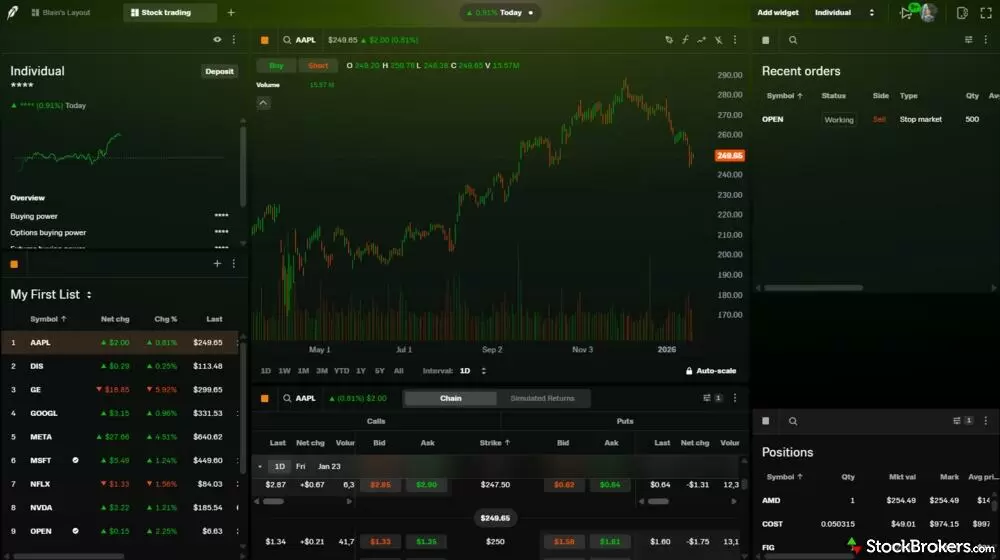
Robinhood Legend is arguably one of the best-looking active trading platforms on the market, with a sleek, modern interface that’s a pleasure to use. However, that clean design comes with trade-offs: some advanced tools and features are missing compared to more robust platforms. It’s a great experience for visual clarity and ease of use, but power traders may find themselves wanting more.
Verdict
Best for active traders who need real tools: Webull.
Best for chart-focused traders who want it clean: Robinhood.
If paper trading, Level 2, conditional orders, or short selling matter to you, only Webull has them. If you mostly want to read a chart without clutter, Legend is the nicer canvas.
Robinhood vs Webull: research
Both keep their research light compared with a full-service broker, but they lean opposite directions. Webull buries you in data. Robinhood hands you readable commentary and not much else. We checked each one feature by feature below.
| Feature |
Webull
|
Robinhood
|
|---|---|---|
| Research - Stocks | Yes | Yes |
| Screener - Stocks | Yes | Yes |
| Research - ETFs | Yes | Yes |
| Screener - ETFs | No | No |
| Research - Mutual Funds | No | No |
| Screener - Mutual Funds | No | No |
| Research - Fixed Income | No | No |
| Screener - Fixed Income | No | No |
| Research - Pink Sheets / OTCBB | Yes | Yes |
| Options Chains - IV | Yes | Yes |
| Option Chains - Total Greeks | 5 | 5 |
| Strategy Net Greeks | Yes | No |
| Options - Strategy Builder | Yes | Yes |
Where Webull wins
Webull gives you mountains of data, and a real market dashboard. Webull's order-flow tools, including position-cost distribution, are unmatched in this pair. It also runs a full economic calendar with earnings, dividends, and Fed events, shows sector performance and advance-decline data, and stacks financial statements and SEC filings on every quote. The yield-curve view, which plots Treasuries against investment-grade and high-yield, is smarter than I expected from an app this young.
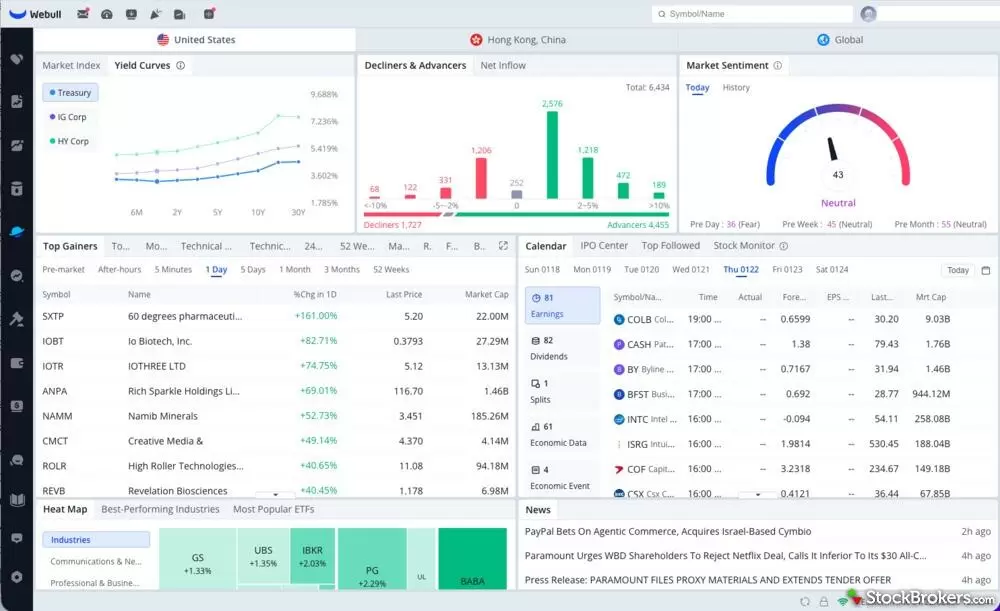
Webull’s Markets overview page is a great way to check in on the market, offering a comprehensive snapshot. It includes tabs for the US as well as international markets. For the US, traders can see major indices prices, yield curves, advance/decline flows, market sentiment, top gainers alongside other most popular lists, market calendars, heatmaps, news, and more.
Where Robinhood wins
Robinhood's in-house writing and its AI digests do a better job of telling you why something happened, where Webull mostly shows you what happened. If you want a quick, human read on the day rather than a wall of metrics, Robinhood is the easier place to get it.

Robinhood’s research tools present analyst ratings in a clean, visually appealing format, shown here with the buy, hold, and sell breakdown for Apple. The platform also includes concise “bulls vs. bears” commentary, giving investors a quick snapshot of both sides of the debate. While this type of data is common across brokerages, Robinhood’s design makes it especially easy to digest at a glance.
Verdict
Best for data and order-flow analysis: Webull.
Best for a readable take on the market: Robinhood.
The clearest divide is the calendar. Webull gives you a full economic calendar to plan around, and Robinhood still can't show you one.
Webull vs Robinhood: education
These two split on quality, not quantity. Both publish a lot, and neither offers formal courses or financial calculators. The difference is how the content reads. Robinhood's is the clearest writing in the business, ordered so a beginner moves from one idea to the next without getting lost, and its options material is a standout. Webull's library is just as broad, but I found article after article hard to follow, oddly sequenced, and thin on depth. Where Webull pulls ahead is practice rather than prose. It won our #1 Paper Trading award, and rehearsing real trades with virtual money is the most effective way to learn on its platform.
| Feature |
Webull
|
Robinhood
|
|---|---|---|
| Education (Stocks) | Yes | Yes |
| Education (ETFs) | Yes | Yes |
| Education (Options) | Yes | Yes |
| Education (Mutual Funds) | No | No |
| Education (Fixed Income) | Yes | Yes |
| Videos | Yes | Yes |
| Webinars | Yes | No |
Verdict
Best for reading and structured self-study: Robinhood.
Best for learning by doing: Webull.
If you learn by reading, Robinhood is the clear pick, and it isn't close on writing quality. If you learn by doing, Webull's paper-trading mode lets you practice a strategy before any money is on the line.
Webull and Robinhood: ease of use
This is the one category where the gap is a full star, and it captures the whole matchup. Robinhood is built on simplicity. You can open it for the first time and place a trade in under a minute, with almost nothing to decode. That streamlined experience is the entire point, and it's why so many first-time investors start there. Webull is powerful but busy. In my testing the labeling was often odd, some tabs led somewhere other than their name suggested, and acronyms showed up with no explanation. You can find everything you need, it just takes longer to learn where things live. The same depth that makes Webull strong for a day trader is what makes it heavier for a newcomer.
Verdict
Best for newcomers who want effortless: Robinhood.
Best for power users who will trade simplicity for capability: Webull.
Final thoughts: Robinhood vs Webull
- Minimum Deposit: $0.00
- Stock Trades: $0.00
- Options (Per Contract): $0.00
Webull has evolved past its origins as a low-cost disruptor, solidifying its position as a sophisticated hub for active market participants. It offers a great mobile experience and a fantastic paper trading platform that offers a perfect sandbox to test strategies without risking capital. With AI-powered summaries that slice through market noise and industry-leading paper trading tools for testing strategies, Webull presents a compelling choice for traders. Read full review
- Zero commissions for options contracts.
- Crypto trading has been reintegrated into the main app.
- Phenomenal, award-winning paper trading platform.
- Lack of account types like Inherited IRAs, Trust accounts, and custodial accounts.
- Constructing multi-leg options strategies can feel cumbersome.
- Education is often disorganized and can be confusing for beginners.
- Minimum Deposit: $0.00
- Stock Trades: $0.00
- Options (Per Contract): $0.00
Robinhood is best known for its commission-free trading, modern mobile and desktop platforms, and low-cost access to options, margin, and futures trading. Read full review
- Robinhood Legend offers 90+ technical indicators.
- 3% IRA match on contributions.
- The Investor's Guild explains complex topics.
- Futures trading and 24-hour trading.
- No economic calendars, sector heat maps, or Treasury yield curves.
- No deep fundamental research.
- Legend lacks critical tools.
- No mutual funds, individual bonds, custodial or trust accounts.
Webull is the one I'd hand to the active or technical trader. It edged Robinhood in our overall ranking on the strength of its order-flow data, its tradeable lineup, and paper trading, which earned our #1 Paper Trading award this year. If you chart seriously, watch order flow, want bonds or 50 coins of crypto, or just want to rehearse a strategy before risking real money, Webull gives you more to work with.
Robinhood is the better call for the everyday investor. It's simpler to use, cheaper to borrow against, and its education is the most readable in the business. It also took our #1 Prediction Markets award this year. If you want an app you can understand in a minute and you don't need Level 2 or paper trading, Robinhood is the easier home. These two finished one spot apart for a reason, so the honest deciding factor is how much complexity you actually want.
Jessica's take
"Webull's largest value is in understanding order flow, with so many great statistics centralized around it that it's really unmatched. Robinhood goes the other way. It's great for the beginner investor, simple and easy. One is built for data, the other for ease."
Jessica Inskip
Director of Investor Research
Overall verdict
Best for active and technical traders: Webull.
Best for everyday investors who want simplicity: Robinhood.
| Feature |
Webull
|
Robinhood
|
Category Winner |
|---|---|---|---|
| Overall |
|
|
Tie |
| Range of Investments |
|
|
Tie |
| Mobile Trading Apps |
|
|
Webull |
| Advanced Trading |
|
|
Tie |
| Research |
|
|
Webull |
| Education |
|
|
Robinhood |
| Ease of Use |
|
|
Robinhood |
Read next
Popular 1v1 comparisons
- Interactive Brokers vs TradeStation 2026
- Fidelity vs Robinhood in 2026
- Charles Schwab vs Interactive Brokers 2026
- Charles Schwab vs Fidelity 2026
- Fidelity vs J.P. Morgan Self-Directed Investing 2026
- E*TRADE vs Robinhood 2026
More trading guides
Discover the best day trading platforms. Compare IBKR, Schwab, Fidelity, E*TRADE, and TradeStation for speed, tools, and margin rates.
Jessica Inskip August 03, 2026
Find top U.S. forex brokers. From tastyfx to OANDA, explore platforms with strong regulation, great tools, and user-friendly trading.
Steven Hatzakis May 29, 2026
We tested the 5 best futures trading platforms of 2026. Compare commissions, margin rates, and tools for beginners and active traders. Find the right platform for you.
Jessica Inskip September 17, 2026
Discover the best brokers for trade execution. Compare Fidelity, Interactive Brokers, and more for price improvement, speed, and transparency.
Jessica Inskip May 22, 2026
Find the top bank brokerages. From Merrill Edge to Ally, discover brokers that combine banking, investing, and rewards in one account.
Jessica Inskip April 16, 2026
Discover the best stock brokers of 2026. Compare Schwab, Fidelity, Interactive Brokers, E*TRADE, and more to find the top trading platform for your needs.
Jessica Inskip August 06, 2026
Find the best IRA accounts. Compare Fidelity, Schwab, Merrill Edge, E*TRADE, & J.P. Morgan for retirement planning, fees, tools, and account flexibility.
Jessica Inskip March 31, 2026
We tested the best options trading platforms for 2026. Compare tastytrade, Fidelity, IBKR, E*TRADE & Schwab on tools, fees, and picks for beginners.
Jessica Inskip September 09, 2026
Explore the best international brokers for U.S. investors. Compare Interactive Brokers, Charles Schwab, and Fidelity for global stock trading access.
Jessica Inskip May 22, 2026
Find the best brokerage for high-net-worth investors. Compare Fidelity, Schwab, Merrill, and more for premium services and tailored investment tools.
Jessica Inskip January 27, 2026
Find the best Roth IRA accounts. Fidelity, Schwab, and E*TRADE lead with low fees, smart investing tools, and retirement planning support.
Andrea Coombes April 27, 2026
Find the best penny stock brokers. Compare Fidelity, Firstrade, Schwab, E*TRADE, and TradeStation for OTC access, fees, and tools.
Jessica Inskip August 02, 2026
Practice investing risk-free with the best paper trading platforms. Compare Webull, Schwab, Interactive Brokers, E*TRADE, and more.
Jessica Inskip July 24, 2026
Interactive Brokers and Fidelity lead our 2026 ranking of the best free stock trading platforms, tested on the true cost of $0 commissions and hidden fees.
Jessica Inskip September 02, 2026
Find the best rollover IRA accounts. Compare Fidelity, Schwab, and E*TRADE for easy transfers, low fees, and smart retirement investing tools.
Andrea Coombes May 15, 2026
Find the best crypto trading platform for 2026. We rank eToro, Fidelity, Interactive Brokers, Webull, and Robinhood on fees, security, and coin selection.
Steven Hatzakis May 27, 2026
Start investing with ease. Explore the best beginner-friendly trading platforms with low fees, great education, and intuitive apps.
Jessica Inskip August 06, 2026Popular broker reviews
Read our Interactive Brokers review and see why it's a top choice for active traders with low costs, cutting-edge platforms, and global reach.
Jessica Inskip July 31, 2026
Read our Public.com review to learn how its intuitive platform and community-driven features help simplify investing for first-time traders.
Jessica Inskip September 18, 2026
Fidelity charges $0 stock and ETF trades and won #1 for Research and Education in 2026. See our tested review of its fees, platforms, IRAs, and apps.
Jessica Inskip September 17, 2026
Read our Webull review and discover its commission-free trading, sleek platforms, paper trading tools, and fractional shares.
Jessica Inskip September 18, 2026
Ally Invest scores 3/5 in our 2026 review. See how its $0 stock trades, $0.50 options, strong fixed income tools, and Ally Bank integration stack up.
Jessica Inskip September 14, 2026
Read our J.P. Morgan Self-Directed Investing review and discover its strengths in research, planning tools, and integration for Chase clients.
Jessica Inskip May 15, 2026
Read our TradeStation review and discover why its pro-level tools, deep customization, and options focus make it a top choice for active traders.
Jessica Inskip September 24, 2026
Read our 2026 E*TRADE review to see how powerful research, versatile platforms, and diverse investments make it a top choice for all investors.
Jessica Inskip September 14, 2026
Read our Charles Schwab review to learn why its platforms, research, and investor resources make it one of the top-ranked brokerages.
Jessica Inskip September 21, 2026
Read our Merrill Edge Self-Directed review and see how it combines powerful investing tools, robust research, and integrated banking benefits.
Jessica Inskip May 04, 2026
Read our eToro review to explore its interactive platform, built-in discussions, and tools for crypto and stock investing.
Jessica Inskip May 20, 2026
Read our Robinhood review and see why it’s a top pick for beginners, with a sleek mobile app, zero commissions, and standout educational tools.
Jessica Inskip September 03, 2026
Read our Firstrade review and see why it’s a top choice for options traders, offering $0 contract fees, robust tools, and a growing feature set.
Jessica Inskip May 04, 2026
Read our tastytrade review and discover why it’s the top choice for options traders, with low fees, advanced tools, and a seamless platform.
Jessica Inskip September 21, 2026About the Editorial Team
Jessica Inskip is Director of Investor Research at StockBrokers.com, bringing 15 years of experience in brokerage and trading strategy. A former FINRA-licensed rep, she held Series 7, 63, 66, and 4 licenses. Jessica focuses on investor education and brokerage industry research, appears regularly on CNBC, Bloomberg, The Schwab Network, Fox Business, and Yahoo! Finance, and hosts the Market MakeHer podcast.
Jeff Anberg is a Senior Editor at StockBrokers.com. Along with years of experience in media distribution at a global newsroom, Jeff has a versatile knowledge base encompassing the technology and financial markets. He is a long-time active investor and engages in research on emerging markets like cryptocurrency. Jeff holds a Bachelor’s Degree in English Literature with a minor in Philosophy from San Francisco State University.
Blain Reinkensmeyer has 25 years of trading experience with over 2,500 trades placed during that time. He heads research for all U.S.-based brokerages on StockBrokers.com and is respected by executives as the leading expert covering the online broker industry. Blain’s insights have been featured in the New York Times, Wall Street Journal, Forbes, and the Chicago Tribune, among other media outlets.