 Charles Schwab
 Fidelity
 Interactive Brokers
 E*TRADE
 Webull
 Robinhood
 TradeStation
 tastytrade
 eToro
eToro Trading 212
 Interactive Investor
 IG
IG Interactive Brokers
 XTB
XTB Hargreaves Lansdown
 Saxo
Saxo Charles Stanley Direct
 CIBC Investor's Edge
 Interactive Brokers
 Moomoo
 Questrade
 Qtrade
 TD Direct Investing
 Wealthsimple
 Finviz
 Stock Rover
 Seeking Alpha
 StockHero
 TipRanks
 TrendSpider
 Trade Ideas
 TraderSync
 TradingView
 Tradervue
 TradeZella
Charles Schwab vs Robinhood 2026

Written by Jessica Inskip
Director of Investor Research

Edited by Jeff Anberg
Senior Editor

Reviewed by Blain Reinkensmeyer
Managing Partner
Jessica InskipDirector of Investor Research
Jessica Inskip is Director of Investor Research at StockBrokers.com, bringing 15 years of experience in brokerage and trading strategy. Jessica focuses on investor education and brokerage industry research.


 Why you can trust us
Led by Jessica Inskip, Director of Investor Research, the StockBrokers.com research team collects thousands of data points across hundreds of variables. We evaluate features important to every kind of investor, including beginners, casual investors, passive investors, and active traders. We carefully track data on margin rates, trading costs, and fees to rate stock brokers across our proprietary testing categories.
Our researchers open personal brokerage accounts and test all available platforms on desktop, web, and mobile for each broker reviewed on StockBrokers.com. Learn more about how we test.
Most people weighing Charles Schwab vs Robinhood are choosing between a full-service broker and a streamlined trading app. For the majority of investors, Schwab is the stronger pick. It wins on research, education, and range of investments, and it pairs all of that with a real bank. Robinhood is the better deal if you trade often and want to keep things simple. Options contracts are $0 there against $0.65 at Schwab, margin rates run far lower, and it's the only one of the two with crypto and prediction markets.
I've spent more than 15 years in retail brokerage, and I held both to the same hands-on standard. Examples of tests I run are building an identical multi-leg options spread on each, running the same stock screen on both, and working through each education library start to finish. Here is my in-depth rundown on these two brokers.
Charles Schwab vs Robinhood
- Minimum Deposit: $0.00
- Stock Trades: $0.00
- Options (Per Contract): $0.65
For most investors, the search for a great broker ends with Charles Schwab. Retaining the #1 Overall ranking in 2026, Schwab continues to set the industry standard. The broker uniquely balances scale with sophistication, offering both simplified mobile tools and the professional-grade thinkorswim platform. From buying a first fractional share to managing a multimillion-dollar estate, Schwab provides a platform tailored to every need, serving as the definitive operating system for modern wealth. Read full review
- thinkorswim is the industry benchmark for professional-grade trading and charting.
- Best in Class Research features actionable daily updates and deep fundamental data.
- Top-tier education with webinars, videos, and courses.
- No spot crypto trading (limited to ETFs and futures).
- "Stock Slices" (fractional shares) are limited to S&P 500 companies.
- Base margin rates are significantly higher than dedicated low-cost competitors.
- Minimum Deposit: $0.00
- Stock Trades: $0.00
- Options (Per Contract): $0.00
Robinhood is best known for its commission-free trading, modern mobile and desktop platforms, and low-cost access to options, margin, and futures trading. Read full review
- Robinhood Legend offers 90+ technical indicators.
- 3% IRA match on contributions.
- The Investor's Guild explains complex topics.
- Futures trading and 24-hour trading.
- No economic calendars, sector heat maps, or Treasury yield curves.
- No deep fundamental research.
- Legend lacks critical tools.
- No mutual funds, individual bonds, custodial or trust accounts.
Robinhood vs Charles Schwab at a glance
Our side-by-side evaluation found a lopsided scorecard with a few decisive exceptions. Charles Schwab wins most of the categories we test, from research to mobile to education. Robinhood answers on price and on a handful of modern products Schwab doesn't carry. The table below shows where each one lands.
| Feature |
 Charles Schwab Charles Schwab
|
 Robinhood Robinhood
|
|---|---|---|
| Overall |
|
|
| Mobile Trading Apps |
|
|
| Advanced Trading |
|
|
| Minimum Deposit | $0.00 | $0.00 |
| Stock Trades | $0.00 | $0.00 |
| Options (Per Contract) | $0.65 | $0.00 |
| Futures Trading | Yes | Yes |
| Crypto Trading | No | Yes |
Top takeaways for Charles Schwab in 2026
- The research is the best I've tested, anchored by an equity ratings report that pairs Schwab's own call with the reasoning behind several third-party firms.
- The product range runs from stocks to a full bond desk to futures, and it sits next to checking, savings, and CDs under one login.
- thinkorswim is a serious active-trader platform, with 374 charting studies, backtesting, and paper trading that Robinhood can't match.
- Education is deep and well-built, with eight multi-hour courses and around 30 live webcasts a week through Schwab Coaching.
- Costs are fair but not the lowest. Options run $0.65 per contract, and margin starts above 12% for smaller balances.
Top takeaways for Robinhood in 2026
- It's one of the cheapest places I've tested to trade options. Contracts, exercise, and assignment are all $0.
- Margin is far cheaper, starting at 5.75% on balances under $25,000 against Schwab's 12.58%.
- Robinhood reaches markets Schwab doesn't, including 22 cryptocurrencies, prediction markets, and IPO access.
- Robinhood Legend is the easiest charting platform I've used, and it can auto-invest on a recurring schedule in both stocks and ETFs.
- Mind the gaps: no mutual funds, no bonds, no accounts for kids or businesses, and a $100 transfer-out fee.
Robinhood vs Charles Schwab: fees and commissions
Stock and ETF trades are free at both brokers, so the real comparison lives in options contracts, margin rates, and the fees you only meet at the edges. We verified every line below against each broker's current pricing.
| Feature |
Charles Schwab
|
Robinhood
|
|---|---|---|
| Stock Trades | $0.00 | $0.00 |
| Mutual Fund Trade Fee | Varies | N/A |
| Options (Per Contract) | $0.65 | $0.00 |
| Options Exercise Fee | $0.00 | $0.00 |
| Options Assignment Fee | $0.00 | $0.00 |
| Futures (Per Contract) | $2.25 | $0.75 |
| Broker Assisted Trade Fee | $25 | N/A |
| Margin Rate Under $25,000 | 12.58% | 5.25% |
| Bond Trade Fee | $1 per bond ($10 min/$250 max) | N/A |
| IRA Annual Fee | $0.00 | $0.00 |
| Account Transfer Out (Full) | $50.00 | $100.00 |
Where Robinhood wins on cost
Robinhood is cheaper almost everywhere a frequent trader actually pays. Options contracts are $0 with no exercise or assignment fees, which adds up fast if you trade spreads every week the way I do. The margin gap is the bigger story. Robinhood lends at 5.75% on balances under $25,000, where Schwab starts at 12.58%. Futures are cheaper too, and there's no surcharge on over-the-counter stocks, which Schwab prices at $6.95.
Where Charles Schwab wins on cost
Schwab wins on the fees around ownership rather than trading. A partial transfer out is free and a full one runs $50, against a flat $100 at Robinhood. More to the point, the same $0 stock commission buys access to things Robinhood doesn't sell at any price: Treasuries, thousands of bonds at $1 each, and no-transaction-fee mutual funds. You're paying nothing to reach a much wider range of assets.
Verdict
Best for active options and margin traders: Robinhood.
Best for low-cost access to a wide product set: Charles Schwab.
If your costs come from trading, Robinhood is plainly cheaper. If they come from owning bonds, funds, and Treasuries, Schwab gets you there for less because Robinhood can't get you there at all.
Charles Schwab vs Robinhood: range of investments
What separates these two is sheer selection. Schwab carries nearly every asset class a U.S. investor can buy, while Robinhood runs a leaner catalog that highlights newer products. One wants to be the only account you ever open. The other is happy being the one you trade in.
| Feature |
Charles Schwab
|
Robinhood
|
|---|---|---|
| Options Trading | Yes | Yes |
| Fractional Shares (Stocks) | Yes | Yes |
| Fractional Shares (ETFs) | No | Yes |
| Mutual Funds | Yes | No |
| Fixed Income (Treasurys) | Yes | No |
| Fixed Income (Corporate Bonds) | Yes | No |
| Fixed Income (Municipal Bonds) | Yes | No |
| Crypto Trading | No | Yes |
| Crypto Trading - Total Coins | 0 | 22 |
| Futures Trading | Yes | Yes |
| Futures Options | Yes | No |
| Forex Trading | Yes | No |
| Prediction markets | No | Yes |
| IPO Access | No | Yes |
| Order Type - After Hours | Yes | Yes |
| Order Type - 24 hr Extended | Yes | Yes |
| Order Type - Broker Assisted | Yes | No |
Where Charles Schwab wins
Schwab has a wider selection, and the gap is enormous. Mutual funds, individual bonds by the thousand, and forex through thinkorswim all live at Schwab, and not one of them exists at Robinhood. Schwab trades across 12 international markets where Robinhood reaches a single one. The account side tells the same story. You can open a 529, a custodial account, a trust, a business account, or a small-business retirement plan at Schwab, and Robinhood opens none of them.
Where Robinhood wins
Robinhood provides newer products and everyday automation. Robinhood lists 22 cryptocurrencies, runs prediction markets, and hands out IPO access that Schwab doesn't offer. Crypto is the headline gap, and it's about to narrow. Schwab is expected to launch its own crypto trading this year, though only spot bitcoin and ethereum, and at a 0.75% fee on the dollar value of each trade. Robinhood also nails the small stuff long-term investors lean on. It runs recurring buys in stocks and ETFs and sells fractional shares of ETFs, not only stocks. Schwab offers fractional stocks through Stock Slices but won't slice an ETF.
Verdict
Best for the widest selection in a single account: Charles Schwab.
Best for crypto, prediction markets, and automated investing: Robinhood.
The catch with Robinhood is everything it leaves out. No mutual funds, no bonds, and no accounts for kids, trusts, or businesses. If none of that is on your list, the omissions won't cost you a thing.
| Feature |
Charles Schwab
|
Robinhood
|
|---|---|---|
| Range of Investments |
|
|
Featured Offers
Robinhood vs Charles Schwab: mobile apps
Both of these rank among the better brokerage apps I've tested, and they're good at almost opposite things. Robinhood's app is built around speed and charting. Schwab ships two apps, a polished flagship and a separate thinkorswim app for active traders. Our evaluation compared both on charting, market data, and order entry.
| Feature |
Charles Schwab
|
Robinhood
|
|---|---|---|
| iPhone App | Yes | Yes |
| Android App | Yes | Yes |
| Apple Watch App | Yes | Yes |
| Stock Alerts | Yes | Yes |
| Mobile Watchlists - Column Customization | Yes | Yes |
| Mobile Watchlists - Create & Manage | Yes | Yes |
| Mobile Watchlists - Column Filtering | Yes | Yes |
Where Robinhood's app wins
Mobile charting this strong is rare. Whatever I set up in Legend carries over to the phone on its own, which saves me when I'm walking into a segment with no desktop nearby. The options chain has come a long way too, now showing the Greeks and implied volatility while the underlying price stays pinned to the top as I move through strikes. It also automates recurring buys, which Schwab's app still won't do.

Robinhood’s mobile options chain features a clean, simplified layout, with percent breakeven shown by default for each contract. While this may appeal to short-term traders, it lacks key metrics, like the Greeks or probability of profit, that serious options traders often rely on. It’s a sleek experience, but one that leans more toward speculation than in-depth strategy analysis.
Where Charles Schwab's app wins
Schwab's app is best for overall market awareness and range. From Schwab's flagship app I can read sector heat maps, Treasury yields, and a daily Schwab Market Update podcast that tells me what moved and why before the open. Active traders get a second, dedicated thinkorswim app with full chains and chat rooms. That two-app approach is exactly why Schwab earned our top mobile honors this year.
Schwab’s thinkorswim options trade ticket on mobile features a trade calculator view with both a P/L diagram and detailed table analysis. In this example, a 30-day-to-expiration at-the-money (ATM) cash-secured put on AAPL is displayed, clearly showing limited profit potential capped at the premium received—regardless of how high the stock rises. The payoff diagram also illustrates the increasing downside risk, mirroring the risk profile of stock ownership and highlighting the neutral to bullish bias of this strategy.
Verdict
Best for a clean, mobile-first experience: Robinhood.
Best for market depth and active trading on the go: Charles Schwab.
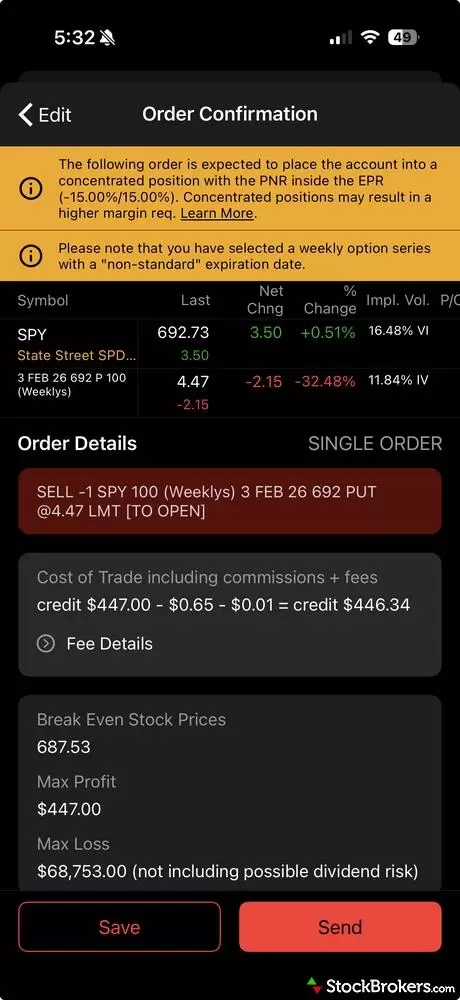
One caution for options traders: neither flagship app is where I'd build a multi-leg spread. Schwab's flagship limits you to single legs, so you'd switch to its thinkorswim app, and Robinhood hides the per-leg detail I need.
| Feature |
Charles Schwab
|
Robinhood
|
|---|---|---|
| Mobile Trading Apps |
|
|
Charles Schwab vs Robinhood: trading platforms and tools
Schwab gives you three venues: the website, the thinkorswim desktop platform, and a thinkorswim mobile app. Robinhood gives you its website plus Robinhood Legend, a browser-based active-trader platform, with no desktop software. The feature gap is wide. Robinhood has no paper trading, no backtesting, no conditional orders, and no short selling.
| Feature |
Charles Schwab
|
Robinhood
|
|---|---|---|
| Active Trading Platform | thinkorswim | Robinhood Legend |
| Desktop Trading Platform | Yes | No |
| Web Trading Platform | Yes | Yes |
| Desktop Platform (Mac) | Yes | No |
| Paper Trading | Yes | No |
| Watchlists - Total Fields | 580 | 34 |
| Charting - Indicators / Studies | 374 | 90 |
| Charting - Drawing Tools | 24 | 26 |
| Charting - Adjust Trades on Chart | Yes | Yes |
| Charting - Custom Studies | Yes | No |
| Ladder Trading | Yes | Yes |
| Level 2 Quotes - Stocks | Yes | Yes |
| Trade Hot Keys | Yes | Yes |
| Trade Ticket - Margin Impact | Yes | Yes |
| Trade Ticket - Tax Lot Selection | Yes | Yes |
Where Charles Schwab wins
Schwab's thinkorswim platform is simply one of the deepest advanced platforms available, and gives you some of the best options tools around. thinkorswim carries 374 charting studies to Legend's 90, plus backtesting and paper trading. Its options analytics are the differentiator: an earnings-analysis tool that shows price action and implied moves around past earnings, and options statistics that read order flow at the bid and ask. I'll be honest that neither platform puts net Greeks on the multi-leg ticket, a longtime gripe of mine, but everything around the Schwab chain runs deeper.

This screenshot showcases a desktop chart of U.S. unemployment rates alongside a live news feed and streaming headlines, enabling traders to track macroeconomic trends in real time. Access to this level of economic insight helps investors connect data with market movement.
Where Robinhood wins
Robinhood is extremely approachable. Legend is the most enjoyable charting platform I've picked up in years, and I'm picky about charts. I had a custom layout running in a couple of minutes, my trend lines lock onto exact prices, and I can draw straight onto an oscillator, so my 80 and 20 lines sit right on RSI. thinkorswim is more capable, but the learning curve is steep. Legend asks almost nothing of you.
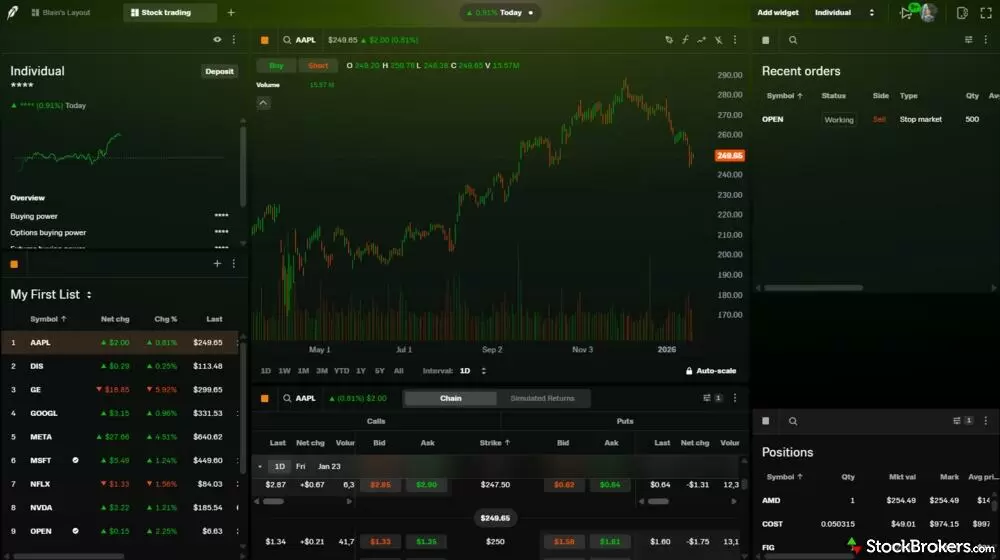
Robinhood Legend is arguably one of the best-looking active trading platforms on the market, with a sleek, modern interface that’s a pleasure to use. However, that clean design comes with trade-offs: some advanced tools and features are missing compared to more robust platforms. It’s a great experience for visual clarity and ease of use, but power traders may find themselves wanting more.
Verdict
Best for advanced, options, and active traders: Charles Schwab.
Best for chart-driven traders who value ease: Robinhood.
thinkorswim is the more powerful platform by a wide margin, and it earned our top desktop-platform honors. But if you're newer to active trading and want to actually enjoy the software, Legend is the friendlier place to learn.
| Feature |
Charles Schwab
|
Robinhood
|
|---|---|---|
| Advanced Trading |
|
|
Robinhood vs Charles Schwab: research
No category separates these two more than research. Schwab runs one of the most complete research libraries I've tested, while Robinhood gives you two bright spots and a lot of empty shelves. We checked both brokers feature by feature below.
| Feature |
Charles Schwab
|
Robinhood
|
|---|---|---|
| Research - Stocks | Yes | Yes |
| Screener - Stocks | Yes | Yes |
| Research - ETFs | Yes | Yes |
| Screener - ETFs | Yes | No |
| Research - Mutual Funds | Yes | No |
| Screener - Mutual Funds | Yes | No |
| Research - Fixed Income | Yes | No |
| Screener - Fixed Income | Yes | No |
| Research - Pink Sheets / OTCBB | Yes | Yes |
| Options Chains - IV | Yes | Yes |
| Option Chains - Total Greeks | 5 | 5 |
| Strategy Net Greeks | Yes | No |
| Options - Strategy Builder | No | Yes |
Where Charles Schwab wins
Schwab's equity ratings report is the standout, because it shows not just a rating but the reasoning behind several third-party firms and the date each call changed. The stock comparison tool lets me hold a company against its sector and the S&P 500 in one view, and I'll use it daily. The screeners filter on forward metrics like next-year P/E and revenue growth, which most brokers can't do.
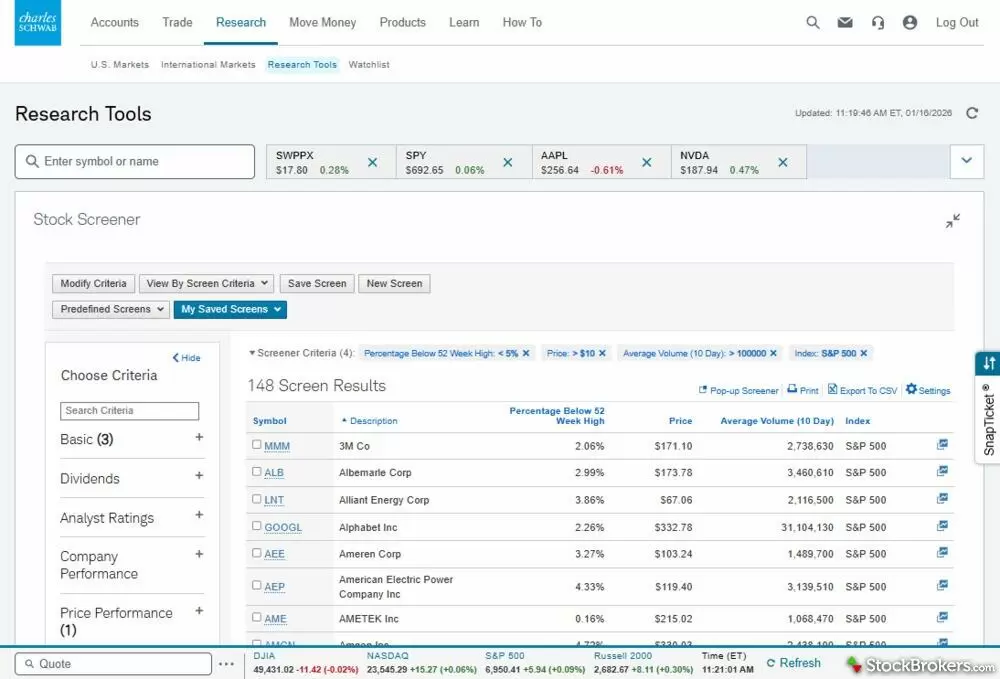
Schwab’s web-based stock screener stands out with advanced filtering tools that include forward-year P/E ratios, projected EPS growth, and revenue estimates—ideal for forward-looking investors. The platform allows users to screen for S&P 500 stocks based on future performance metrics, earnings surprises, and Schwab Analyst Ratings. Unlike many screeners that focus solely on historical data, Schwab helps investors identify high-potential opportunities based on forward projections.
Where Robinhood wins
Robinhood does an amazing job with its research commentary and context. The Investor's Guild, Robinhood's in-house publication, is a real pleasure to read. The pieces read like the market talk I get to have with sharp analysts through my work, the kind of conversation most retail investors never sit in on. Layer in the AI digests that explain why a stock just moved, and Robinhood hands you plain-language context better than most big brokers. Depth of data is the one thing it can't hand you.

Robinhood’s research tools present analyst ratings in a clean, visually appealing format, shown here with the buy, hold, and sell breakdown for Apple. The platform also includes concise “bulls vs. bears” commentary, giving investors a quick snapshot of both sides of the debate. While this type of data is common across brokerages, Robinhood’s design makes it especially easy to digest at a glance.
Verdict
Best for serious research and screening: Charles Schwab.
Best for readable market context: Robinhood.
Robinhood has real gaps to its research offering. There's no economic calendar, no sector performance view, and the stock screener skips the filters I rely on. Searching for solid dividend payers, I had no way to screen on free cash flow or payout ratio.
| Feature |
Charles Schwab
|
Robinhood
|
|---|---|---|
| Research |
|
|
Charles Schwab vs Robinhood: education
This one is closer than the star gap implies. Robinhood produces some of the clearest investing content anywhere. Its options material eases you into time decay and volatility before it ever piles on the Greeks, and it nicknames the four core strategies the four horsemen, a touch I find charming. Schwab's library, though, is larger and far better outfitted. It runs eight multi-hour courses with quizzes, roughly 30 live webcasts a week through Schwab Coaching, and the calculators and progress tracking Robinhood doesn't have at all. Schwab's video production is the best I've seen from any broker. The lone weakness is structure. Apart from the courses, Schwab's material isn't always ordered for learning, whereas Robinhood's flows logically from the very first click.
| Feature |
Charles Schwab
|
Robinhood
|
|---|---|---|
| Education (Stocks) | Yes | Yes |
| Education (ETFs) | Yes | Yes |
| Education (Options) | Yes | Yes |
| Education (Mutual Funds) | Yes | No |
| Education (Fixed Income) | Yes | Yes |
| Videos | Yes | Yes |
| Webinars | Yes | No |
Verdict
Best for a structured program with live coaching: Charles Schwab.
Best for plain-English articles you'll actually finish: Robinhood.
If you want a curriculum, calculators, and a live human teaching you technical analysis, Schwab has no peer here. If you want to read one excellent article at a time on your phone, Robinhood's writing is the standard. Just know there are no courses, webinars, or calculators behind it.
| Feature |
Charles Schwab
|
Robinhood
|
|---|---|---|
| Education |
|
|
Charles Schwab and Robinhood: accounts and banking
This is the cleanest split in the comparison. Schwab is a bank as well as a broker, with FDIC-insured checking and savings, CDs, mortgages, and a debit and credit card, all under the same login as your brokerage account. Robinhood has no FDIC banking, no checking or savings, and no CDs. It offers a debit card and a cash-back credit card, plus an IRA match that vests like an employer 401(k) match, which is a clever retirement incentive. Schwab also opens account types Robinhood doesn't touch, including trusts, business accounts, and the kind of complex retirement plans that matter to high-net-worth investors and small-business owners.
Verdict
Best for banking and investing under one roof: Charles Schwab.
Best for a simple brokerage with a rewarding card and IRA match: Robinhood.
Final thoughts: Robinhood vs Charles Schwab
- Minimum Deposit: $0.00
- Stock Trades: $0.00
- Options (Per Contract): $0.65
For most investors, the search for a great broker ends with Charles Schwab. Retaining the #1 Overall ranking in 2026, Schwab continues to set the industry standard. The broker uniquely balances scale with sophistication, offering both simplified mobile tools and the professional-grade thinkorswim platform. From buying a first fractional share to managing a multimillion-dollar estate, Schwab provides a platform tailored to every need, serving as the definitive operating system for modern wealth. Read full review
- thinkorswim is the industry benchmark for professional-grade trading and charting.
- Best in Class Research features actionable daily updates and deep fundamental data.
- Top-tier education with webinars, videos, and courses.
- No spot crypto trading (limited to ETFs and futures).
- "Stock Slices" (fractional shares) are limited to S&P 500 companies.
- Base margin rates are significantly higher than dedicated low-cost competitors.
- Minimum Deposit: $0.00
- Stock Trades: $0.00
- Options (Per Contract): $0.00
Robinhood is best known for its commission-free trading, modern mobile and desktop platforms, and low-cost access to options, margin, and futures trading. Read full review
- Robinhood Legend offers 90+ technical indicators.
- 3% IRA match on contributions.
- The Investor's Guild explains complex topics.
- Futures trading and 24-hour trading.
- No economic calendars, sector heat maps, or Treasury yield curves.
- No deep fundamental research.
- Legend lacks critical tools.
- No mutual funds, individual bonds, custodial or trust accounts.
For most investors, my answer is Schwab. It took our #1 Stock Research award this year, which lines up with how often I reach for its equity ratings report and comparison tool in my own work. The product range stretches from Treasuries to a small-business 401(k), thinkorswim treats active and options traders like adults, and the whole thing sits beside a real bank. If you're investing for the long term, saving for retirement, or you just want one account that does it all, that's where I'd send you. It won our #1 pick for best overall broker in our 2026 Annual Awards for these reasons.
Robinhood, though, owns a real piece of this matchup. It is commission-free for options, its margin is far lower, and it took our #1 Prediction Markets award this year. Throw in 22 cryptocurrencies and the most pleasant trading app I've touched, and the pitch sells itself. If you trade with one eye on cost, live on your phone, and want crypto in the mix, Robinhood is the one to choose.
Jessica's take
"It's very hard to top the charting on thinkorswim, but it isn't easy to use. Robinhood Legend is probably the easiest technical analysis platform out there. thinkorswim can do more, but the best platform is the one you'll actually use."
Jessica Inskip
Director of Investor Research
Overall verdict
Best for most investors: Charles Schwab.
Best for low-cost options, crypto, and mobile-first trading: Robinhood.
| Feature |
Charles Schwab
|
Robinhood
|
Category Winner |
|---|---|---|---|
| Overall |
|
|
Charles Schwab |
| Range of Investments |
|
|
Charles Schwab |
| Mobile Trading Apps |
|
|
Charles Schwab |
| Advanced Trading |
|
|
Charles Schwab |
| Research |
|
|
Charles Schwab |
| Education |
|
|
Charles Schwab |
| Ease of Use |
|
|
Charles Schwab |
Read next
Popular 1v1 comparisons
- Charles Schwab vs Fidelity 2026
- Fidelity vs J.P. Morgan Self-Directed Investing 2026
- E*TRADE vs Robinhood 2026
- Fidelity vs Robinhood in 2026
- Charles Schwab vs Interactive Brokers 2026
- Interactive Brokers vs TradeStation 2026
More trading guides

We tested the best options trading platforms for 2026. Compare tastytrade, Fidelity, IBKR, E*TRADE & Schwab on tools, fees, and picks for beginners.
Jessica Inskip September 09, 2026
Explore the best international brokers for U.S. investors. Compare Interactive Brokers, Charles Schwab, and Fidelity for global stock trading access.
Jessica Inskip May 22, 2026
Find top U.S. forex brokers. From tastyfx to OANDA, explore platforms with strong regulation, great tools, and user-friendly trading.
Steven Hatzakis May 29, 2026
Discover the best brokers for trade execution. Compare Fidelity, Interactive Brokers, and more for price improvement, speed, and transparency.
Jessica Inskip May 22, 2026
Find the top bank brokerages. From Merrill Edge to Ally, discover brokers that combine banking, investing, and rewards in one account.
Jessica Inskip April 16, 2026
Practice investing risk-free with the best paper trading platforms. Compare Webull, Schwab, Interactive Brokers, E*TRADE, and more.
Jessica Inskip July 24, 2026
Start investing with ease. Explore the best beginner-friendly trading platforms with low fees, great education, and intuitive apps.
Jessica Inskip October 05, 2026
Find the best rollover IRA accounts. Compare Fidelity, Schwab, and E*TRADE for easy transfers, low fees, and smart retirement investing tools.
Andrea Coombes May 15, 2026
We tested the 5 best futures trading platforms of 2026. Compare commissions, margin rates, and tools for beginners and active traders. Find the right platform for you.
Jessica Inskip October 05, 2026
Find the best IRA accounts. Compare Fidelity, Schwab, Merrill Edge, E*TRADE, & J.P. Morgan for retirement planning, fees, tools, and account flexibility.
Jessica Inskip March 31, 2026
Interactive Brokers and Fidelity lead our 2026 ranking of the best free stock trading platforms, tested on the true cost of $0 commissions and hidden fees.
Jessica Inskip September 02, 2026
Find the best Roth IRA accounts. Fidelity, Schwab, and E*TRADE lead with low fees, smart investing tools, and retirement planning support.
Andrea Coombes April 27, 2026
Discover the best day trading platforms. Compare IBKR, Schwab, Fidelity, E*TRADE, and TradeStation for speed, tools, and margin rates.
Jessica Inskip October 05, 2026
Find the best penny stock brokers. Compare Fidelity, Firstrade, Schwab, E*TRADE, and TradeStation for OTC access, fees, and tools.
Jessica Inskip August 02, 2026
Find the best brokerage for high-net-worth investors. Compare Fidelity, Schwab, Merrill, and more for premium services and tailored investment tools.
Jessica Inskip January 27, 2026
Find the best crypto trading platform for 2026. We rank eToro, Fidelity, Interactive Brokers, Webull, and Robinhood on fees, security, and coin selection.
Steven Hatzakis May 27, 2026
Discover the best stock brokers of 2026. Compare Schwab, Fidelity, Interactive Brokers, E*TRADE, and more to find the top trading platform for your needs.
Jessica Inskip August 06, 2026Popular broker reviews
Read our Interactive Brokers review and see why it's a top choice for active traders with low costs, cutting-edge platforms, and global reach.
Jessica Inskip July 31, 2026
Read our TradeStation review and discover why its pro-level tools, deep customization, and options focus make it a top choice for active traders.
Jessica Inskip October 07, 2026
Read our Webull review and discover its commission-free trading, sleek platforms, paper trading tools, and fractional shares.
Jessica Inskip September 18, 2026
Read our 2026 E*TRADE review to see how powerful research, versatile platforms, and diverse investments make it a top choice for all investors.
Jessica Inskip September 29, 2026
Read our Merrill Edge Self-Directed review and see how it combines powerful investing tools, robust research, and integrated banking benefits.
Jessica Inskip September 29, 2026
Ally Invest scores 3/5 in our 2026 review. See how its $0 stock trades, $0.50 options, strong fixed income tools, and Ally Bank integration stack up.
Jessica Inskip September 14, 2026
Our Robinhood review tests $0 stock and options trades, #1-ranked prediction markets, and AI agent trading, plus where its website research falls short.
Jessica Inskip October 01, 2026
Read our Charles Schwab review to learn why its platforms, research, and investor resources make it one of the top-ranked brokerages.
Jessica Inskip September 30, 2026
Our eToro review rates the social investing platform 3.0/5. Stock and ETF trades cost $0, crypto trades carry a 1% fee, and the minimum deposit is $50.
Jessica Inskip September 25, 2026
Fidelity charges $0 stock and ETF trades and won #1 for Research and Education in 2026. See our tested review of its fees, platforms, IRAs, and apps.
Jessica Inskip September 30, 2026
Read our Firstrade review and see why it’s a top choice for options traders, offering $0 contract fees, robust tools, and a growing feature set.
Jessica Inskip May 04, 2026
Read our J.P. Morgan Self-Directed Investing review and discover its strengths in research, planning tools, and integration for Chase clients.
Jessica Inskip May 15, 2026
Read our Public.com review to learn how its intuitive platform and community-driven features help simplify investing for first-time traders.
Jessica Inskip September 18, 2026
Read our tastytrade review and discover why it’s the top choice for options traders, with low fees, advanced tools, and a seamless platform.
Jessica Inskip October 05, 2026About the Editorial Team
Jessica Inskip is Director of Investor Research at StockBrokers.com, bringing 15 years of experience in brokerage and trading strategy. A former FINRA-licensed rep, she held Series 7, 63, 66, and 4 licenses. Jessica focuses on investor education and brokerage industry research, appears regularly on CNBC, Bloomberg, The Schwab Network, Fox Business, and Yahoo! Finance, and hosts the Market MakeHer podcast.
Jeff Anberg is a Senior Editor at StockBrokers.com. Along with years of experience in media distribution at a global newsroom, Jeff has a versatile knowledge base encompassing the technology and financial markets. He is a long-time active investor and engages in research on emerging markets like cryptocurrency. Jeff holds a Bachelor’s Degree in English Literature with a minor in Philosophy from San Francisco State University.
Blain Reinkensmeyer has 25 years of trading experience with over 2,500 trades placed during that time. He heads research for all U.S.-based brokerages on StockBrokers.com and is respected by executives as the leading expert covering the online broker industry. Blain’s insights have been featured in the New York Times, Wall Street Journal, Forbes, and the Chicago Tribune, among other media outlets.