 Charles Schwab
 Fidelity
 Interactive Brokers
 E*TRADE
 Webull
 TradeStation
 tastytrade
 eToro
eToro Trading 212
 Interactive Investor
 IG
IG Interactive Brokers
 XTB
XTB Hargreaves Lansdown
 Saxo
Saxo Charles Stanley Direct
 CIBC Investor's Edge
 Interactive Brokers
 Moomoo
 Questrade
 Qtrade
 TD Direct Investing
 Wealthsimple
 Finviz
 Stock Rover
 Seeking Alpha
 StockHero
 TipRanks
 TrendSpider
 Trade Ideas
 TraderSync
 TradingView
 Tradervue
 TradeZella
Best Bond & Fixed Income Trading Platforms for 2026

Written by Jessica Inskip
Director of Investor Research

Edited by Jeff Anberg
Senior Editor

Fact-checked by Joey Shadeck
Research Analyst
Jessica InskipDirector of Investor Research
Jessica Inskip is Director of Investor Research at StockBrokers.com, bringing 15 years of experience in brokerage and trading strategy. Jessica focuses on investor education and brokerage industry research.


 Why you can trust us
Led by Jessica Inskip, Director of Investor Research, the StockBrokers.com research team collects thousands of data points across hundreds of variables. We evaluate features important to every kind of investor, including beginners, casual investors, passive investors, and active traders. We carefully track data on margin rates, trading costs, and fees to rate stock brokers across our proprietary testing categories.
Our researchers open personal brokerage accounts and test all available platforms on desktop, web, and mobile for each broker reviewed on StockBrokers.com. Learn more about how we test.
Fidelity is the best bond trading platform for 2026, with more than 100,000 bond offerings and a $1 mark-up per bond on secondary trades. Charles Schwab ranks second for fixed income education, and Interactive Brokers leads for global bond access.
Unlike stocks, where price discovery is instant, the bond market can be opaque, making the quality of your broker’s inventory and fixed-income analysis tools the primary driver of your success.
Many modern apps completely ignore fixed income, and even some full-service brokers treat it as a legacy feature with clunky interfaces. If you are looking to preserve capital or generate reliable income, you need a broker that provides direct access to competitive pricing on municipal, corporate, and Treasury bonds, rather than just forcing you into ETFs.
I have spent extensive time testing the fixed-income capabilities of major brokerages, specifically looking for those that make building a bond ladder as intuitive as buying a share of stock. The standout winners combine vast inventory with robust tools and educational resources that help you build your fixed-income portfolio.
How we evaluate the best bond trading platforms
Unlike stock trading, evaluating fixed income requires deep-diving into inventory depth and pricing transparency. Our testing process, led by Jessica Inskip, involves manually searching for specific CUSIPs and comparing secondary market buying power. We prioritize platforms that offer:
- Bond ladder builders: Tools that automate cash flow and interest rate management.
- Transparent pricing: Identifying hidden "markups" or "markdowns" that many brokers obscure.
- Institutional access: Scrutinizing the availability of new-issue Treasurys and CDs.
The brokers selected below represent the gold standard for accessing debt markets efficiently and affordably.
Best bond and fixed income trading platforms
- Minimum Deposit: $0.00
- Stock Trades: $0.00
- Options (Per Contract): $0.65
Fidelity is a value-driven online broker offering $0 trades, extensive fixed income inventory, strong bond research tools, and an easy-to-use mobile app. Read full review
- Extensive bond inventory and pricing transparency.
- Top-notch fixed income research and education.
- Decades of reliable client service.
- No dedicated mobile app for active trading.
- Minimum Deposit: $0.00
- Stock Trades: $0.00
- Options (Per Contract): $0.65
For most fixed income investors, the search for a great broker ends with Charles Schwab. Retaining the #1 Overall ranking in 2026, Schwab excels with extensive bond education, deep inventory, and powerful tools like thinkorswim. From Treasurys to complex portfolios, Schwab delivers a complete bond trading experience. Read full review
- thinkorswim supports advanced fixed income analysis and charting.
- Best in Class Research includes comprehensive bond market insights.
- Top-tier education covering bond strategies and laddering.
- No spot crypto trading (limited to ETFs and futures).
- "Stock Slices" (fractional shares) are limited to S&P 500 companies.
- Base margin rates are significantly higher than dedicated low-cost competitors.
- Minimum Deposit: $0.00
- Stock Trades: $0.00
- Options (Per Contract): $0.65
Interactive Brokers is a go-to choice for global bond traders, offering access to international fixed income markets, institutional-grade platforms, and highly competitive pricing. Read full review
- Access to global bond markets across 150+ exchanges.
- IBKR Desktop delivers advanced fixed income tools and analytics.
- Industry-leading margin rates and competitive interest yields.
- Density of features requires a significant time investment.
- Educational content skips over the basics for true beginners.
- Certain tools lack the curated context needed.
- Minimum Deposit: $0.00
- Stock Trades: $0.00
- Options (Per Contract): $0.65
With two distinct platforms, E*TRADE supports both long-term bond investors and active traders, offering an intuitive experience alongside strong fixed income tools like its bond ladder builder. Read full review
- User-friendly bond trading experience with laddering tools.
- Access to Morgan Stanley’s fixed income research and insights.
- Strong platform balance for passive and active investors.
- Base margin rates, starting at over 12%, are significantly higher than top competitors.
- You can’t buy Bitcoin or Ethereum directly; crypto exposure is limited to ETFs and futures.
- You can’t buy fractional shares of individual stocks.
- Minimum Deposit: $0.00
- Stock Trades: $0.00
- Options (Per Contract): $0.65
J.P. Morgan Self-Directed Investing offers a simple, streamlined bond trading experience, especially for Chase customers, with integrated research and easy access to Treasurys. Read full review
- Seamless transfers between Chase and investment accounts.
- Clean, intuitive interface for bond investing.
- Zero commissions on secondary U.S. Treasurys and CDs.
- No streaming real-time quotes.
- No cryptocurrencies, futures, or forex.
- Limited tools for active bond traders.
Top picks for the best bond trading platforms
1. Fidelity – Best overall for bond trading
Fidelity is, without question, the best bond trading platform for 2026. While many brokers treat fixed income as an afterthought, Fidelity provides a dedicated hub that feels like a standalone professional terminal. In my testing, I was blown away by the sheer depth of inventory with access to over 100,000 new issue and secondary market offerings. Whether I was looking for municipal bonds, corporate debt, or Credit Union Share Certificates (a unique find), the search filters were comprehensive. Pricing was refreshingly transparent: a simple $1 mark-up or mark-down per bond for secondary trades and $0 for online U.S. Treasury trades.
Analytical Tools: What truly separates Fidelity from the pack is its analytical power on the portfolio level. The Fixed Income Dashboard is a masterpiece for portfolio management, allowing you to view your holdings through a "cash flow" lens to track income and risk simultaneously. When constructing your portfolio, I found the Bond Ladder tool particularly helpful; it guides you through constructing a series of maturing securities to manage income flow and interest rate risk without needing a spreadsheet. Unlike many competitors, Fidelity also allows retail clients to participate in primary auctions, a feature often ring-fenced for institutional players.
Fixed-income education: The educational resources are equally impressive. I dug into advanced articles on "Duration" and "Convexity" that went far beyond the basics, offering real-world examples of how to hedge a portfolio against rate changes. For investors who take income seriously, Fidelity offers an unmatched combination of tools, inventory, low costs, and institutional-grade data.
Jessica's take
"If you are managing a serious income portfolio, you need to see Fidelity's Fixed Income Dashboard. In my notes, I literally called this a 'bond geek's world.' It allows you to model hypothetical purchases to see exactly how a new bond would impact your portfolio's duration and yield before you buy it. Most brokers just give you a list of CUSIPs; Fidelity gives you a command center."
Jessica Inskip
Director of Investor Research
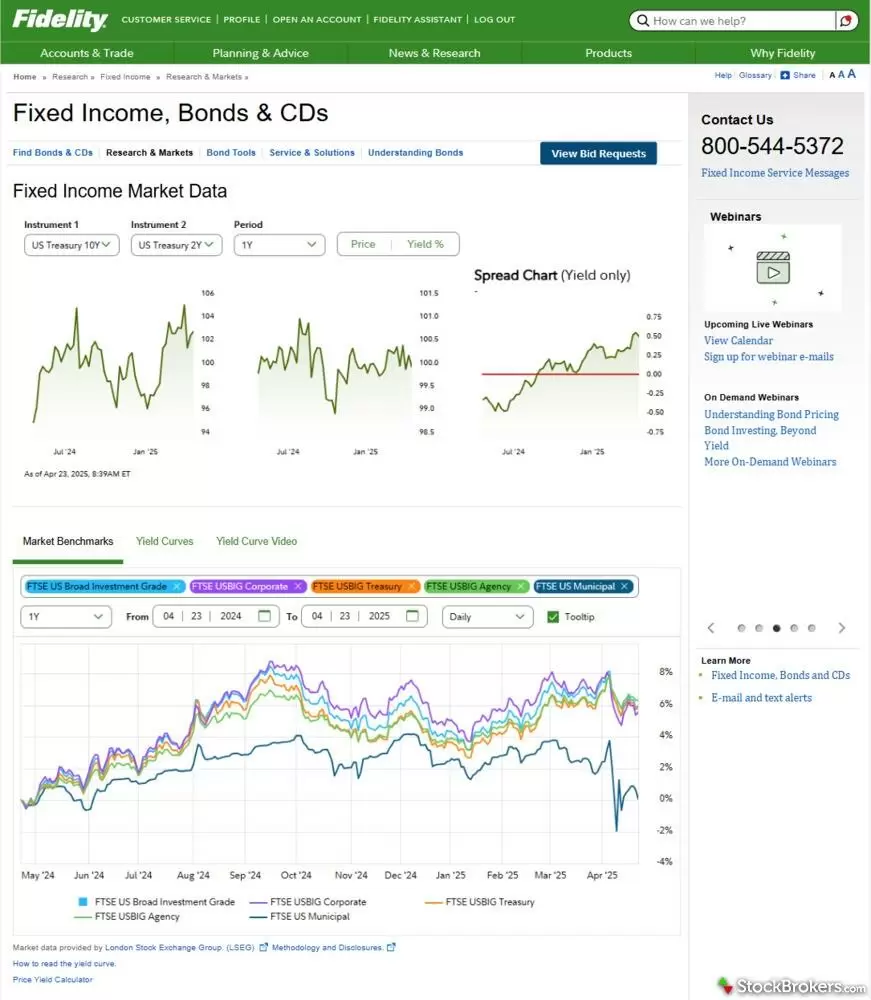
The Fidelity Fixed Income, Bonds & CDs research hub provides a comprehensive view of the market, featuring interactive market data charts, yield benchmark comparisons, and a live economic calendar for informed trading decisions.
2. Charles Schwab – Best for fixed-income education
Charles Schwab is a close runner-up, particularly for investors who want to understand the "why" behind their fixed-income trades. While Fidelity may edge it out on pure dashboard analytics, Schwab’s BondSource platform offers a level of market context that I found incredibly valuable. Accessing over 60,000 daily CUSIPs from 200+ dealers, Schwab ensures you aren't just seeing one price—you are seeing a competitive landscape. Whether I was hunting for municipal bonds or participating in new issue Treasury auctions, the liquidity was consistently excellent.
Macro visualizations: Where Schwab truly differentiates itself is in its ability to visualize the macro environment. The fixed income hub doesn’t just list yields; it displays a dynamic U.S. Treasury yield curve, allowing you to overlay today’s rates against last month’s or last year’s. This historical context is vital for understanding whether the curve is inverting or steepening, a signal that dictates strategy. For execution, the CD and Treasury Ladder Builder is intuitive, making it simple to stagger maturities for reliable cash flow without complex math.
Fixed-income education: Education here is not an afterthought; it is integrated directly into the workflow. Before I even placed a trade, I was presented with expert commentary on Fed policy and "watch" lists from rating agencies. If you ever feel out of your depth, Schwab provides access to a dedicated team of Fixed Income Specialists who can walk you through the nuances of the bond market. It is this blend of high-tech tools and high-touch service that makes Schwab a top-tier bond trading platform.

The Charles Schwab CD & Treasury Ladder Builder simplifies fixed-income investing with predefined 1, 2, and 5-year ladder templates and real-time APY visualization.
3. Interactive Brokers – Best for global bond trading
Interactive Brokers (IBKR) is the platform for the bond trader who thinks globally. While most brokers confine you to U.S. Treasurys and domestic corporate debt, IBKR blows the doors off with access to non-U.S. sovereign bonds and global corporate debt. In my testing, I found I could seamlessly screen for debt issued by foreign governments or European corporates just as easily as I could for a U.S. Treasury note. The "Bond Scanner" is powerful, allowing granular filtering by currency, country of issuer, and specific credit worthiness ratings (Moody’s and S&P).
Tax tools: However, IBKR is a professional’s tool, and it assumes you know what you are doing. I did not find a pre-built "ladder builder" like at Fidelity or Schwab, which means you will need to construct your maturity schedules manually. But what it lacks in hand-holding, it makes up for in tax efficiency. The new Tax Planner within the PortfolioAnalyst suite is a game-changer. It allowed me to model tax-loss harvesting opportunities across my entire portfolio and even preview the tax impact of a bond trade before clicking "submit."
Fixed-income education: The educational content on the IBKR Campus is also distinctively high-level. I found courses specifically covering SOFR futures and advanced bond derivatives, which are topics that other brokers rarely touch. For the sophisticated investor who wants to trade global debt or hedge interest rate risk with futures, Interactive Brokers is unrivaled in its capabilities.
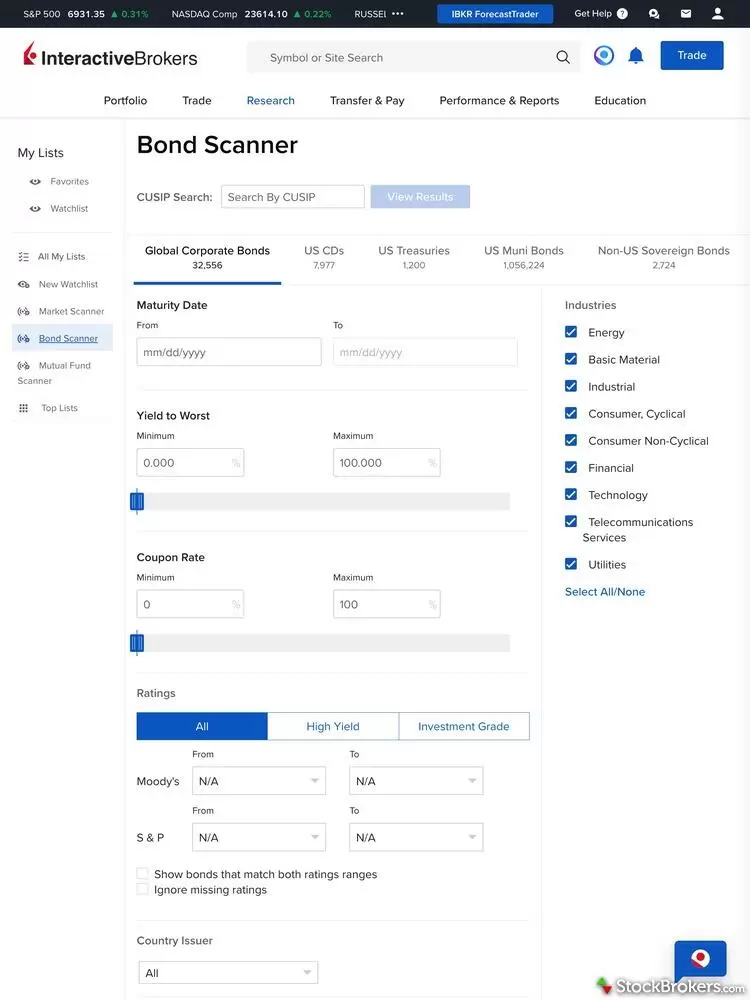
The Interactive Brokers Bond Scanner allows traders to filter thousands of fixed-income assets, including Global Corporate Bonds, US Treasuries, and US Muni Bonds, by critical metrics like maturity, yield, and credit rating.
4. E*TRADE – Best for ease of use
E*TRADE is an exceptional choice for investors who want to trade bonds without getting bogged down in institutional jargon. The platform’s Bond Resource Center is designed with clarity in mind, organizing inventory into intuitive "Quick Ideas" categories like "Conservative" (for short-term Treasurys) or "Tax-Advantaged" (for municipal bonds). In my testing, I found the visual educational tools particularly helpful; the platform uses "seesaw" diagrams to explain the inverse relationship between bond prices and yields, making complex concepts instantly clickable.
Beyond the visuals, the execution tools are easy to use but powerful. The Bond Ladder builder is seamless, and I appreciated the clear alerts for upcoming Treasury auctions, which distinguish new issues from secondary market inventory. For self-directed investors who want a streamlined, highly visual bond trading platform that simplifies portfolio construction, E*TRADE delivers a top-tier experience.
5. J.P. Morgan Self-Directed Investing – Best for simplicity
J.P. Morgan Self-Directed Investing is ideal for clients who value a clean, modern aesthetic over complex institutional tools. If you already bank with Chase, the integration here is seamless. In my testing, I found the fixed income quote pages to be among the most visually appealing in the industry. It cleanly displays crucial data like "Yield to Worst" (YTW) and call schedules without the clutter typical of older platforms.
The screener is surprisingly efficient. I was able to filter for high-yield investment-grade corporate bonds in just two clicks using the intuitive Yield Table. However, it is important to note that J.P. Morgan currently lacks a bond ladder builder, meaning you will need to track maturity dates manually. For investors seeking a straightforward, highly accessible bond trading platform to buy and hold individual securities, J.P. Morgan delivers a polished experience.
Bond trading platform pricing comparison
Here's a summary of the pricing for the best bond trading brokers.
| Feature |
 Charles Schwab Charles Schwab
|
 Fidelity Fidelity
|
 Interactive Brokers Interactive Brokers
|
 E*TRADE E*TRADE
|
 J.P. Morgan Self-Directed Investing J.P. Morgan Self-Directed Investing
|
|---|---|---|---|---|---|
| Minimum Deposit | $0.00 | $0.00 | $0.00 | $0.00 | $0.00 |
| Bond Trade Fee | $1 per bond ($10 min/$250 max) | $1 per bond | Varies | Varies | $1 per bond ($10 min, $250 max) |
| Treasury Trade Fee | Varies | $0 | Varies | $0.00 | $0 |
| Fixed Income (Corporate Bonds) | Yes | Yes | Yes | Yes | Yes |
Bond broker reviews
Read our J.P. Morgan Self-Directed Investing review and discover its strengths in research, planning tools, and integration for Chase clients.
Jessica Inskip May 15, 2026
Fidelity charges $0 stock and ETF trades and won #1 for Research and Education in 2026. See our tested review of its fees, platforms, IRAs, and apps.
Jessica Inskip September 17, 2026
Read our 2026 E*TRADE review to see how powerful research, versatile platforms, and diverse investments make it a top choice for all investors.
Jessica Inskip September 14, 2026
Read our Charles Schwab review to learn why its platforms, research, and investor resources make it one of the top-ranked brokerages.
Jessica Inskip September 21, 2026
Read our Interactive Brokers review and see why it's a top choice for active traders with low costs, cutting-edge platforms, and global reach.
Jessica Inskip July 31, 2026Related guides

Learn how bonds work, from face value and coupon rates to bond pricing, yields, and credit ratings. Discover the role of bonds in investing.
Sam Levine, CFA, CMT December 29, 2025
Discover the best stock brokers of 2026. Compare Schwab, Fidelity, Interactive Brokers, E*TRADE, and more to find the top trading platform for your needs.
Jessica Inskip August 06, 2026
Find the best Roth IRA accounts. Fidelity, Schwab, and E*TRADE lead with low fees, smart investing tools, and retirement planning support.
Andrea Coombes April 27, 2026
Find the best IRA accounts. Compare Fidelity, Schwab, Merrill Edge, E*TRADE, & J.P. Morgan for retirement planning, fees, tools, and account flexibility.
Jessica Inskip March 31, 2026More guides
Discover the best day trading platforms. Compare IBKR, Schwab, Fidelity, E*TRADE, and TradeStation for speed, tools, and margin rates.
Jessica Inskip August 03, 2026
Find the best brokerage for high-net-worth investors. Compare Fidelity, Schwab, Merrill, and more for premium services and tailored investment tools.
Jessica Inskip January 27, 2026
Find the best crypto trading platform for 2026. We rank eToro, Fidelity, Interactive Brokers, Webull, and Robinhood on fees, security, and coin selection.
Steven Hatzakis May 27, 2026
Discover the best brokers for trade execution. Compare Fidelity, Interactive Brokers, and more for price improvement, speed, and transparency.
Jessica Inskip May 22, 2026
Find the best IRA accounts. Compare Fidelity, Schwab, Merrill Edge, E*TRADE, & J.P. Morgan for retirement planning, fees, tools, and account flexibility.
Jessica Inskip March 31, 2026
Find the best Roth IRA accounts. Fidelity, Schwab, and E*TRADE lead with low fees, smart investing tools, and retirement planning support.
Andrea Coombes April 27, 2026
Find the top bank brokerages. From Merrill Edge to Ally, discover brokers that combine banking, investing, and rewards in one account.
Jessica Inskip April 16, 2026
Practice investing risk-free with the best paper trading platforms. Compare Webull, Schwab, Interactive Brokers, E*TRADE, and more.
Jessica Inskip July 24, 2026
Discover the best stock brokers of 2026. Compare Schwab, Fidelity, Interactive Brokers, E*TRADE, and more to find the top trading platform for your needs.
Jessica Inskip August 06, 2026
Find top U.S. forex brokers. From tastyfx to OANDA, explore platforms with strong regulation, great tools, and user-friendly trading.
Steven Hatzakis May 29, 2026
Find the best rollover IRA accounts. Compare Fidelity, Schwab, and E*TRADE for easy transfers, low fees, and smart retirement investing tools.
Andrea Coombes May 15, 2026
Find the best penny stock brokers. Compare Fidelity, Firstrade, Schwab, E*TRADE, and TradeStation for OTC access, fees, and tools.
Jessica Inskip August 02, 2026
Explore the best international brokers for U.S. investors. Compare Interactive Brokers, Charles Schwab, and Fidelity for global stock trading access.
Jessica Inskip May 22, 2026
We tested the 5 best futures trading platforms of 2026. Compare commissions, margin rates, and tools for beginners and active traders. Find the right platform for you.
Jessica Inskip September 17, 2026
Start investing with ease. Explore the best beginner-friendly trading platforms with low fees, great education, and intuitive apps.
Jessica Inskip August 06, 2026
Interactive Brokers and Fidelity lead our 2026 ranking of the best free stock trading platforms, tested on the true cost of $0 commissions and hidden fees.
Jessica Inskip September 02, 2026
We tested the best options trading platforms for 2026. Compare tastytrade, Fidelity, IBKR, E*TRADE & Schwab on tools, fees, and picks for beginners.
Jessica Inskip September 09, 2026About the Editorial Team
Jessica Inskip is Director of Investor Research at StockBrokers.com, bringing 15 years of experience in brokerage and trading strategy. A former FINRA-licensed rep, she held Series 7, 63, 66, and 4 licenses. Jessica focuses on investor education and brokerage industry research, appears regularly on CNBC, Bloomberg, The Schwab Network, Fox Business, and Yahoo! Finance, and hosts the Market MakeHer podcast.
Jeff Anberg is a Senior Editor at StockBrokers.com. Along with years of experience in media distribution at a global newsroom, Jeff has a versatile knowledge base encompassing the technology and financial markets. He is a long-time active investor and engages in research on emerging markets like cryptocurrency. Jeff holds a Bachelor’s Degree in English Literature with a minor in Philosophy from San Francisco State University.
Joey Shadeck is the Content Strategist and Research Analyst for StockBrokers.com. He holds dual degrees in Finance and Marketing from Oakland University, and has been an active trader and investor for close to 10 years. An industry veteran, Joey obtains and verifies data, conducts research, and analyzes and validates our content.