 Charles Schwab
 Fidelity
 Interactive Brokers
 E*TRADE
 Webull
 Robinhood
 TradeStation
 tastytrade
 eToro
eToro Trading 212
 Interactive Investor
 IG
IG Interactive Brokers
 XTB
XTB Hargreaves Lansdown
 Saxo
Saxo Charles Stanley Direct
 CIBC Investor's Edge
 Interactive Brokers
 Moomoo
 Questrade
 Qtrade
 TD Direct Investing
 Wealthsimple
 Finviz
 Stock Rover
 Seeking Alpha
 StockHero
 TipRanks
 TrendSpider
 Trade Ideas
 TraderSync
 TradingView
 Tradervue
 TradeZella
CIBC Investor's Edge Review

Written by Colin Graves
Contributing Writer

Fact-checked by Joey Shadeck
Research Analyst

Edited by Hannah Smith
Staff Editor
Colin GravesContributing Writer
Colin Graves is a Winnipeg-based financial writer and former banker with more than eight years of experience covering investments, brokerages, and personal finance.

CIBC Investor’s Edge is the online brokerage of CIBC, one of Canada’s largest banks. Built for self-directed investors, it offers access to stocks, ETFs, mutual funds, options, and fixed-income securities. As part of a major banking institution, it’s designed to appeal to investors who value the convenience of keeping their banking and investing under one roof. In recent years, Investor’s Edge has introduced commission-free trades for eligible clients and reduced pricing for younger investors, helping it become more competitive within the big bank brokerage space.
Having tested a wide range of Canadian brokerages over the years, I was interested to see how Investor’s Edge compares in today’s market. Investor’s Edge delivers solid value overall, within the big bank category, due to its lower trading commissions and reduced fees for younger investors. However, it falls short of the best-in-class brokers. It’s capable enough for long-term, buy-and-hold investors, especially existing CIBC clients. But its mobile app is mediocre, it lacks premium streaming tools that advanced traders are looking for, and the overall cost isn’t cheap. This makes it difficult for me to recommend it over more modern, lower-cost alternatives.
-
Minimum Deposit:
$0 -
Stock/ETF Trade Fee:
$6.95 -
Mutual Fund Trade Fee:
$6.95
| Fees | |
| Range of Investments | |
| Mobile App | |
| Web Platform | |
| Education | |
| Ease of Use |
 Why you can trust us
Led by Jessica Inskip, Director of Investor Research, the StockBrokers.com research team collects thousands of data points across hundreds of variables. We evaluate features important to every kind of investor, including beginners, casual investors, passive investors, and active traders. We carefully track data on margin rates, trading costs, and fees to rate stock brokers across our proprietary testing categories.
Our researchers open personal brokerage accounts and test all available platforms on desktop, web, and mobile for each broker reviewed on StockBrokers.com. Learn more about how we test.
Table of Contents
Pros and cons
PROS
- Lowest trading fees among the big bank brokers.
- Wide range of investments and account types.
- Commission-free trades for young investors.
- Offers access to Canadian Depository Receipts (CDRs).
CONS
- Mediocre mobile trading app.
- Live chat isn’t available to prospective customers.
- $100 annual account fee.
- Fractional shares limited to eligible U.S. stocks and ETFs or select CDRs.
My top takeaways for CIBC Investor's Edge in 2026:
- At $6.95 per trade, CIBC Investor’s Edge has the lowest commission fees among Canada’s big bank brokerages.
- Young investors (under 25) can access free trades and aren’t charged annual account fees. Students also benefit from reduced fees.
- Its mobile app is mediocre at best, with an uninspiring design and limited research tools.
CIBC Investor's Edge fees
CIBC Investor’s Edge charges $6.95 per online stock, ETF, and options trade. That is the lowest standard commission among Canada’s big bank brokerages. This includes reduced fees for qualifying student investors and zero-commission trades for investors under 25. Unfortunately, its fees are still much higher than those of the growing number of zero-commission brokerages, including Qtrade, Questrade, and Wealthsimple.
Stocks, ETFs, and options: CIBC charges a standard trading fee of $6.95 per trade for online stock, ETF, and options trades, plus an additional $1.25 per contract for options. It waives trading fees for investors under 25 who have a CIBC Smart Start chequing account. Eligible student investors are charged a reduced trading fee of $5.95. There’s also reduced pricing for active traders of $4.95 per trade. Online trades in more than 200 eligible ETFs are commission-free, including funds from CIBC, Mackenzie, iShares, and Vanguard. You must hold each eligible ETF for at least one business day. Fractional trades of less than one share cost $1.95. A promotion waives that commission until October 31, 2027.
Mutual funds: CIBC charges $6.95 for mutual fund trades (except for money market mutual funds). This is lower than Questrade’s $9.95 fee, but higher than TD Direct Investing, which doesn’t charge mutual fund trading fees.
Account and inactivity fees: Investor’s Edge charges an annual $100 fee for all active accounts, except for FHSAs. The fee will be waived if your combined account balances total $10,000 or more. This aligns with other big banks, while brokers such as Questrade and Wealthsimple don’t charge any account fees.
| Feature |
 CIBC Investor’s Edge CIBC Investor’s Edge
|
|---|---|
| Minimum Deposit | $0 |
| Inactivity fees | $0 |
| Stock/ETF Trade Fee | $6.95 |
| Mutual Fund Trade Fee | $6.95 |
| Bond Trade Fee | N/A |
| FX Currency Conversion Fee | N/A |
| Penny Stock Fee (OTC) | N/A |
| Account closure fee | $150 |
Range of investments
CIBC Investor’s Edge offers a broad range of investments to satisfy most investors, including stocks, ETFs, options, mutual funds, GICs, fixed-income (including bonds), precious metals, IPOs, and structured notes. You can also invest in Canadian Depository Receipts (CDRs), which allow you to gain fractional ownership of foreign companies' shares in Canadian dollars. Fractional shares are available on more than 1,000 eligible U.S. stocks and ETFs, with a $1 minimum investment. You can hold them in any account, including a TFSA, FHSA, or RRSP. Investor’s Edge doesn’t support forex, CFDs, futures, or crypto trading (outside of crypto ETFs).
Almost all account types are available, except for Registered Disability Savings Plans (RDSPs). This includes Cash and Margin (non-registered), RRSPs, Spousal RRSPs, LRSPs, TFSAs, RRIFs, LIRAs, PRIFs, LRIFs, FHSAs, and RESPs. Non-personal accounts, such as corporate or partnership accounts, formal trusts, investment clubs, and estate accounts, are also available.
| Feature |
CIBC Investor’s Edge
|
|---|---|
| Bond trading | Yes |
| CFD trading | No |
| Crypto trading | No |
| ETF trading | Yes |
| Forex trading | No |
| Fractional Shares (Stocks) | Yes |
| Recurring investments | Yes |
| Futures trading | No |
| Options trading | Yes |
| Margin trading | Yes |
| Mutual Funds | Yes |
| Penny (OTC) stocks | Yes |
| Stock trading (CA) | Yes |
| Stock trading (U.S.) | Yes |
| Stock trading (Global) | No |
Mobile trading apps
CIBC Investor’s Edge offers a single mobile trading app, CIBC Mobile Wealth, available for download on iOS and Android devices. While the user interface is pretty easy to navigate, it lacks some critical features found on other brokers' mobile apps. For example, when you pull up a stock, you’ll see market data and recent market news (provided by Refinitiv), but there’s no analysis provided, such as analyst or sentiment ratings. You can pull up advanced charts, but you can’t set stock alerts. The app is also separate from CIBC’s banking app. By contrast, TD allows its customers to bank and invest in the same app, making it far more convenient.
These are significant drawbacks, especially since it's the only mobile trading platform CIBC offers. If you consider a robust mobile app a non-negotiable, consider Qtrade or TD Direct Investing, among others.
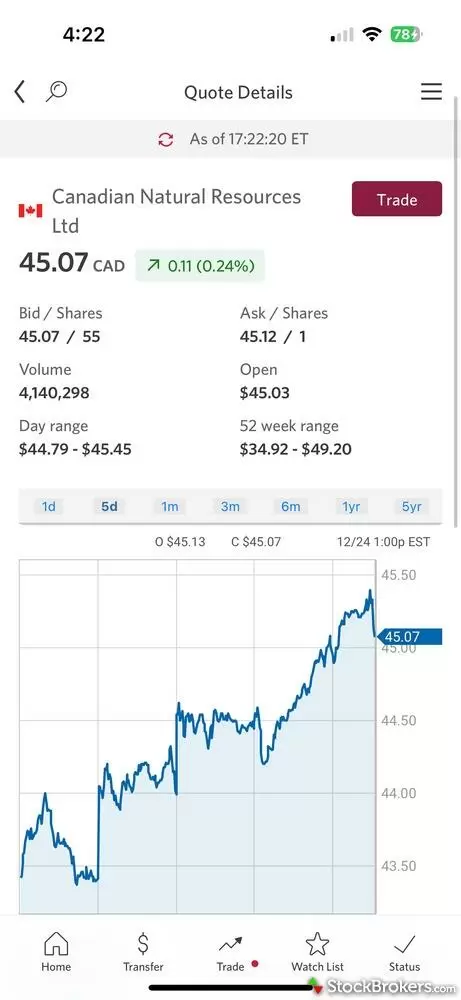
The mobile app screenshot highlights the Quotes Details screen, showing the current share price, intraday gain/loss, bid-ask details, volume, 52-week range, and more, in a mobile-friendly layout. Investors can quickly analyze price movement using multiple time-frame charts and access the trading function with a dedicated Trade button.
| Feature |
CIBC Investor’s Edge
|
|---|---|
| iPhone App | Yes |
| Android App | Yes |
Trading platforms
CIBC Investor’s Edge offers a single web-based trading platform. Thankfully, it’s more capable than its mobile app, and includes stock alerts and robust trading and analysis tools. Its Stock Centre screen (see image below) is reminiscent of TD's WebBroker platform, offering a wealth of information on the page with a horizontal menu across the top so you can easily access key details, such as market news, analyst ratings, reports, charts, financials, technical analysis, and more. Advanced charts come in five types, with numerous overlays and nearly 30 indicators. You can use several drawing tools, add notes, and save charts as templates.
Overall, the Investor’s Edge platform is best suited for long-term buy-and-hold investors. Unlike TD Direct Investing and Questrade, it doesn’t offer a dedicated advanced platform for active traders, including day traders, and you can’t purchase premium streaming packages or access Level 2 quotes.
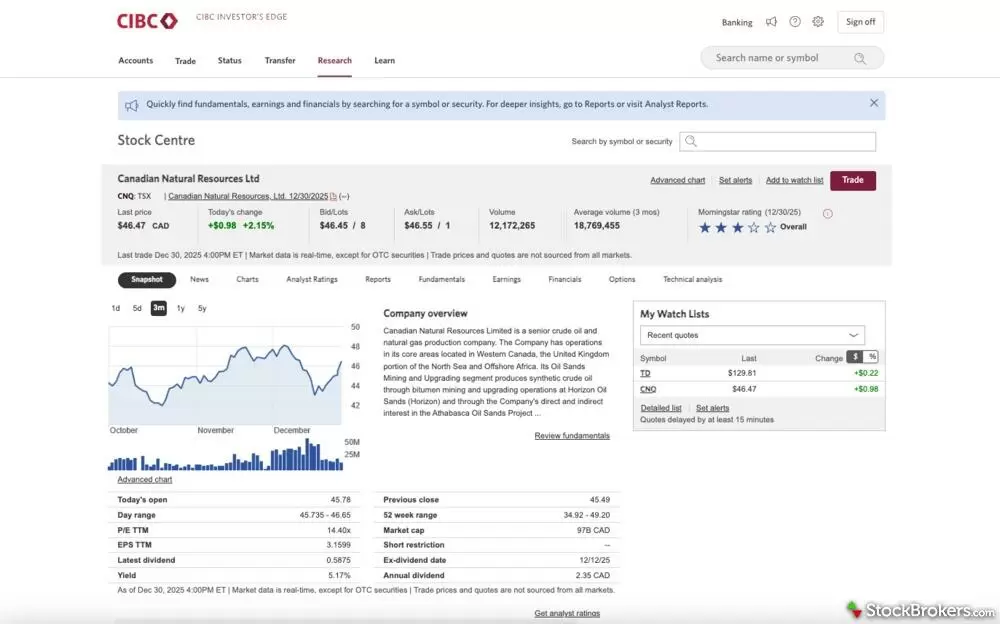
This screenshot shows the CIBC Investor’s Edge desktop platform’s Stock Centre page, where you can view a company snapshot with real-time quotes, bid/ask data, volume, Morningstar ratings, and recent performance. It includes interactive charts, analyst ratings, and you can also see company overviews, key metrics, and manage watchlists directly from the screen.
| Feature |
CIBC Investor’s Edge
|
|---|---|
| Desktop Trading Platform | No |
| Web Trading Platform | Yes |
| Stock Alerts | Yes |
| Charting - Indicators / Studies | 28 |
| Research - Stocks | Yes |
| Research - CFDs | No |
| Research - Mutual Funds | Yes |
| Research - ETFs | Yes |
| Research - Bonds | No |
| Trade Journal | |
| Paper Trading | No |
| Screener | Yes |
Research
Unlike its mobile app, which offers only market news, CIBC Investor’s Edge’s desktop platform provides solid research. This includes Morningstar and analyst ratings for equities, market news articles, and trade ideas for stocks, ETFs, and mutual funds. You can filter equities by themes, such as AI, Berkshire Hathaway Holdings, Canadian Dividend ETFs, and many more. It also offers a complete stock and ETF screening tool. Trading Central provides technical analysis.
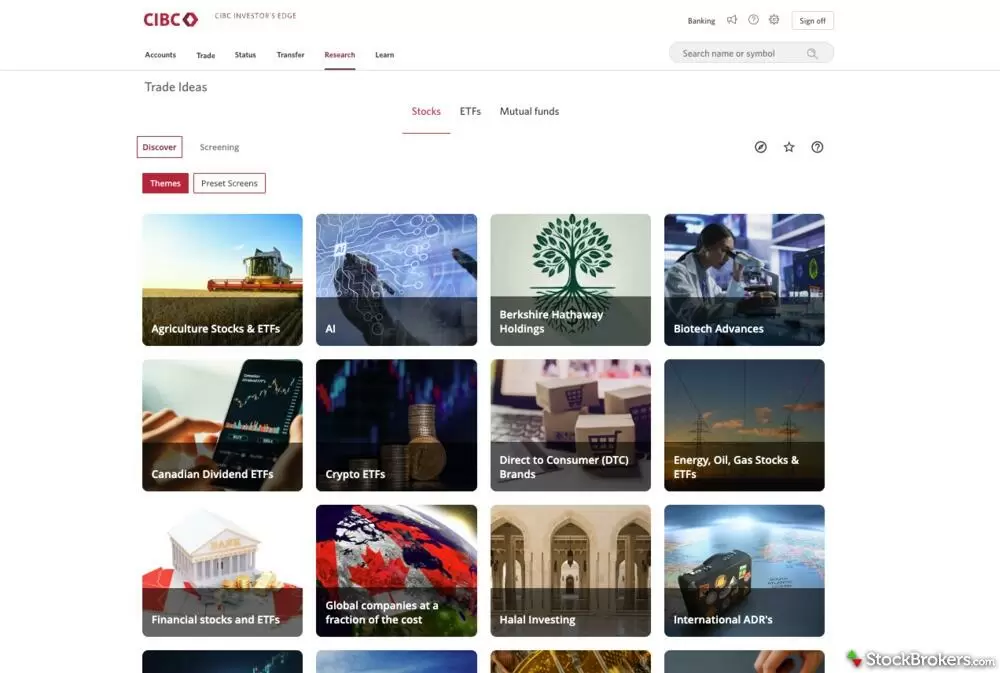
This screenshot showcases the Trade Ideas page from the desktop platform. Investors can use this tool to discover themed stock and ETF ideas across categories like AI, Canadian Dividend ETFs, Biotech, Crypto ETFs, and more. From here, investors can dive deeper into specific categories or switch to preset screens and custom screening tools.
| Feature |
CIBC Investor’s Edge
|
|---|---|
| Research - Stocks | Yes |
| Research - Bonds | No |
| Research - CFDs | No |
| Research - ETFs | Yes |
| Research - Mutual Funds | Yes |
Education
Most Canadian brokerages leave a lot to be desired when it comes to educational tools, and Investor’s Edge is no exception. Its Learning Centre only has dozens of basic articles on stocks and ETFs, plus short videos on trading concepts such as order types, margin, and options. There are no regular webinars. One bright spot is an Investing 101 course that offers 8 lessons (articles) introducing beginner traders to basic investing concepts, such as risk tolerance, portfolio diversification, stocks, ETFs, and tips for building good investing habits. A 15-part options course and a companion 16-video YouTube series cover options in more depth. It would be nice to see more interactive video content.
| Feature |
CIBC Investor’s Edge
|
|---|---|
| Education (Stocks) | Yes |
| Education (ETFs) | Yes |
| Education (Mutual Funds) | No |
| Education (Retirement) | No |
| Webinars | No |
| Videos | Yes |
| Interactive Learning - Quizzes | No |
| Courses | Yes |
Banking services
CIBC Investor’s Edge doesn’t offer banking services, but it’s a division of CIBC, one of Canada’s largest retail banks. This means that CIBC customers can manage their day-to-day banking and self-directed investing under the same roof, making it easier to transfer money back and forth and view all of their financial holdings. It’s one of the perks of dealing with a big bank brokerage.
Final thoughts
When I research online brokerages, I’m never looking for perfection, because all brokers have strengths and weaknesses. However, I do want to see at least one standout quality, ideally two. Some brokers, like Questrade and Wealthsimple, lead the way on fees. Wealthsimple gets top marks for beginners, due to its ease of use. And TD Direct Investing delivers a class-leading trading platform with WebBroker.
When testing CIBC Investor’s Edge, its value is a bit more nuanced. The platform is well-rounded and dependable, even if it doesn’t lead the pack in a single category. Its trading fees are lower than those of many bank-owned brokerages, though still higher than some independent competitors at almost $7 per trade. And while the desktop trading platform is solid, with plenty to offer the average investor, the mobile app only covers the essentials. It provides advanced charts, but I believe most investors would rather see analyst ratings or sentiment analysis tools included.
Overall, while lower-cost alternatives like Questrade or Qtrade may appeal more to fee-conscious investors, CIBC Investor’s Edge remains a credible option, especially for existing CIBC clients who value keeping their banking and investing under one roof. Younger investors may also appreciate access to commission-free trades.
CIBC Investor's Edge star ratings
| Feature |
CIBC Investor’s Edge
|
|---|---|
| Overall |
|
| Fees |
|
| Range of Investments |
|
| Mobile App |
|
| Web Platform |
|
| Education |
|
| Ease of Use |
|
StockBrokers.com Review Methodology
Why you should trust us
Colin Graves, a contributing writer for StockBrokers.com, has over eight years of experience covering investments and Canadian brokerage platforms. Before becoming a full-time writer, Colin spent over two decades in the banking industry, including 15 years as a people manager with a Top 10 North American financial institution. He has completed both the Canadian Securities (CSC) and the Professional Financial Planning (PFPC) courses and has appeared in leading Canadian personal finance publications such as MoneySense, Money.ca, MapleMoney, and The College Investor.
Blain Reinkensmeyer, co-founder of StockBrokers.com, has been investing and trading for over 25 years. After having placed over 2,000 trades in his late teens and early 20s, he became one of the first in digital media to review online brokerages. Today, Blain is widely respected as a leading expert on finance and investing, specifically the U.S. online brokerage industry. Blain has been quoted in The New York Times, The Wall Street Journal, Forbes, and Fast Company, among others. Blain created the original scoring rubrics for StockBrokers.com and oversees all testing and rating methodologies.
How we tested
- We used our own brokerage accounts for testing.
- We collected hundreds of data points across the brokers we review.
- We tested each online broker's website, desktop platforms, and mobile app, where applicable.
- We maintained strict editorial independence; brokers cannot pay for inclusion or a higher rating.
Our research team meticulously collected data on every feature of importance to a wide range of customer profiles, including beginners, casual investors, passive investors, and active traders. We carefully track variables like margin rates, trading costs, fees, and platform features and use them to help rate brokers across a range of categories measuring ease of use, range of investments, education, and more.
At StockBrokers.com, our reviewers use a variety of computing devices to evaluate platforms and tools. Our reviews and data collection were conducted using the following devices chosen to reflect the everyday hardware our readers are likely to be using rather than top-tier configurations: iPhone SE running the latest iOS version, MacBook Pro M1 with 8 GB RAM running the current MacOS, and a Dell Vostro 5402 laptop i5 with 8 GB RAM running Windows 11 Pro.
Each broker was evaluated and scored on over 60 different variables across six key categories for Canadian investors: Range of Investments, Platforms & Tools, Mobile Trading, Education, Ease of Use, and Overall. Learn more about how we test.
Read next
Explore further guidance on trading in Canada.
- TD Direct Investing Review
- Qtrade Review
- Best Canadian Brokerage Firms in 2026
- Best Trading Apps in Canada for 2026
- Interactive Brokers Review
- Questrade Review
- Best Forex Brokers in Canada for 2026
- Wealthsimple Review
About CIBC Investor's Edge
Founded in 1991, CIBC Investor’s Edge is the self-directed brokerage division of CIBC, one of Canada’s largest banks. Based in Toronto, it serves investors across Canada and is regulated by the Canadian Investment Regulatory Organization (CIRO) and is a member of the Canadian Investor Protection Fund (CIPF). The platform offers trading in stocks, ETFs, mutual funds, options, and fixed-income securities. In recent years, it has introduced commission-free trades for eligible clients and discounted pricing for younger investors, helping it remain competitive among Canada’s big bank brokerages.
About the Editorial Team
Colin Graves is a Winnipeg-based financial writer with more than eight years of experience covering investments and brokerages. A former banking exec who managed over $1B in assets, he holds CSC and PFPC credentials. His work appears in MoneySense, Money.ca, MapleMoney, and more.
Joey Shadeck is the Content Strategist and Research Analyst for StockBrokers.com. He holds dual degrees in Finance and Marketing from Oakland University, and has been an active trader and investor for close to 10 years. An industry veteran, Joey obtains and verifies data, conducts research, and analyzes and validates our content.
Hannah Smith is a Staff Editor at StockBrokers.com. With a background in SEO and years of experience in digital media, Hannah is focused on creating high-quality, data-driven content that helps investors make informed decisions. With a master's degree in English from North Carolina State University, she brings a strong foundation in writing, research, and editorial strategy to her work.