 Charles Schwab
 Fidelity
 Interactive Brokers
 E*TRADE
 Webull
 TradeStation
 tastytrade
 eToro
eToro Trading 212
 Interactive Investor
 IG
IG Interactive Brokers
 XTB
XTB Hargreaves Lansdown
 Saxo
Saxo Charles Stanley Direct
 CIBC Investor's Edge
 Interactive Brokers
 Moomoo
 Questrade
 Qtrade
 TD Direct Investing
 Wealthsimple
 Finviz
 Stock Rover
 Seeking Alpha
 StockHero
 TipRanks
 TrendSpider
 Trade Ideas
 TraderSync
 TradingView
 Tradervue
 TradeZella
Best Prediction Market Apps for 2026

Written by Blain Reinkensmeyer
Managing Partner

Edited by John Bringans
Managing Editor

Fact-checked by Joey Shadeck
Research Analyst

Fact-checked by Steven Hatzakis
Director of Online Broker Research
Blain ReinkensmeyerManaging Partner
Blain Reinkensmeyer heads research for all U.S.-based brokerages on StockBrokers.com. He has more than 25 years of trading experience and has been featured in the New York Times, Wall Street Journal, and Forbes, among other media outlets.

The best prediction market app in 2026 is Kalshi, followed by Robinhood and Polymarket. A fully U.S.-regulated exchange dedicated entirely to event contracts, Kalshi offers an immersive experience that multi-asset brokerages simply can't replicate.
Prediction markets have exploded in popularity, letting retail investors trade directly on real-world outcomes. Instead of buying stocks, you trade binary "Yes/No" contracts on U.S. elections, local gas prices, and sporting events.
Keep scrolling for my hands-on impressions of the best prediction market apps for 2026. I break down what makes each platform unique and where they hide their fees (and why I stick with my FanDuel account for sports betting).
Best Prediction Market Apps
 How we tested
Led by Jessica Inskip, Director of Investor Research, the StockBrokers.com research team collects thousands of data points across hundreds of variables. We evaluate features important to every kind of investor, including beginners, casual investors, passive investors, and active traders. We carefully track data on margin rates, trading costs, and fees to rate stock brokers across our proprietary testing categories.
Our researchers open personal brokerage accounts and test all available platforms on desktop, web, and mobile for each broker reviewed on StockBrokers.com. Learn more about how we test.
How Blain chose the best prediction market apps
My first step was checking the regulatory standing and accessibility of each platform for U.S. traders. I started with exchanges registered with the Commodity Futures Trading Commission (CFTC) to make sure I was recommending legal, domestic options, while also adding myself to lengthy waitlists for platforms like Polymarket to understand the true barrier to entry for a user.
I performed hands-on testing of each app by opening accounts and placing real-money bets, often in small increments, to assess the entire order flow. I specifically looked at:
Fees and transparency: I went through the funding process, comparing free ACH transfers against the hidden costs of debit card fees and crypto "on-ramping" via third-party gateways.
Order Ticket Transparency: I tested how each app displays (or, sometimes, hides) commission details. I looked for sneaky UI elements, like hidden fee symbols. I rewarded clear, layperson-friendly summaries that spell out the bet in plain English.
UI/UX: I evaluated how each app organizes active positions. I looked for thoughtful design choices, such as whether open bets are prominently displayed or buried behind sub-tabs, and whether the app offered specialized "modes" for different trading styles.
I also compared the breadth of markets, distinguishing between platforms that offer "surface-level" events (like Super Bowl winners) and those that provide granular depth (like specific gas prices or Fed meeting word counts). Finally, I weighed the convenience of integrated brokerage apps (like Robinhood) against the specialized power of native exchanges (like Kalshi). Ultimately, the apps that made this list are those that balance fair pricing with an interface that doesn't get in the way of the trade.
- Politics markets offered: Yes
- Economics markets offered: Yes
- Sports markets offered: Yes
The premier dedicated platform for event contracts. Kalshi offers unmatched granularity, from Fed meeting "mentions" to local gas prices. While fee transparency on the order ticket is frustratingly opaque, its purpose-built tools and professional pricing make it our #1 pick.
- Deeply granular markets for politics and niche local data.
- Clever interface modes tailored to your specific trading style.
- Sneaky UI hides trading commissions behind a tiny symbol.
- Finding your active positions is harder than it should be.
- Politics markets offered: Yes
- Economics markets offered: Yes
- Sports markets offered: Yes
The ultimate convenience choice for everyday investors. Robinhood makes placing bets as simple as trading stocks within a familiar app. While flat fees make "long shots" expensive and it’s currently mobile-only, its simplicity and clear position tracking are perfect for beginners. Read full review
- Super convenient if you already trade stocks on Robinhood.
- Keeps your active bets front and center on the screen.
- Flat fees make low-priced "long shots" way too expensive.
- Locked to mobile – no web trading allowed yet.
- Politics markets offered: Yes
- Economics markets offered: Yes
- Sports markets offered: Yes
Polymarket offers deep variety but remains hampered by a massive U.S. waitlist and crypto-native friction. It's the best for international depth and niche tech, AI, and geopolitical markets, provided you can navigate the blockchain-based funding process.
- Massive global variety you simply won't find anywhere else.
- Trading on world and geopolitical events is completely free.
- A massive U.S. waitlist still blocks most new users.
- Dealing with crypto transfers and wallets is a total hassle.
- Politics markets offered: Yes
- Economics markets offered: Yes
- Sports markets offered: No
Best for institutional hedging and active IBKR clients. It offers rock-bottom pricing at $0.01 per contract but lacks sports and engaging features. The interface feels like a bare-bones utility, making it a solid, low-cost choice strictly for sophisticated traders. Read full review
- Rock-bottom $0.01 fee makes it the cheapest traditional option.
- Best for pros needing institutional-grade CME event contracts.
- No sports markets, which is a bummer for casual fans.
- Bare-bones interface feels a bit like an unfinished prototype.
My top picks for prediction market apps in 2026
1. Kalshi – Best prediction market app
| Company | U.S. Residents | Non-U.S. Residents | Crypto wallet required |
 Kalshi Kalshi
|
Yes | Yes | No |
Kalshi is my choice for the best prediction market app in 2026. Because Kalshi is dedicated to event contracts, you get an immersive prediction experience that online brokers can't replicate. It has the purpose-built tools and pricing structure to be a perfect home for bettors.
Tradable markets: Kalshi offers detailed "Mentions" markets (like betting on how many times a specific word might be said in a Fed meeting), and you can bet on gas prices in specific cities or tech layoff counts. You’ll also find markets for mortgage rates, TSA checkpoint numbers, and specific court rulings. Kalshi also offers a deep, granular market for U.S. politics.
Sports market: You’ll find deep in-game props, "Combos" (their version of a parlay), and an official NHL partnership that drops team logos directly into the UI. However, if you’re looking for an alternative to your sports betting app, I would not recommend Kalshi – or any prediction market app. The experience I have with my FanDuel app is just way better for sports betting.
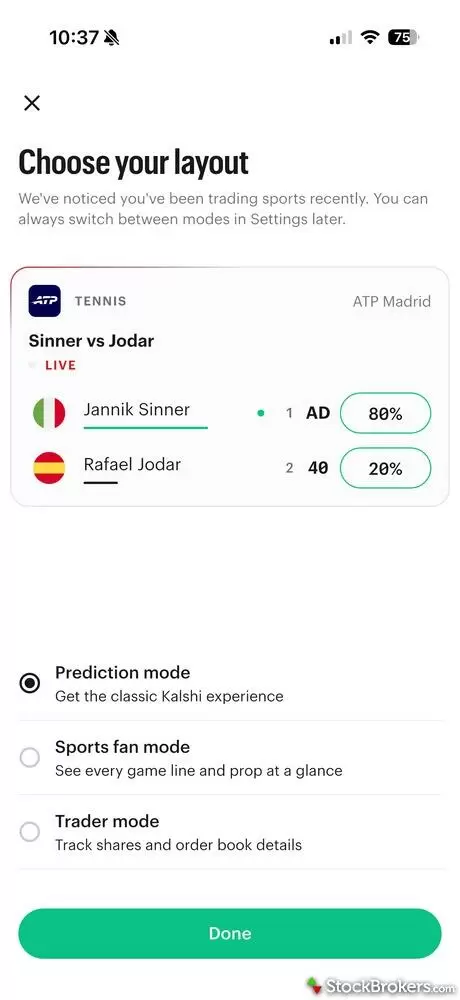
With Kalshi's app, you can choose the layout that best suits your needs. Choose between "Prediction mode," "Sports fan mode," and "Trader mode."
What I liked most about Kalshi:
- Navigation: You can choose between "Prediction mode," "Sports fan mode," and "Trader mode." Decide whether you want the classic Kalshi experience, a quick glance at every game line and prop, or to dive into the weeds as an active trader.
- Social: I liked Kalshi’s Leaderboard and Activity stream, where you can see rankings for overall profit, total volume traded, and most correct predictions. You can tap on and follow top users, and request to join their "Inner Circle" to view their positions. There are also cleverly placed buttons on trade tickets to share bets socially.
What I didn't really like about Kalshi:
- Fee transparency: On the default order ticket, Kalshi doesn’t summarize the commission details (what your trade will cost you). Your fee is hidden behind a tiny, tappable "$" symbol. This feels sneaky; your costs constantly shift based on the odds of your bet.
Blain's take
"In April 2026, Kalshi rolled out a live odds tracker for U.S. politics via its partnership with ElectionOdds. It won’t debut until the midterms, but it's another example of Kalshi going above and beyond to personalize the experience."
Blain Reinkensmeyer
Managing Partner
2. Robinhood – Best prediction market app for investors
| Company | U.S. Residents | Non-U.S. Residents | Crypto wallet required |
 Robinhood Robinhood
|
Yes | No | No |
Robinhood takes the #2 spot on my list and is my top prediction market app for everyday investors. As a Robinhood Gold client who also trades stocks and options, I love the convenience of managing my prediction market bets in the same app.
Tradable markets: Robinhood offers a curated selection of markets, prioritizing high-visibility events (I counted roughly 1,900 open events). You can trade 24/7 on economic indicators, S&P 500 targets, pop culture events, and major U.S. elections.
I’ve noticed the app dynamically adjusts to what's popular; for instance, when elections are taking place, those markets are prominently featured at the top of the app. That said, you won't find the extreme variety or niche categories that you'd find on a global platform like Polymarket.
Sports contracts: I’ve used Robinhood’s prediction markets for over a year, and sports are clearly the dominant market. You’ll find major U.S. pro leagues (NFL, NBA, NHL) and college athletics, but the app tends to focus on high-visibility game winners (like, who wins the Super Bowl). That said, I still prefer the experience of my FanDuel account for sports bets.
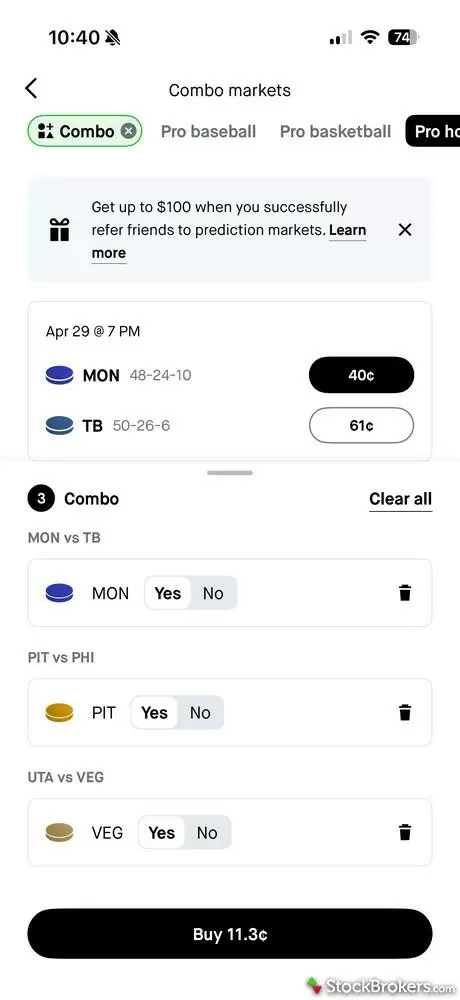
Robinhood’s "Combo" feature acts as a parlay for prediction markets, allowing you to bundle multiple event contracts, like a game winner and a player prop, into a single trade.
What I liked most about Robinhood:
- Order ticket simplicity: Placing bets is as simple as placing a stock trade. I appreciate that the order preview is layperson-friendly.
- Position visibility: Robinhood displays your active, open bets prominently under a "Your positions" header, right on the quote page.
What I didn't really like about Robinhood:
- Expensive for "long shots": Robinhood charges a flat fee of $0.02 per contract. This sounds tiny, but it makes trading "long shots" incredibly expensive (a $0.02 fee on a $0.05 contract equates to a 40% effective fee).
- Mobile exclusive: Despite mixed information online, you can’t trade prediction markets on Robinhood's website or its active trader platform, Robinhood Legend. I verified this in my personal account; my open prediction contracts don't show up on desktop, and there is a notice stating event contracts can't be traded on the web.
3. Polymarket - Best for niche prediction markets
| Company | U.S. Residents | Non-U.S. Residents | Crypto wallet required |
 Polymarket Polymarket
|
No | Yes | Yes |
Polymarket is a popular native prediction market app, but it currently has a massive waitlist for U.S. customers (when I registered, I was #1,363,251). Because of this, I still recommend Robinhood or Kalshi for now. Note: I strongly advise against using a VPN to bypass the waitlist; it isn't worth the risk of having your winnings canceled.
Tradable markets: Polymarket offers a massive, global inventory of niche markets that are often unavailable elsewhere. You can bet on tech and AI (like OpenAI IPO dates), specific geopolitics (like the status of the Strait of Hormuz or Iranian diplomatic meetings – which are notably fee-free), and niche culture (like Eurovision winners or Elon Musk’s social media post counts).
The platform dominates headlines for its controversial markets (like the capture of Nicolás Maduro or whether the Titan submersible would be found), but I expect these won't be available to U.S. residents.
Sports contracts: Polymarket’s international sports depth is impressive, hosting over 4,000 active sports markets, including for high-volume events like the FIFA World Cup. Despite Polymarket’s official partnership with the NHL, I didn’t see any NHL team logos in my browser experience. This could be because I’m still on the U.S. waitlist and don’t formally have an open account, but I’m not sure.
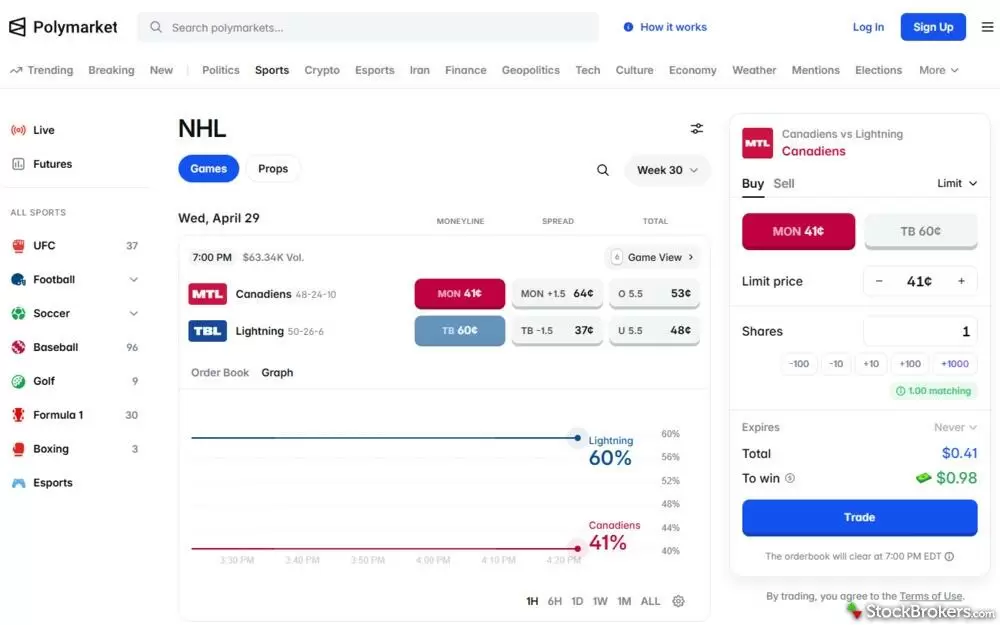
Despite an official partnership with the NHL, Polymarket’s app lacks licensed team logos and trademarks for users on the U.S. waitlist. The platform offers high-volume hockey markets, but the visual experience remains surprisingly basic compared to traditional sportsbooks.
What I liked most about Polymarket:
- Display: I love being able to quick-view bets without opening the full quote. Also, the ability to toggle the odds format (American, Decimal, Fractional, etc.) is a nice touch.
- Top Holders:You can click to view the "Top Holders" of a contract. Seeing the users with the most profitable open positions alongside an activity stream of live community trades is a fantastic, unique feature.
What I didn't really like about Polymarket:
- Crypto transactions: Polymarket operates on the Polygon blockchain using USDC. Crypto isn't my go-to way of transacting, so dealing with transfers is a hassle. If you use a third-party gateway like MoonPay to deposit fiat via debit card, processing fees can eat 1% to 4.5% of your money.
- Order Book: Polymarket leans heavily on its crypto roots by defaulting to an Order Book view.
4. Interactive Brokers - Best for professional hedging
| Company | U.S. Residents | Non-U.S. Residents | Crypto wallet required |
 Interactive Brokers Interactive Brokers
|
Yes | Yes | No |
Interactive Brokers’ prediction market platform, IBKR ForecastTrader, is best for professionals or existing IBKR clients looking to hedge with economic and financial contracts. It has few bells and whistles and feels built strictly for sophisticated investors. If you’re a beginner looking to place bets for fun, I wouldn’t recommend it.
Tradable markets: Compared to Kalshi, Robinhood, and Polymarket, IBKR offers the least number of contracts, but given the basic UI, this simplicity plays to its advantage. IBKR focuses on a narrow, technical suite of markets designed for institutional hedging. You can quick-view markets by six different categories: Elections, Financial Markets, Technology, Economic Indicators, Government, and Environmental.
You can trade on precise economic indicators (like YoY PCE or GDP growth), climate forecasts (like daily high temperatures for 20 major U.S. cities), and U.S. elections (political markets are focused strictly on U.S. midterm and gubernatorial elections).
Sports contracts: Unlike my other top picks, Interactive Brokers offers almost no sports contracts. It notably avoids the sports betting scene altogether to maintain a strictly professional, "investing-first" profile.
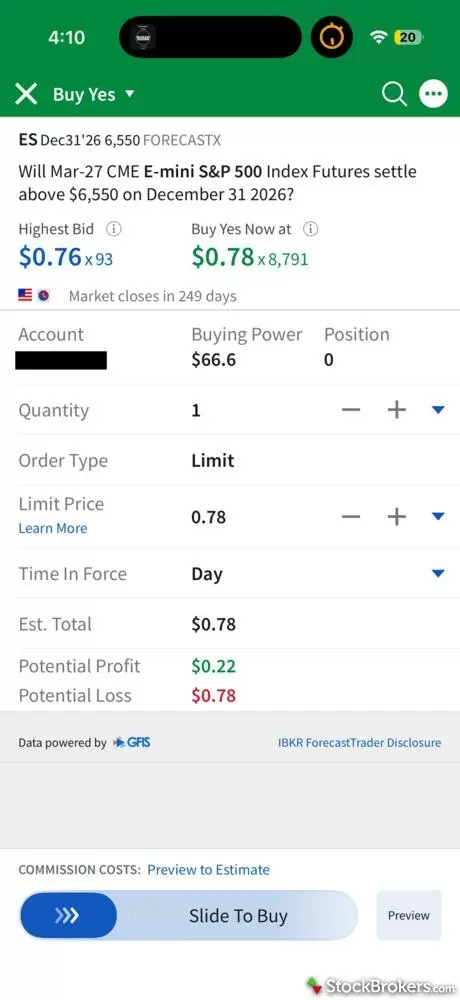
IBKR offers institutional-grade CME event contracts that settle based on the movement of underlying S&P 500 futures. Designed for professional hedging rather than casual betting, these contracts prioritize technical accuracy and deep financial data over the gamified social features found on retail apps.
What I liked most about Interactive Brokers:
- Rock-bottom pricing: IBKR is exceptionally cheap. Their standard flat fee of $0.01 per contract for ForecastEx trades is half the cost of Robinhood.
- Professional order tickets: The order ticket gets the job done cleanly for advanced users. It defaults strictly to limit orders by contract quantity, and tapping the number shows a fanned list of prices labeled for the ask, mid, and bid.
What I didn't really like about Interactive Brokers:
- A "meh" quote experience: Contracts default to a 1-week chart, and there is no view for longer time periods! When I was looking at a year-end Bitcoin prediction contract, not being able to view long-term betting history severely limited the experience.
- Disjointed layout: A "More Contracts" module interrupts the page before you can scroll down to read the actual market rules. Furthermore, an "Underlying Data" tab completely failed to load for me during testing, it just showed a Pac-Man-like character icon, and said "No data here."
Related guides
We tested the 5 best futures trading platforms of 2026. Compare commissions, margin rates, and tools for beginners and active traders. Find the right platform for you.
Jessica Inskip July 31, 2026
Compare the best crypto trading platforms in the UK for 2026. I tested eToro, IG, Interactive Brokers and Revolut on fees, coins and ease of use.
Elizabeth Anderson September 01, 2026
Start investing with ease. Explore the best beginner-friendly trading platforms with low fees, great education, and intuitive apps.
Jessica Inskip August 06, 2026
We tested dozens of platforms to find the eight best stock trading apps for 2026. Compare top picks like Schwab and Fidelity for every investing style.
Jessica Inskip August 06, 2026More guides
Find the top bank brokerages. From Merrill Edge to Ally, discover brokers that combine banking, investing, and rewards in one account.
Jessica Inskip April 16, 2026
Find the best IRA accounts. Compare Fidelity, Schwab, Merrill Edge, E*TRADE, & J.P. Morgan for retirement planning, fees, tools, and account flexibility.
Jessica Inskip March 31, 2026
Find the best rollover IRA accounts. Compare Fidelity, Schwab, and E*TRADE for easy transfers, low fees, and smart retirement investing tools.
Andrea Coombes May 15, 2026
Explore the best international brokers for U.S. investors. Compare Interactive Brokers, Charles Schwab, and Fidelity for global stock trading access.
Jessica Inskip May 22, 2026
Interactive Brokers and Fidelity lead our 2026 ranking of the best free stock trading platforms, tested on the true cost of $0 commissions and hidden fees.
Jessica Inskip September 02, 2026
Discover the best stock brokers of 2026. Compare Schwab, Fidelity, Interactive Brokers, E*TRADE, and more to find the top trading platform for your needs.
Jessica Inskip August 06, 2026
Discover the best brokers for trade execution. Compare Fidelity, Interactive Brokers, and more for price improvement, speed, and transparency.
Jessica Inskip May 22, 2026
Practice investing risk-free with the best paper trading platforms. Compare Webull, Schwab, Interactive Brokers, E*TRADE, and more.
Jessica Inskip July 24, 2026
Find the best Roth IRA accounts. Fidelity, Schwab, and E*TRADE lead with low fees, smart investing tools, and retirement planning support.
Andrea Coombes April 27, 2026
We tested the best options trading platforms for 2026. Compare tastytrade, Fidelity, IBKR, E*TRADE & Schwab on tools, fees, and picks for beginners.
Jessica Inskip September 09, 2026
Discover the best day trading platforms. Compare IBKR, Schwab, Fidelity, E*TRADE, and TradeStation for speed, tools, and margin rates.
Jessica Inskip August 03, 2026
Find top U.S. forex brokers. From tastyfx to OANDA, explore platforms with strong regulation, great tools, and user-friendly trading.
Steven Hatzakis May 29, 2026
Find the best crypto trading platform for 2026. We rank eToro, Fidelity, Interactive Brokers, Webull, and Robinhood on fees, security, and coin selection.
Steven Hatzakis May 27, 2026
Find the best penny stock brokers. Compare Fidelity, Firstrade, Schwab, E*TRADE, and TradeStation for OTC access, fees, and tools.
Jessica Inskip August 02, 2026
Find the best brokerage for high-net-worth investors. Compare Fidelity, Schwab, Merrill, and more for premium services and tailored investment tools.
Jessica Inskip January 27, 2026
We tested the 5 best futures trading platforms of 2026. Compare commissions, margin rates, and tools for beginners and active traders. Find the right platform for you.
Jessica Inskip July 31, 2026
Start investing with ease. Explore the best beginner-friendly trading platforms with low fees, great education, and intuitive apps.
Jessica Inskip August 06, 2026Popular stock broker reviews
Read our Robinhood review and see why it’s a top pick for beginners, with a sleek mobile app, zero commissions, and standout educational tools.
Jessica Inskip September 03, 2026
Read our J.P. Morgan Self-Directed Investing review and discover its strengths in research, planning tools, and integration for Chase clients.
Jessica Inskip May 15, 2026
Read our Webull review and discover its commission-free trading, sleek platforms, paper trading tools, and fractional shares.
Jessica Inskip August 10, 2026
Read our Merrill Edge Self-Directed review and see how it combines powerful investing tools, robust research, and integrated banking benefits.
Jessica Inskip May 04, 2026
Read our Public.com review to learn how its intuitive platform and community-driven features help simplify investing for first-time traders.
Jessica Inskip July 31, 2026
Read our Charles Schwab review to learn why its platforms, research, and investor resources make it one of the top-ranked brokerages.
Jessica Inskip September 08, 2026
Read our tastytrade review and discover why it’s the top choice for options traders, with low fees, advanced tools, and a seamless platform.
Jessica Inskip May 04, 2026
Read our Firstrade review and see why it’s a top choice for options traders, offering $0 contract fees, robust tools, and a growing feature set.
Jessica Inskip May 04, 2026
Read our eToro review to explore its interactive platform, built-in discussions, and tools for crypto and stock investing.
Jessica Inskip May 20, 2026
Fidelity charges $0 stock and ETF trades and won #1 for Research and Education in 2026. See our tested review of its fees, platforms, IRAs, and apps.
Jessica Inskip August 17, 2026
Read our TradeStation review and discover why its pro-level tools, deep customization, and options focus make it a top choice for active traders.
Jessica Inskip September 11, 2026
Read our Interactive Brokers review and see why it's a top choice for active traders with low costs, cutting-edge platforms, and global reach.
Jessica Inskip July 31, 2026
Read our 2026 E*TRADE review to see how powerful research, versatile platforms, and diverse investments make it a top choice for all investors.
Jessica Inskip September 14, 2026
Ally Invest scores 3/5 in our 2026 review. See how its $0 stock trades, $0.50 options, strong fixed income tools, and Ally Bank integration stack up.
Jessica Inskip September 14, 2026About the Editorial Team
Blain Reinkensmeyer has more than 25 years of trading experience with over 2,500 trades placed during that time. He heads research for all U.S.-based brokerages on StockBrokers.com and is respected by executives as the leading expert covering the online broker industry. Blain’s insights have been featured in the New York Times, Wall Street Journal, Forbes, and the Chicago Tribune, among other media outlets.
John Bringans is the Managing Editor of StockBrokers.com. An experienced media professional, John has a decade of editorial experience with a background that includes key leadership roles at global newsroom outlets. He holds a Bachelor’s Degree in English Literature from San Francisco State University, and conducts research on forex and the financial services industry while assisting in the production of content.
Joey Shadeck is the Content Strategist and Research Analyst for StockBrokers.com. He holds dual degrees in Finance and Marketing from Oakland University, and has been an active trader and investor for close to 10 years. An industry veteran, Joey obtains and verifies data, conducts research, and analyzes and validates our content.
Steven Hatzakis is the Global Director of Research for ForexBrokers.com. Steven previously served as an Editor for Finance Magnates, where he authored over 1,000 published articles about the online finance industry. Steven is an active fintech and crypto industry researcher and advises blockchain companies at the board level. Over the past 20 years, Steven has held numerous positions within the international forex markets, from writing to consulting to serving as a registered commodity futures representative.