 Charles Schwab
 Fidelity
 Interactive Brokers
 E*TRADE
 Webull
 TradeStation
 tastytrade
 eToro
eToro Trading 212
 Interactive Investor
 IG
IG Interactive Brokers
 XTB
XTB Hargreaves Lansdown
 Saxo
Saxo Charles Stanley Direct
 CIBC Investor's Edge
 Interactive Brokers
 Moomoo
 Questrade
 Qtrade
 TD Direct Investing
 Wealthsimple
 Finviz
 Stock Rover
 Seeking Alpha
 StockHero
 TipRanks
 TrendSpider
 Trade Ideas
 TraderSync
 TradingView
 Tradervue
 TradeZella
Trading 212 Review

Written by Elizabeth Anderson
Lead Writer for the UK

Edited by Jeff Anberg
Senior Editor

Fact-checked by Steven Hatzakis
Director of Online Broker Research
Elizabeth AndersonLead Writer for the UK
Elizabeth Anderson is the lead writer and researcher for U.K. content on StockBrokers.com. She has been a financial journalist for more than a decade and has written for major publications including BBC, The Times, and Bloomberg.

Your capital is at risk.
Trading 212 is a commission-free investment platform that charges no platform fee and no dealing commission across its stocks and shares ISA, cash ISA, SIPP and general investment account. I've been using it for about three years, starting with an Invest account before the cash ISA existed. I think the strongest reason to choose it is the low fees.
The platform suits beginners and buy-and-hold investors, and the SIPP it added this year has made it appealing to people saving for a pension. You get around 14,200 investments, fractional shares from £1, and a flexible ISA that lets you replace what you take out. What you don't get is mutual funds, gilts, corporate bonds or a Junior ISA, and there is no phone number to ring.
If your priority is keeping costs down, very few U.K. platforms will beat it.
-
Minimum Deposit:
£1 -
ISA:
Yes -
SIPP:
Yes
| Investment Choices | |
| Charges & Fees | |
| Website | |
| Education | |
| Mobile App | |
| Ease of Use |
Check out StockBrokers.com's picks for the best UK investment platforms in 2026.
| #1 Overall | Winner |
| #1 Stocks and Shares ISA | Winner |
| #1 Beginners | Winner |
| 2026 | #1 |
| 2025 | #2 |
| 2024 | #2 |
| 2023 | #5 |
| 2022 | #5 |
| 2021 | #4 |
 Why you can trust us
Led by Elizabeth Anderson, Lead Writer and Researcher, the StockBrokers.com research team for the U.K. collects data and tests products on an ongoing basis. We review the tools and features most important to U.K. investors – including beginners, casual investors, passive investors, and active traders.
We collect and track data on trading charges, fees, and interest rates to make it easier to understand the cost of investing in the U.K. We analyze a wide range of savings and investment offerings, like ISAs, SIPPs, investment portfolios, pensions, and active trading accounts. We hand-collect and audit data across more than 50 variables in our coverage of the best U.K. investment platforms.
Our researchers open personal brokerage accounts and test all available platforms on desktop, web, and mobile for each broker reviewed on StockBrokers.com. Learn more about how we test.
Table of Contents
Pros and cons
PROS
CONS
- Doesn't offer mutual funds, gilts, or corporate bonds.
- Difficult to search for ETFs by theme or currency.
- No Junior ISA.
- No phone support, no desktop platform, and no drawdown.
My top takeaways for Trading 212 in 2026:
- Trading 212 charges no platform fee and no dealing commission across its stocks and shares ISA, cash ISA, SIPP and general investment account.
- There are around 14,200 investments available, made up of 9,000 shares, 5,000 ETFs and 200 investment trusts.
- Uninvested cash earns 3.8% in the stocks and shares ISA and general investment account, and the cash ISA pays 3.6%. These rates on uninvested cash are subject to change.
- The 0.15% currency conversion fee is well below the 1%-plus charged by several traditional platforms.
- The SIPP carries no platform charge and no dealing fees. Contributions get the standard 25% government tax relief, so £80 paid in becomes £100.
Trading 212 fees
Trading 212 claims to be one of the cheapest brokers in the U.K., and the pricing backs that up. The annual platform fee is £0 regardless of your account balance. Most U.K. platforms charge a percentage that tapers as your pot grows. Trading 212 doesn't. That matters most on a pension, where balances tend to be large, and a percentage charge on a large pot adds up over the years.
Commission-free trading: Share deals, ETF deals, and investment trust deals are £0. There is no regular dealing fee at all, so how often you trade makes no difference to what you pay. The minimum deposit is £1.
Paying money in: Bank transfers are free with no limit. Card payments, Google Pay, Apple Pay and Klarna are free up to a total of £2,000, and after that Trading 212 charges 0.7%. The £2,000 is a running total across everything you have ever paid in by those methods, not a per-payment allowance, and the app shows how much of it you have left on the deposit screen. Bank transfer avoids it entirely.
What is left is tax and fund charges. Buying a share listed on the London Stock Exchange carries 0.5% stamp duty reserve tax, and there is none on ETFs, gilts or bonds. Orders over £10,000 carry a £1.50 PTM levy on both the buy and the sell. ETF managers take their annual charge out of the fund, as they do everywhere. Telephone dealing is not an option here, because there is no dealing line to call.
Currency conversion: Buying a share listed overseas costs 0.15%, and selling it costs another 0.15%. A round trip on an overseas holding is 0.30%. That is lower than most rivals. Some of the more traditional platforms, and some of the names favoured by high-net-worth investors, charge more than 1%. For most people, FX charges are not a huge concern, though the gap widens if you hold a lot of U.S. stock.
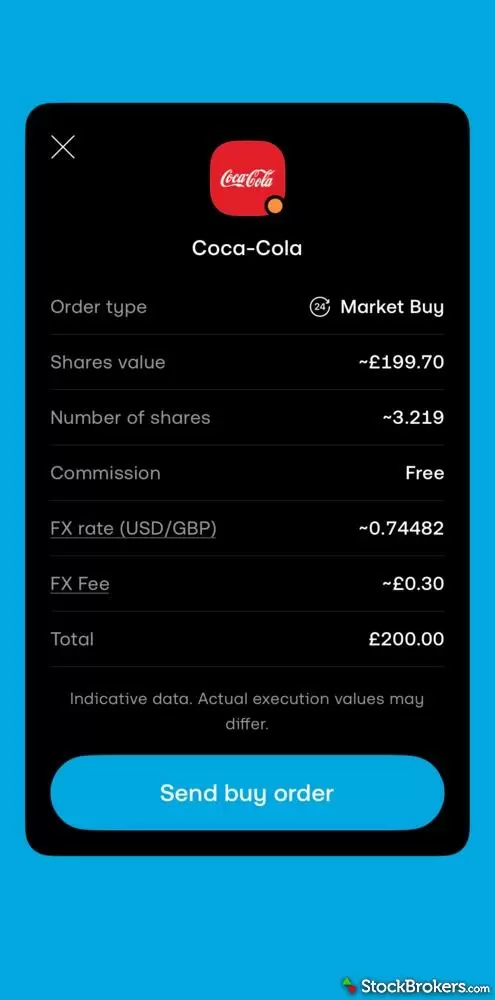
Buying shares of an American company like Coca-Cola incurs an FX fee. The order ticket also shows the current conversion rate between USD and GBP and what the total cost will be.
Holding foreign currency: The Invest account holds cash in 13 currencies, including U.S. dollars, euros, Swiss francs, and Canadian and Australian dollars. Convert once, and you can buy dollar-priced shares from that balance without paying the fee again. When you place an order, you choose between your primary currency and the asset's currency, and picking the asset's currency avoids the conversion. This does not work in the stocks and shares ISA, which holds cash in sterling only. Pies hold cash in your primary currency too, so a pie order converts even if you hold the asset's currency elsewhere. For an ISA investor buying U.S. shares, the 0.15% applies on every buy and every sell.
Withdrawals and exits: There are no withdrawal fees, no inactivity fees and no transfer-out fees. The minimum withdrawal is £1. Every time I've taken money out of Trading 212 it has been quick and easy to do.
Interest on cash: Uninvested cash in the general investment account and the stocks and shares ISA earns 3.8%, paid daily. You have to switch it on yourself, by tapping 'earn interest on cash' in settings. That same section shows where your money is held, which is a mix of banks and money market funds. That split matters for protection. The bank portion carries FSCS deposit cover if that bank fails, but the money market fund portion does not. Cash in other currencies also earns interest at various rates: 3.3% on U.S. dollars and 2.2% on euros. These rates on uninvested cash are subject to change.
Miscellaneous fees: Real-time market data is free to every user, with no subscription to buy. Holding an ISA or a SIPP carries no monthly charge.
The 212 Card: The card spends the uninvested cash in your Invest account. It is not a credit card, and it is not available through the ISA. Paynetics issues it and Trading 212 distributes it. The virtual card is free and works through Apple Pay and Google Pay. A physical card carries a one-time issue charge, and the amount shows in the app when you order it. Card spending carries no FX fee, which is a better rate than the 0.15% you pay when converting money inside the app. ATM withdrawals are free up to £400 a month in the U.K. and up to €400 a month elsewhere, then 1%.
Cashback changed during 2026 and the headline rate is easy to misread. The base rate is 0%. You earn 1.5% only if you have switched on Cashback Reinvest and have at least one qualifying subscription running on the card. It is capped at £15 a month and is reinvested rather than paid out as spendable cash. The older 0.5% and 2% rates were withdrawn over the summer.
| Feature |
 Trading 212 Trading 212
|
|---|---|
| Minimum Deposit | £1 |
| Share Trading: 0-9 Deals/ Month | £0 |
| Share Trading: 10-19 Deals/ Month | £0 |
| Share Trading: 20+ Deals/ Month | £0 |
| Annual Platform Fee (Funds): £0 - £250,000 | £0 |
| Annual Platform Fee (Funds): £250K-£500K | £0 |
| Annual Platform Fee (Funds): £500,000 - £1m | £0 |
| Annual Platform Fee (Funds): £1m and over | £0 |
| Bonds - Corporate - Fee | N/A |
| Bonds - Government (Gilts) - Fee | N/A |
| ETFs - Fee | £0 |
| Investment Trusts - Fee | £0 |
| Telephone Dealing Fee | N/A |
What type of trader are you?
New to the world of investing? See my picks for the best UK trading platforms for beginners. More experienced traders should check out my guide to the best UK Trading Platforms for Active Traders. If you're looking to trade shares on the go, read my guide to the best UK stock trading apps.
Range of investments
Trading 212 gives you around 14,200 investments, made up of 9,000 shares, 5,000 ETFs and 200 investment trusts. There are no mutual funds. The share list covers a reasonable selection of markets, including the U.S., U.K., Germany, Canada, France and Spain. It is mainly North America and Europe, so the missing markets are Asia, the Middle East and other emerging markets.
Fractional shares: You can buy by pounds rather than by whole shares, and the minimum order size is £1. That matters most on expensive U.S. names, where one share can cost hundreds of pounds. Fractional dealing works in the ISA and the SIPP. Dividends on fractions are paid in as free cash, rounded to the nearest penny, unless you hold the stock in a pie, where they reinvest automatically. Only whole shares can be transferred out, because the receiving provider may not support fractions.
What you cannot buy: There are no individual gilts and no corporate bonds. You cannot buy crypto directly, and there is no spread betting. Crypto ETNs are available in the general investment account. You cannot buy new ones inside a stocks and shares ISA. HMRC reclassified crypto ETNs as qualifying investments for the Innovative Finance ISA from 6 April 2026, which took them out of the stocks and shares wrapper. Anything bought on or before 5 April 2026 can stay where it is, and Trading 212 says you are not required to sell it. Investment trusts are there, and City of London and Scottish Mortgage both appear if you search 'trust' and filter by stocks, but they are not a separate asset class.
Pies rather than ready-made portfolios: There are no ready-made portfolios in the way Hargreaves Lansdown, AJ Bell and Lloyds offer them. What you get instead is the pie, which you can build yourself, copy from another user, or take as a model pie built on data from ETF houses such as WisdomTree, Vanguard and BlackRock. If a ready-made portfolio is what you are after, other platforms handle that better.
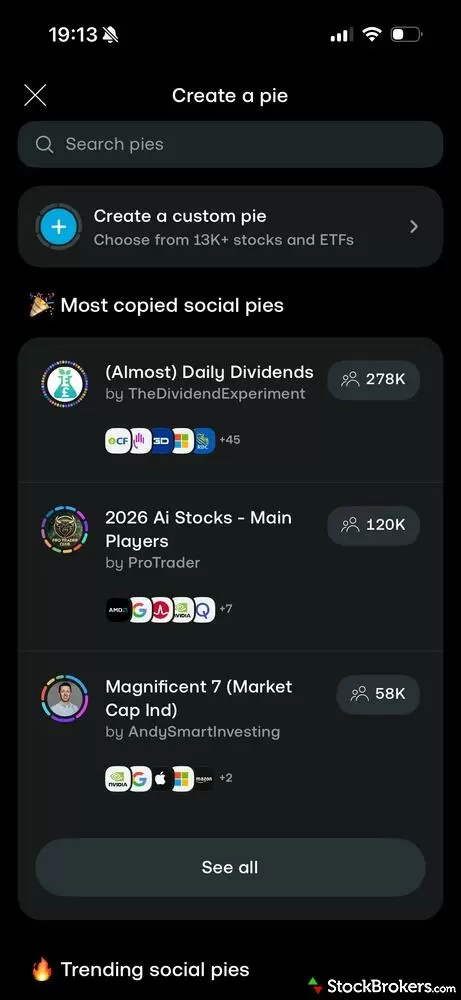
Rather than any ready-made portfolios, Trading 212 offers the ability to create pies. These allow you to allocate funds to ETFs and shares by percentages that you can control.
There is no Junior ISA and no Junior SIPP, which is a shame, because the rest of the wrapper range is close to complete.
Elizabeth's take
The CFD products are the part that gives me pause, because they remain prominent in the app even inside a stocks and shares ISA view, with a product such as Tech100 20X CFD sitting right at the top. Tapping it prompts you to open a CFD account, and a lot of new investors will not understand how different that is from buying a share or an ETF outright.
Elizabeth Anderson
Lead Writer for the UK
Trading 212 SIPP
The SIPP arrived this year with no platform charge, which is unusual, though newer platforms such as Freetrade and InvestEngine have gone the same way. There are no dealing fees either.
Trading 212 does not run the pension wrapper itself. Platform One acts as trustee and administrator for the scheme, while Trading 212 handles the app, the dealing and the custody of what you hold. Your SIPP terms come from both firms.
It suits people paying into a pension rather than drawing one down, because there is no drawdown support. If you plan to take an income, look elsewhere. You also cannot make limited company or employer contributions, the same limitation Freetrade and InvestEngine carry. For those you need a traditional broker such as Vanguard, Hargreaves Lansdown or AJ Bell.
Tax relief: Contributions get the standard 25% top-up from the government, so £80 paid in becomes £100 in the SIPP. Higher and additional rate taxpayers claim the rest through self assessment. The annual allowance is up to £60,000, and it can be lower depending on your income and on what you have already taken from a pension.
Transferring a SIPP in: Transfers from another provider are accepted, and partial transfers appear to be supported. Trading 212 quotes 2 to 8 weeks for a cash transfer and 4 to 12 weeks for a stock transfer, and your existing provider sets much of that pace. I initiated a partial transfer to test how it worked and there was very little to it. The money landed in my Trading 212 SIPP eight days after I started, which was quicker than the published range. You open a new account in the app, select SIPP, then choose to transfer in, giving the account number of your existing provider and the amount. It is worth selling your investments to cash first, so your old provider has nothing to liquidate and can just move the money across.
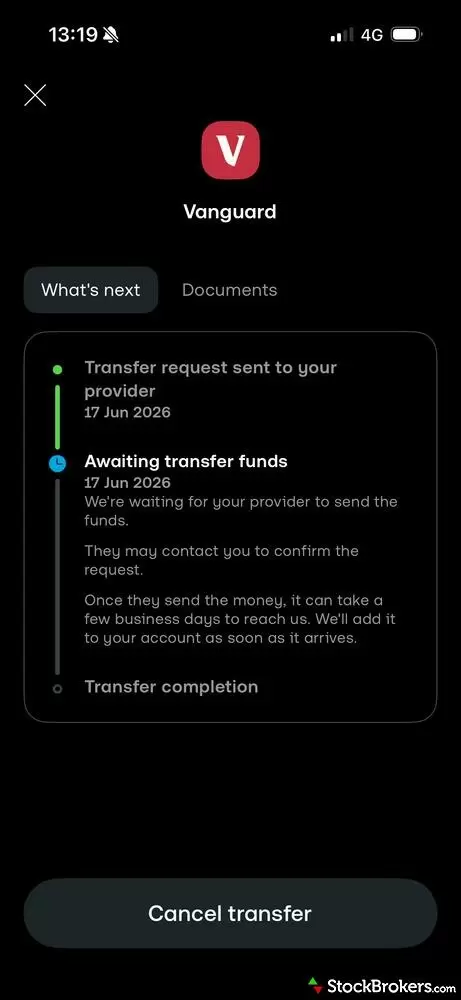
I found transferring into a Trading 212 SIPP from a different provider to be relatively simple and easy to do.
| Feature |
Trading 212
|
|---|---|
| Share Trading | Yes |
| CFD Trading | Yes |
| ETFs | Yes |
| Mutual Funds | No |
| Bonds - Corporate | No |
| Bonds - Government (Gilts) | No |
| Investment Trusts | Yes |
| Spread Betting | No |
| Crypto Trading | No |
| Advisor Services | No |
Trading 212 ISA review
Most people arrive at Trading 212 for the tax wrapper, and there are two of them. There is a cash ISA and a stocks and shares ISA, neither of them carrying a platform charge, and the ISA is flexible.
Trading 212 cash ISA
The cash ISA pays 3.6% at the moment, which is a decent rate set against the high street banks. It is easy-access, so you can withdraw money whenever you want.
What I like is how visible the interest is. Select the cash ISA tab and a notification at the top tells you exactly how much you have earned over the past week. Interest is paid daily.
Trading 212 stocks and shares ISA
You can hold shares and ETFs in the stocks and shares ISA, with no platform fee, no dealing commission and no monthly charge. Uninvested cash inside the wrapper earns 3.8%, which is higher than the rate on Trading 212's own cash ISA. Fractional dealing works here too, so £1 is enough to open a position.
Beyond the low fees, what I like about it is that it is easy to use. Connecting a bank account to pay money in takes very little effort, and buying an investment is quick. The pie tab shows every holding in one place, with the overall gain or loss in both percentage and pounds since you bought.
The one thing that does not carry across from the general account is the crypto ETN. HMRC moved crypto ETNs into the Innovative Finance ISA on 6 April 2026, so you cannot buy new ones in a stocks and shares ISA. Existing holdings bought before that date can remain.
ISA flexibility and transfers
The ISA is flexible, which means money you take out during a tax year can go back in during the same tax year without eating any more of your £20,000 annual allowance. I have used this once or twice. The first time was to check it worked and see how quickly the money moved, and the second was when a tax bill landed. I took the money out to pay it and put it back once other money had come in. Both directions were faster than I expected.
Transfers in: Trading 212 accepts ISA transfers in and the whole thing is done online. There is no bonus for transferring at the moment, though incentives do show up in peak ISA season during March and April.
Mobile trading apps
Buying a stock took me five taps. Open the app, tap the search icon, pick a stock from the screen or search for one, choose buy, slide to the amount you want or key in an exact value, hit review order, then send buy order. Keying in a value rather than a share count is the part I use most, because fractional dealing lets me put in £150 without thinking about the share price.
Order types: Market, limit, stop and stop limit, on both the ISA and the general investment account. That covers buying at the current price and lining up trades to catch a gap in the price.
Auto-invest: Setting up regular investing is not easy. You cannot schedule one straight into a single share or ETF. You have to build a pie first and then set auto-invest on the pie, choosing the amount and whether it runs weekly, fortnightly or monthly.
Charting: The charts are powered by TradingView, and 104 indicators and 15 drawing tools come free. You can view by day, week, month, year to date, year or max, and toggle between candles and a line. Saving an indicator setup is useful, because it then applies to every investment you open rather than being rebuilt each time. Pulling up the full charting view from the arrow at the bottom of a chart is fiddly on a phone. The bigger gap is that you cannot overlay two shares or two indices on one chart, so comparing the performance of two holdings side by side is not possible. I think that is a shame. Corporate events do not display on the chart either.
Portfolio tracking: The home screen shows the account value split between what is invested and what is held in cash, along with how much of your annual ISA allowance is left. Treat that allowance figure with caution, because Trading 212 cannot see ISAs you hold on other platforms. Performance shows in both percentage and pounds, for the whole portfolio and for each holding, which not every platform does. Price alerts take one tap on the bell at the top right, and push notifications sit in the same place.
AI analysis: It is displayed prominently and says nothing much of value. I have used it to see which of my holdings moved most on the day and not for anything else.
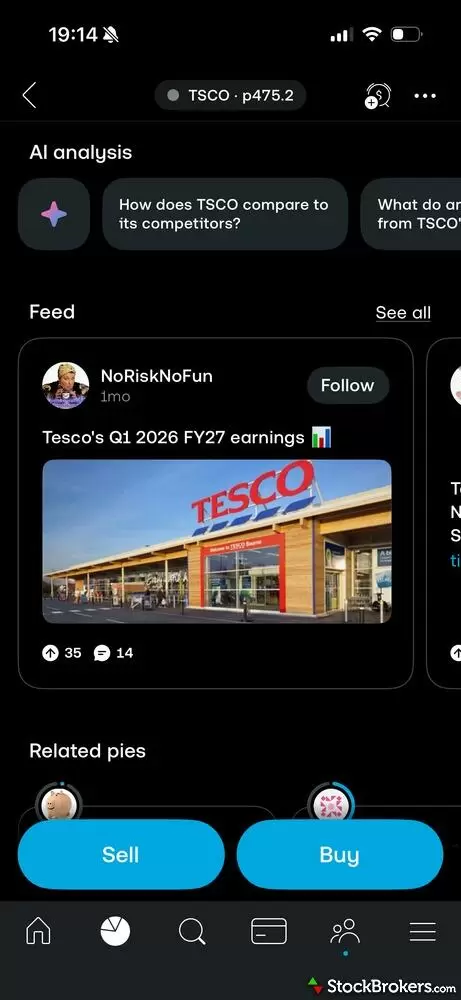
Viewing a profile of a stock on the Trading 212 mobile app, in this case Tesco, includes prompts for AI analysis, a feed of recent news, and related pies.
Trading platforms
You can trade in real time through the Trading 212 website, and it does the core jobs. Orders go through the same way they do in the app, against the same account. It is not very in-depth, though, and it does not do a great deal that the app does not already do. Where it earns its place is screen size. Searching and sorting investments on a laptop is easier than doing it on a phone, and the top winners and losers are easy to see on the home page. If you do everything from your phone anyway, you will barely need it.
Web charting: The same free TradingView charting sits behind the website, with the same 104 indicators and 15 drawing tools. It is close to identical to the app version, with one practical difference. Full-screen charts on a monitor are far easier to work with than the phone version, which I find fiddly.
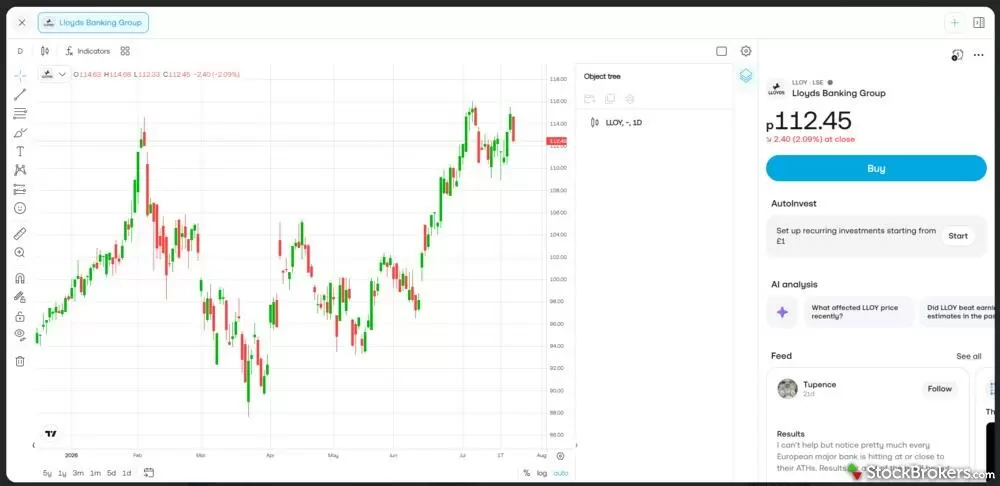
The charting on the Trading 212 web platform utilises TradingView charts. Displayed here is the stock chart for Lloyds Banking Group alongside an order ticket.
Desktop platform: There isn't one. Trading 212 runs an iPhone app, an Android app and the website, and there is no downloadable desktop software. If a desktop terminal is what you want, a specialist broker such as Interactive Brokers, IG or Saxo is a better fit.
Demo account: There is a demo account, and it is aimed mostly at the CFD side of the business. For someone opening an ISA it is less useful than it sounds. Beginners investing through an ISA tend to start with a small real amount while they get to grips with the platform, which does the same job.
| Feature |
Trading 212
|
|---|---|
| Web Platform | Yes |
| iPhone App | Yes |
| Android App | Yes |
| Stock Alerts | Yes |
| Charting - Indicators / Studies | 104 |
| Charting - Drawing Tools | 15 |
| Charting - Notes | Yes |
| Charting - Display Corporate Events | No |
| Charting - Stock Overlays | No |
| Charting - Index Overlays | No |
Interested in additional trading tools?
Looking for more resources to help you become a better trader? See our picks for the best stock screeners, best trading journals, or best free stock chart websites. If you're newer to trading, read our guide on how to invest in stocks in the U.K.
Research
Tap into a holding and you get a chart of the share price history, the high and low over the past day and the past year, the annualised return over the past five years, and the top holdings if it is an ETF. Every ETF also carries a link to its key information document, supplied by the ETF provider, which gives the ongoing annual charge along with the fund's objectives and investment policy. For a lot of investors that is a good starting point.
Stock screening: Filtering shares works well. You can filter by theme, including airlines, automotive and defence, and sort by the U.K.'s biggest companies, U.S. greats, or most bought and most sold. You can also sort by index and then break that down into sectors such as financials or technology, which is a good way to filter shares by country or exchange. The website goes further than the app, letting you filter and sort by dividend yield, sector and analyst consensus.
ETF screening: This is the weakest part of the platform and my main criticism of it. Tabs at the top of the app show most traded, most owned and most sold, and those all lean towards individual shares. About fourth down there is a most popular ETFs section, with tabs for equity ETFs, commodity ETFs and money market ETFs. Searching beyond that is difficult. If you want a more specialist ETF, one focused on megatrends or on innovation in electric cars, it is hard to find on Trading 212. You cannot sort ETFs by currency either, so filtering for a U.K.-based or a U.S.-based fund is not possible. InvestEngine, which specialises in ETFs, makes searching by theme far easier. If you already know the ETF you want, buying it on Trading 212 is easy. Getting inspiration is not.
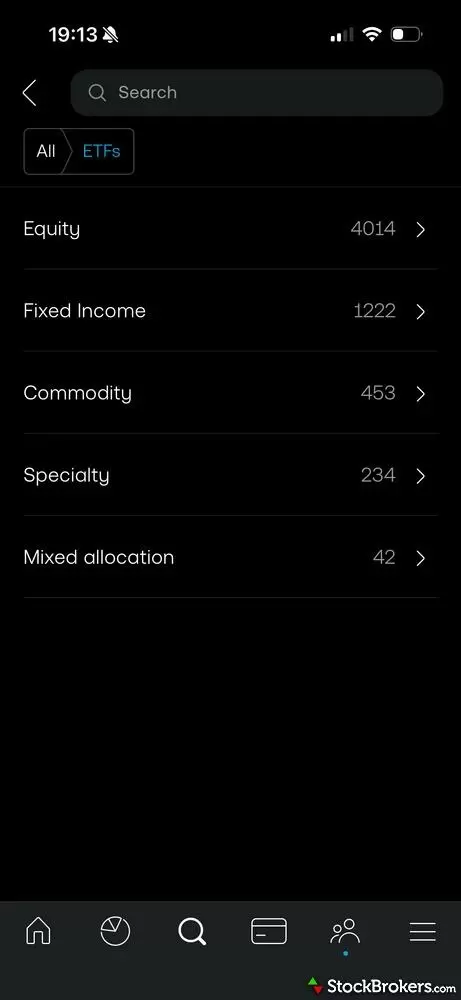
Filtering ETFs to scan for investing opportunities or ideas can be difficult on the Trading 212 app. You have to work through five broad asset classes rather than filtering by theme or industry, and equity alone runs to 4,014 funds.
Real-time data: Free to every user, with no fee and no subscription.
What is absent is research on anything other than shares and ETFs. There are no fund factsheets and no mutual fund screener, because there are no mutual funds. There is no bond research either.
Education
The written material will get a beginner started and not much further. The Learn section of the website carries articles on subjects like building a dividend portfolio and a beginner's guide to diversification. It is not in the same league as the education on some larger platforms. However, a new customer will still find enough there to open an account and make a first investment.
Videos: The YouTube channel is the stronger half. I counted more than 260 videos and more than 1 million subscribers. The Investing 101 series covers the basics, including what ETFs and money market funds are, and there are videos on setting up pies and auto-invest and on dividend investing. More experienced investors get material on momentum trading and on what indicators such as the Stochastic Oscillator mean. One gap is odd. I can't see an obvious video guide to using the platform itself, which feels like a missed opportunity, and other YouTube channels have filled that space instead.
Webinars and tools: There are none of either. Trading 212 runs no client webinars, live or archived, and there are no calculators or planning tools, including no retirement calculator.
Customer support: There is no phone support, either for existing customers or for anyone thinking about joining. You cannot ring up and speak to a person about a problem. In-app live chat is open to existing customers and support runs 24 hours a day, seven days a week, with email as the other route in. Prospective customers do not get live chat. There is no advice service either, so nobody at Trading 212 is going to tell you what to buy. If your portfolio has any complexity, or you simply want a number to ring when something goes wrong, a platform with telephone support will suit you better.
| Feature |
Trading 212
|
|---|---|
| Education (Share Trading) | Yes |
| Education (Funds) | Yes |
| Education (Retirement) | Yes |
| Client Webinars | No |
| Client Webinars (Archived) | No |
Are you new to investing?
We thoroughly tested 16 top U.K. brokerages to find the best choices for beginner investors. Read more in our guide.
Final thoughts
-
Minimum Deposit:
£1 -
ISA:
Yes -
SIPP:
Yes
| Investment Choices | |
| Charges & Fees | |
| Website | |
| Education | |
| Mobile App | |
| Ease of Use |
Check out StockBrokers.com's picks for the best UK investment platforms in 2026.
| #1 Overall | Winner |
| #1 Stocks and Shares ISA | Winner |
| #1 Beginners | Winner |
| 2026 | #1 |
| 2025 | #2 |
| 2024 | #2 |
| 2023 | #5 |
| 2022 | #5 |
| 2021 | #4 |
I'd recommend Trading 212 to anyone whose first question is what a platform costs. You are charged no platform fee, nothing on dealing, 0.15% on currency conversion, and 3.8% paid on cash you haven't invested yet. It appeals to people who want to spend less on investing fees and keep more of their returns, and that is most of us.
Trading 212 took our 2026 award for the best stocks and shares ISA, which the zero fees and the flexible wrapper both earn. The SIPP is the newer story and it works the same way, with no platform charge and no dealing fees. Trading 212 quotes 2 to 8 weeks for a cash transfer in. Mine completed in eight days.
What holds it back is depth. Trading 212 does not offer mutual funds, gilts, corporate bonds, or a Junior ISA. ETF discovery is poor unless you already know what you are buying. There is no desktop platform and no phone number to ring. I'd also say I don't concentrate several hundred thousand pounds on any one newer app. I spread my own money across more than one brokerage.
If you have less than £100,000 to invest, you care about keeping costs down, and you are happy choosing your own shares and ETFs, I think this is the strongest option available to U.K. investors. If you are an active trader who wants a desktop platform, or you want ready-made portfolios, or you need to draw an income from your pension, look at Saxo, IG or one of the traditional brokers instead.
Trading 212 Star Ratings
| Feature |
Trading 212
|
|---|---|
| Overall Rating |
|
| Charges & Fees |
|
| Investment Choices |
|
| Mobile App |
|
| Website |
|
| Ease of Use |
|
| Education |
|
Our testing
Why you should trust us
Elizabeth Anderson has been a financial journalist for more than a decade. She’s written for major national newspapers, contributed to corporate reports and research, and reviewed dozens of share dealing platforms, SIPP providers, ISAs, and brokerage firms. Elizabeth started her career at Bloomberg and has worked for the BBC, The Telegraph, The Times and the i newspaper. She is passionate about helping people understand finance and investing. A keen investor herself, Elizabeth invests through general dealing accounts, ISAs and several SIPPs.
All content on StockBrokers.com is handwritten by a writer, fact-checked by a member of our research team, and edited and published by an editor. Our ratings, rankings, and opinions are entirely our own, and the result of our extensive research and decades of collective experience covering the U.K. brokerage industry.
Ultimately, our rigorous data validation process yields an error rate of less than .1% each year, providing site visitors with quality data they can trust. Learn more about how we test.
How we tested
At StockBrokers.com, our online broker reviews are based on our collected quantitative data as well as the observations and qualified opinions of our expert researchers. Each year we publish tens of thousands of words of research and collect hundreds of data points while testing brokerage firms, share dealing platforms, SIPP providers, ISA providers, and other financial service providers relevant to U.K. investors.
Mobile testing is conducted on modern devices that run the most up-to-date operating systems available:
- For Apple, we use MacBook Pro laptops running the latest version of and the iPhone 15 running the latest version of iOS.
- For Android, we use the Samsung Galaxy S23 Ultra devices running Android OS 14.
All websites and web-based platforms are tested using the latest version of the Google Chrome browser.
Our researchers thoroughly test a wide range of key features, such as the availability and quality of trading platforms for web, desktop, and mobile, charting, real-time and streaming quotes, and educational resources – among other important variables. We also evaluate the overall design of the mobile experience, and look for a fluid user experience moving between mobile and desktop platforms.
Read next
AJ Bell review 2026: Explore ISAs, SIPPs, fees, app features, and ratings. Find out if AJ Bell is the best UK investing platform today.
Elizabeth Anderson June 01, 2026
Trade U.K. and U.S. shares commission-free with CMC Invest. Backed by CMC Markets. Explore if it’s the right app for your portfolio today.
Elizabeth Anderson June 01, 2026
eToro review UK 2026: we tested fees, the app, ISA, crypto and safety first-hand. See pros, cons and who eToro is best for before you sign up.
Elizabeth Anderson June 01, 2026
Capital.com is a U.K. broker primarily known for CFDs (contracts for difference) and spread betting. While it previously offered the chance to buy and sell shares commission-free, you can no longer buy shares directly through Capital.com. Trading is limited to an unleveraged CFD account.
Elizabeth Anderson May 04, 2026
Explore Halifax Share Dealing’s flat fees, ISA options, and ready-made portfolios. Find out whether Halifax offers good value for your investing style.
Elizabeth Anderson June 01, 2026
Interactive Investor offers flat fees, wide investment choice, and strong research tools. See who ii is best for and whether it’s the right platform for you.
Elizabeth Anderson August 10, 2026
Review Lloyds’ investing platform, ISA fees, SIPP costs, and investment options. See if Lloyds is the right low-cost choice for your portfolio.
Elizabeth Anderson June 01, 2026
Our hands-on Hargreaves Lansdown review after testing 16 UK platforms — fees, ISA and SIPP costs, app, and who HL is best for in 2026.
Elizabeth Anderson June 01, 2026
Interactive Brokers offers low-cost, global trading for all investors. Learn more today and see if it’s right for you.
Elizabeth Anderson June 01, 2026
Charles Stanley Direct is an online investment platform where you can invest in a wide range of products, including stocks and ETFs, using various accounts like tax-advantaged ISAs and SIPPs.
Elizabeth Anderson June 01, 2026
Review Freetrade’s fees, ISA costs, and investment options. Learn whether Freetrade’s commission-free trading is the right choice for your portfolio.
Elizabeth Anderson August 26, 2026
IG review 2026. No platform fee, no dealing commission, and 3.75% on uninvested cash. Strong for confident investors, though there are no fractional shares.
Elizabeth Anderson September 01, 2026
Review Vanguard’s low fees, ISA and SIPP options, and simple long-term investing funds. See if Vanguard is the right low-cost platform for your portfolio.
Elizabeth Anderson June 01, 2026
Saxo UK review: Compare ISAs, fees, and trading tools. Discover if Saxo’s global platform is right for your investing goals today.
Elizabeth Anderson June 01, 2026
Webull has a good app, desktop platform, and low fees, but is limited in the UK by offering only US stocks with no products offered from other markets.
Elizabeth Anderson May 04, 2026
Revolut offers easy app-based investing with commission-free trades and a new stocks & shares ISA. See whether Revolut is the right platform for your portfolio.
Elizabeth Anderson June 01, 2026
Robinhood is great for trading UK stocks and for beginners who want to learn the basics without worrying about small trades being swallowed up by hefty fees.
Elizabeth Anderson June 01, 2026
XTB’s low fees and solid education make it ideal for new investors. Learn more about its features and drawbacks in our full XTB review.
Elizabeth Anderson June 01, 2026
Barclays Smart Investor offers a wide range of investments and accounts. See fees, features, and whether it's worth it in our 2026 review.
Elizabeth Anderson June 01, 2026Popular Guides

Compare the best investment platforms in the UK with detailed information on their features, fees, and investment options.
Elizabeth Anderson September 01, 2026
The best U.K. day trading platforms for 2026, tested and ranked. Compare Interactive Brokers, Saxo, IG, XTB and Trading 212 on charting, speed and fees.
Elizabeth Anderson August 21, 2026
We tested 16 FCA-regulated U.K. platforms to find the best trading platforms for beginners in 2026. Compare fees, ISAs, and apps to pick your first platform.
Elizabeth Anderson September 01, 2026
The best UK mobile trading apps appeal to all levels of trading skill — beginner, active trader, and longer-term investor. Check out our top picks here.
Elizabeth Anderson September 01, 2026More Guides
- Best Lifetime ISAs of 2026
- Best SIPP Providers of 2026
- 5 Best Demo Trading Accounts in the UK for 2026
- Best Online Brokers for Crypto Trading in 2026
- Best Junior SIPPs for 2026
- Best Stocks and Shares ISAs for 2026
- Best Cash ISA Accounts & Rates for 2026
About Trading 212
Trading 212 is an FCA-regulated investment platform. It launched commission-free share dealing in the U.K. in 2017 and free fractional dealing at the end of 2019. The cash ISA arrived in May 2024 and the SIPP in 2026. Alongside the Invest account, the cash ISA, the stocks and shares ISA and the SIPP, it runs a separate CFD business.
The cash ISA launch in May 2024 widened the platform's appeal beyond investors to savers, and it has become more beginner-friendly since. You still need some working knowledge of investing before you get much out of it.
About the Editorial Team
Elizabeth Anderson, lead writer and researcher for the U.K. market, has been a financial journalist for more than a decade. In addition to her work with StockBrokers.com, she has written extensively for major publications including BBC, The Times, and Bloomberg. A keen investor herself, she is passionate about helping people understand finance and investing.
Jeff Anberg is a Senior Editor at StockBrokers.com. Along with years of experience in media distribution at a global newsroom, Jeff has a versatile knowledge base encompassing the technology and financial markets. He is a long-time active investor and engages in research on emerging markets like cryptocurrency. Jeff holds a Bachelor’s Degree in English Literature with a minor in Philosophy from San Francisco State University.
Steven Hatzakis is the Global Director of Research for ForexBrokers.com. Steven previously served as an Editor for Finance Magnates, where he authored over 1,000 published articles about the online finance industry. Steven is an active fintech and crypto industry researcher and advises blockchain companies at the board level. Over the past 20 years, Steven has held numerous positions within the international forex markets, from writing to consulting to serving as a registered commodity futures representative.