 Charles Schwab
 Fidelity
 Interactive Brokers
 E*TRADE
 Webull
 Robinhood
 TradeStation
 tastytrade
 eToro
eToro Trading 212
 Interactive Investor
 IG
IG Interactive Brokers
 XTB
XTB Hargreaves Lansdown
 Saxo
Saxo Charles Stanley Direct
 CIBC Investor's Edge
 Interactive Brokers
 Moomoo
 Questrade
 Qtrade
 TD Direct Investing
 Wealthsimple
 Finviz
 Stock Rover
 Seeking Alpha
 StockHero
 TipRanks
 TrendSpider
 Trade Ideas
 TraderSync
 TradingView
 Tradervue
 TradeZella
E*TRADE vs Robinhood 2026

Written by Jessica Inskip
Director of Investor Research

Edited by Jeff Anberg
Senior Editor

Reviewed by Blain Reinkensmeyer
Managing Partner
Jessica InskipDirector of Investor Research
Jessica Inskip is Director of Investor Research at StockBrokers.com, bringing 15 years of experience in brokerage and trading strategy. Jessica focuses on investor education and brokerage industry research.


 Why you can trust us
Led by Jessica Inskip, Director of Investor Research, the StockBrokers.com research team collects thousands of data points across hundreds of variables. We evaluate features important to every kind of investor, including beginners, casual investors, passive investors, and active traders. We carefully track data on margin rates, trading costs, and fees to rate stock brokers across our proprietary testing categories.
Our researchers open personal brokerage accounts and test all available platforms on desktop, web, and mobile for each broker reviewed on StockBrokers.com. Learn more about how we test.
E*TRADE vs Robinhood pits a full-service veteran against the app that made commission-free trading the norm. For most investors, E*TRADE is the stronger all-around pick. It brings Morgan Stanley research, mutual funds and bonds, in-depth options tools, and a bank attached to the brokerage. Robinhood is the better deal for cost-focused traders. Options contracts are $0 there against $0.65 at E*TRADE, margin runs far cheaper, and it lists 22 cryptocurrencies to E*TRADE's three. It also runs prediction markets E*TRADE doesn't offer.
E*TRADE vs Robinhood
- Minimum Deposit: $0.00
- Stock Trades: $0.00
- Options (Per Contract): $0.65
With two distinct platforms (E*TRADE Web and Power E*TRADE) the broker effectively serves both the "set-it-and-forget-it" investor and the high-volume derivatives trader. Whether you aim to construct a long-term retirement portfolio or deploy complex options strategies, E*TRADE provides a sophisticated, dependable environment that grows with your ambition. Read full review
- High-quality experience for both passive investors and active traders.
- Access to Morgan Stanley’s deep market analysis and interactive reports.
- Excellent bond resource center and a user-friendly ladder tool.
- Base margin rates, starting at over 12%, are significantly higher than top competitors.
- Spot crypto trading is limited to Bitcoin, Ethereum, and Solana, and those assets are held at zerohash rather than at E*TRADE.
- Minimum Deposit: $0.00
- Stock Trades: $0.00
- Options (Per Contract): $0.00
Robinhood is best known for its commission-free trading, modern mobile and desktop platforms, and low-cost access to options, margin, and futures trading. Read full review
- Robinhood Legend offers 90+ technical indicators.
- 3% IRA match on contributions.
- The Investor's Guild explains complex topics.
- Futures trading and 24-hour trading.
- No economic calendars, sector heat maps, or Treasury yield curves.
- No deep fundamental research.
- Legend lacks critical tools.
- No mutual funds, individual bonds, custodial or trust accounts.
Robinhood vs E*TRADE at a glance
Our testing found a clear shape to this matchup. E*TRADE wins most of the categories we grade, from research to platforms to range of investments. Robinhood answers on price, on simplicity, and on prediction markets E*TRADE doesn't carry. The table below breaks it down.
| Feature |
 E*TRADE E*TRADE
|
 Robinhood Robinhood
|
|---|---|---|
| Overall |
|
|
| Mobile Trading Apps |
|
|
| Advanced Trading |
|
|
| Minimum Deposit | $0.00 | $0.00 |
| Stock Trades | $0.00 | $0.00 |
| Options (Per Contract) | $0.65 | $0.00 |
| Futures Trading | Yes | Yes |
| Crypto Trading | Yes | Yes |
Top takeaways for E*TRADE in 2026
- The research is Morgan Stanley-backed with scannable analyst reports and a standout sector valuation tool.
- Power E*TRADE won our #1 Active Trading Web Platform award, and building a multi-leg options trade on it is refreshingly easy.
- The product range runs from mutual funds to bonds to futures, with FDIC banking attached to the brokerage.
- The account lineup is deep, including SEP and SIMPLE IRAs, custodial, trust, and business accounts.
- Costs run higher for active traders. Options are $0.65 per contract and margin starts near 13%.
Top takeaways for Robinhood in 2026
- It's the cheaper broker for active trading, with $0 options contracts and margin starting at 5.75%.
- Robinhood lists 22 coins to E*TRADE's three, plus prediction markets E*TRADE doesn't offer.
- Its education is the most readable I test, ordered so a beginner never gets lost.
- It automates the small things, with recurring buys and fractional shares in both stocks and ETFs.
- The gaps are real: no mutual funds, no bonds, no paper trading, and thinner research.
Robinhood vs E*TRADE: fees and commissions
Stocks trade free at both, and E*TRADE clears mutual funds and online Treasuries at $0 too. The gaps show up in options, margin, and what each broker lets you trade. We verified the pricing below.
| Feature |
E*TRADE
|
Robinhood
|
|---|---|---|
| Stock Trades | $0.00 | $0.00 |
| Mutual Fund Trade Fee | $0.00 | N/A |
| Options (Per Contract) | $0.65 | $0.00 |
| Options Exercise Fee | $0.00 | $0.00 |
| Options Assignment Fee | $0.00 | $0.00 |
| Futures (Per Contract) | $1.50 | $0.75 |
| Broker Assisted Trade Fee | $25 | N/A |
| Margin Rate Under $25,000 | 12.95% | 5.25% |
| Bond Trade Fee | Varies | N/A |
| IRA Annual Fee | $0.00 | $0.00 |
| Account Transfer Out (Full) | $75.00 | $100.00 |
Where Robinhood wins on cost
Robinhood is the cheaper home for anyone who trades actively. Options contracts are $0 with no exercise or assignment fees, where E*TRADE charges $0.65 per contract. The margin gap is wider still. Robinhood lends from 5.75% while E*TRADE starts near 13% on smaller balances. Robinhood is cheaper on futures too, at $0.75 a contract to E*TRADE's $1.50.
Where E*TRADE wins on cost
E*TRADE charges nothing to trade mutual funds or buy Treasuries online, two things Robinhood doesn't offer at all. Moving an account out is also less expensive, with free partial transfers and a $75 full transfer against Robinhood's flat $100. For the buy-and-hold investor who lives in funds, E*TRADE is the cheaper place to actually own what you want.
Verdict
Best for active options and margin traders: Robinhood.
Best for fund and bond investors: E*TRADE.
The split is clean. Robinhood is cheaper if your costs come from trading, and E*TRADE is cheaper if they come from owning funds and bonds Robinhood can't offer.
E*TRADE vs Robinhood: range of investments
E*TRADE is built to be a complete brokerage. Robinhood is built to trade a focused, modern slice of the market. That difference decides who each one suits.
| Feature |
E*TRADE
|
Robinhood
|
|---|---|---|
| Options Trading | Yes | Yes |
| Fractional Shares (Stocks) | Yes | Yes |
| Fractional Shares (ETFs) | Yes | Yes |
| Mutual Funds | Yes | No |
| Fixed Income (Treasurys) | Yes | No |
| Fixed Income (Corporate Bonds) | Yes | No |
| Fixed Income (Municipal Bonds) | Yes | No |
| Crypto Trading | Yes | Yes |
| Crypto Trading - Total Coins | 3 | 22 |
| Futures Trading | Yes | Yes |
| Futures Options | Yes | No |
| Forex Trading | No | No |
| Prediction markets | No | Yes |
| IPO Access | Yes | Yes |
| Order Type - After Hours | Yes | Yes |
| Order Type - 24 hr Extended | No | Yes |
| Order Type - Broker Assisted | Yes | No |
Where E*TRADE wins
E*TRADE simply covers more of the market. It trades mutual funds, a deep bond and CD lineup, futures, and futures options, none of which Robinhood offers. The account side runs deeper too, with SEP and SIMPLE IRAs, custodial accounts, trusts, and business accounts that Robinhood doesn't open. E*TRADE now matches Robinhood on fractional shares of individual stocks.
Where Robinhood wins
Robinhood owns the modern lineup. It lists 22 cryptocurrencies to E*TRADE's three and runs prediction markets E*TRADE doesn't offer. It also runs recurring buys in both stocks and ETFs, where E*TRADE automates ETFs only. For recurring dollar-based investing in the names you choose, Robinhood is the more flexible app.
Verdict
Best for a complete, traditional lineup: E*TRADE.
Best for crypto selection and prediction markets: Robinhood.
If you want mutual funds, bonds, or a trust account, only E*TRADE delivers. If you want a broader crypto menu or prediction markets, Robinhood is the better fit.
Featured Offers
Robinhood vs E*TRADE: mobile apps
Both score well on mobile, but they reward different users. Robinhood ships one clean app for everyone. E*TRADE ships two, a flagship app plus a separate Power E*TRADE app for active traders. Our testing compared research, charting, and order entry on each.
| Feature |
E*TRADE
|
Robinhood
|
|---|---|---|
| iPhone App | Yes | Yes |
| Android App | Yes | Yes |
| Apple Watch App | Yes | Yes |
| Stock Alerts | Yes | Yes |
| Mobile Watchlists - Column Customization | Yes | Yes |
| Mobile Watchlists - Create & Manage | Yes | Yes |
| Mobile Watchlists - Column Filtering | Yes | Yes |
Where Robinhood's app wins
Robinhood is the easier app to live in day to day. The layout is sleek, placing a trade takes seconds, and the AI digests give a quick read on why a stock moved. Recurring buys run quietly in the background. For someone who checks in a few times a week rather than all day, nothing here gets in the way.

Robinhood’s mobile options chain features a clean, simplified layout, with percent breakeven shown by default for each contract. While this may appeal to short-term traders, it lacks key metrics, like the Greeks or probability of profit, that serious options traders often rely on. It’s a sleek experience, but one that leans more toward speculation than in-depth strategy analysis.
Where E*TRADE's app wins
E*TRADE puts real stock research in your hand. Pull up a company and you get Morgan Stanley reports built for a phone screen, scannable rather than buried in a PDF, plus analyst targets and earnings analysis. Serious traders also get the dedicated Power E*TRADE app, where the charts they built on desktop carry over. The flagship app's own options chain is basic, so options traders will want that second app.
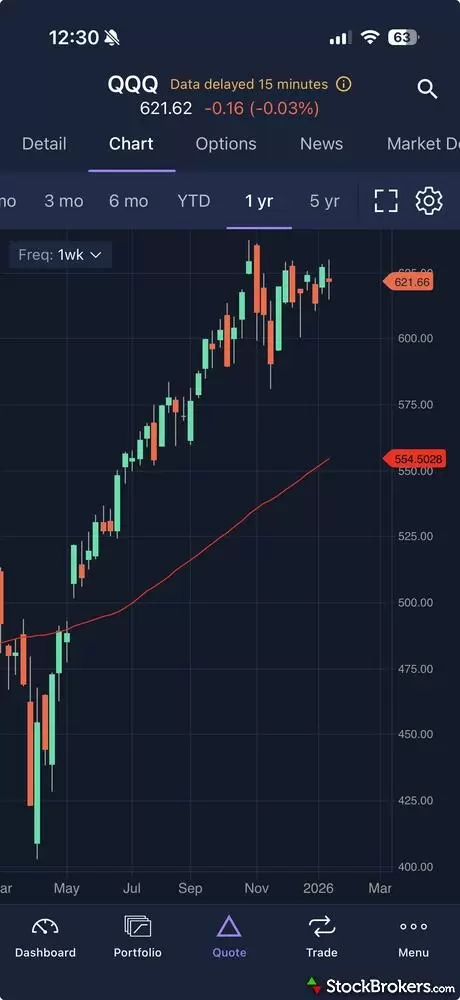
Power E*TRADE’s mobile app delivers advanced charting tools designed for active traders on the go. This customized view shows a candlestick chart with 13, 26, and 40-week moving averages applied. The platform makes it easy to personalize technical charts and monitor market momentum from your phone.
Verdict
Best for simple, everyday investing: Robinhood.
Best for research and active trading on the go: E*TRADE.
Robinhood is the smoother daily driver. E*TRADE gives you more to dig into, especially if you research stocks or want a true active-trader app.
E*TRADE vs Robinhood: trading platforms and tools
E*TRADE gives you Power E*TRADE on the web plus a Power E*TRADE Pro desktop platform. Robinhood gives you its website and Robinhood Legend, a browser-based active trader platform. Neither offers backtesting, but the rest of the toolset splits sharply.
| Feature |
E*TRADE
|
Robinhood
|
|---|---|---|
| Active Trading Platform | Power E*TRADE | Robinhood Legend |
| Desktop Trading Platform | Yes | No |
| Web Trading Platform | Yes | Yes |
| Desktop Platform (Mac) | Yes | No |
| Paper Trading | Yes | No |
| Watchlists - Total Fields | 43 | 34 |
| Charting - Indicators / Studies | 121 | 90 |
| Charting - Drawing Tools | 37 | 26 |
| Charting - Adjust Trades on Chart | Yes | Yes |
| Charting - Custom Studies | No | No |
| Ladder Trading | No | Yes |
| Level 2 Quotes - Stocks | Yes | Yes |
| Trade Hot Keys | Yes | Yes |
| Trade Ticket - Margin Impact | Yes | Yes |
| Trade Ticket - Tax Lot Selection | Yes | Yes |
Where E*TRADE wins
E*TRADE is the better options platform, and it isn't close. On Power E*TRADE I built a bull call spread straight off the chain by clicking an ask and a bid, with the bid and ask shown for each leg and a snapshot analysis laying out max profit, loss, and breakeven. The tool suite goes further with an income backtester and a strategy optimizer that suggests trades to match your outlook. E*TRADE also brings paper trading, Level 2 quotes, conditional orders, and short selling, none of which Robinhood offers.

Power E*TRADE’s snapshot analysis makes options trading more approachable by visually mapping out key outcomes like max gain, max loss, and breakeven. In this example of purchasing a long call, the platform uses intuitive smiley face icons to highlight these critical points, adding a touch of fun to a typically complex strategy. It’s a great way to help traders quickly grasp potential risk and reward.
Where Robinhood wins
Robinhood Legend is the cleaner, more approachable canvas. Its drawings snap to exact prices, while E*TRADE's drawing tools fought me and wouldn't lock to a level. Legend is lighter to set up and quicker to move around, so if your day is mostly reading charts rather than building spreads, it's the nicer place to work.
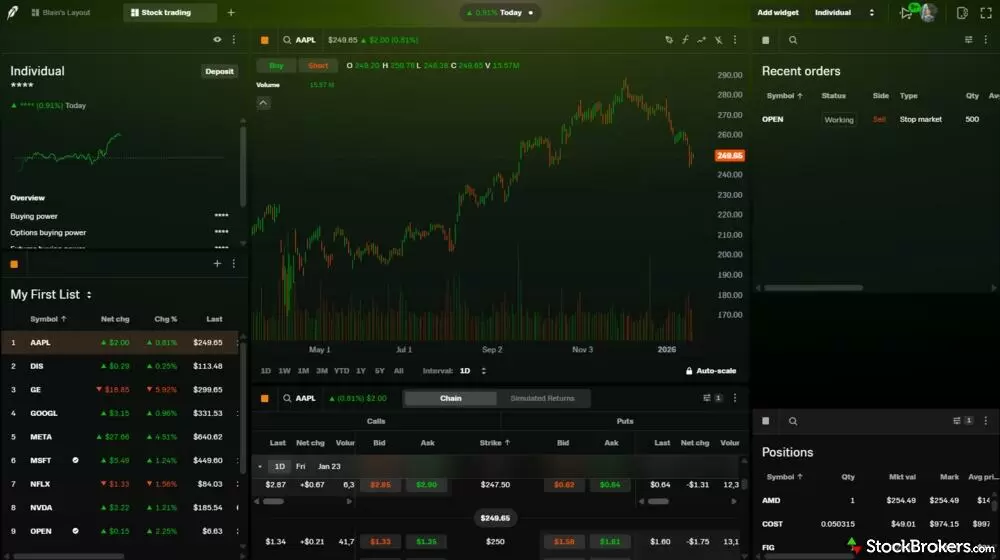
Robinhood Legend is arguably one of the best-looking active trading platforms on the market, with a sleek, modern interface that’s a pleasure to use. However, that clean design comes with trade-offs: some advanced tools and features are missing compared to more robust platforms. It’s a great experience for visual clarity and ease of use, but power traders may find themselves wanting more.
Verdict
Best for options and active traders: E*TRADE.
Best for clean, chart-first simplicity: Robinhood.
If you trade options or want paper trading and conditional orders, E*TRADE is the real toolkit. If you mostly chart and want it smooth, Legend wins on feel.
Robinhood vs E*TRADE: research
This is the widest gap between them. E*TRADE carries institutional-grade research from Morgan Stanley, while Robinhood keeps things light and readable. We checked both feature by feature below.
| Feature |
E*TRADE
|
Robinhood
|
|---|---|---|
| Research - Stocks | Yes | Yes |
| Screener - Stocks | Yes | Yes |
| Research - ETFs | Yes | Yes |
| Screener - ETFs | Yes | No |
| Research - Mutual Funds | Yes | No |
| Screener - Mutual Funds | Yes | No |
| Research - Fixed Income | Yes | No |
| Screener - Fixed Income | Yes | No |
| Research - Pink Sheets / OTCBB | Yes | Yes |
| Options Chains - IV | Yes | Yes |
| Option Chains - Total Greeks | 5 | 5 |
| Strategy Net Greeks | Yes | No |
| Options - Strategy Builder | Yes | Yes |
Where E*TRADE wins
E*TRADE gives you depth almost everywhere. Pull up a stock and you get six analyst reports, including Morgan Stanley research designed to be scanned rather than downloaded. Its sector tool plots valuation and growth metrics across all 12 sectors against the S&P 500, and the mutual fund and fixed income research are among the best I test. There's also a full options tool suite with a probability calculator and income finder.
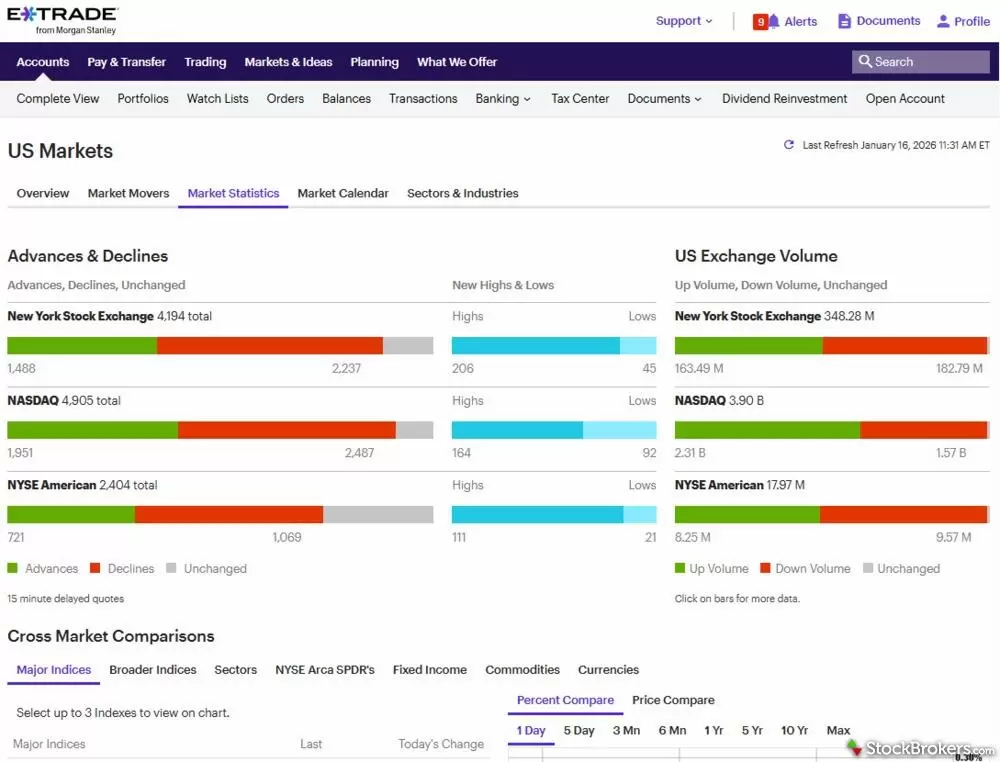
E*TRADE’s market breadth tool offers a clear snapshot of advancers and decliners across the Nasdaq and NYSE, helping traders gauge overall market strength. With visual breakdowns of new highs and lows, plus exchange volume metrics, it’s a powerful data visualization tool for understanding market momentum at a glance.
Where Robinhood wins
Robinhood is the better quick read. Its in-house Investor's Guild and AI digests explain why something moved in plain language, where E*TRADE shows you more data than a casual investor needs. If you want a fast, human take rather than a research terminal, Robinhood gets you there with less effort.

Robinhood’s research tools present analyst ratings in a clean, visually appealing format, shown here with the buy, hold, and sell breakdown for Apple. The platform also includes concise “bulls vs. bears” commentary, giving investors a quick snapshot of both sides of the debate. While this type of data is common across brokerages, Robinhood’s design makes it especially easy to digest at a glance.
Verdict
Best for deep research and screening: E*TRADE.
Best for a readable market take: Robinhood.
The contrast is stark on data. E*TRADE has mutual fund and bond research, sector analysis, and full screeners. Robinhood still can't show you an economic calendar.
E*TRADE vs Robinhood: education
These two stumble in opposite ways. E*TRADE has more material, with strong webinars, excellent fixed income content, a top-notch tax center, and detailed retirement tools. The problem is finding any of it. Its library is sprawling and poorly ordered, and I had to search for almost everything, which would overwhelm a true beginner. Robinhood is the reverse. It offers no courses, webinars, or calculators, but what it writes is the clearest in the business, sequenced so a new investor moves from one idea to the next without getting lost.
| Feature |
E*TRADE
|
Robinhood
|
|---|---|---|
| Education (Stocks) | Yes | Yes |
| Education (ETFs) | Yes | Yes |
| Education (Options) | Yes | Yes |
| Education (Mutual Funds) | Yes | No |
| Education (Fixed Income) | Yes | Yes |
| Videos | Yes | Yes |
| Webinars | Yes | No |
Verdict
Best for clear beginner reading: Robinhood.
Best for webinars and retirement and tax planning: E*TRADE.
If you're starting from zero and want to read your way up, Robinhood's writing is easier to follow. If you want live webinars and serious planning tools, E*TRADE has the deeper shelf, as long as you're willing to hunt for it.
E*TRADE and Robinhood: accounts and banking
E*TRADE is a bank as well as a broker, with FDIC-insured checking and savings, CDs, mortgages, and a debit and credit card sitting alongside the brokerage. Robinhood has no FDIC banking, no checking or savings, and no CDs. It offers a debit card and a cash-back credit card, plus an IRA match that vests like an employer 401(k) match. E*TRADE also opens the account types Robinhood skips, including SEP and SIMPLE IRAs, custodial accounts, trusts, and business accounts, which matters once your financial life grows past a single brokerage account.
Verdict
Best for banking and a full account lineup: E*TRADE.
Best for the IRA match and a simple card: Robinhood.
Final thoughts: Robinhood vs E*TRADE
- Minimum Deposit: $0.00
- Stock Trades: $0.00
- Options (Per Contract): $0.65
With two distinct platforms (E*TRADE Web and Power E*TRADE) the broker effectively serves both the "set-it-and-forget-it" investor and the high-volume derivatives trader. Whether you aim to construct a long-term retirement portfolio or deploy complex options strategies, E*TRADE provides a sophisticated, dependable environment that grows with your ambition. Read full review
- High-quality experience for both passive investors and active traders.
- Access to Morgan Stanley’s deep market analysis and interactive reports.
- Excellent bond resource center and a user-friendly ladder tool.
- Base margin rates, starting at over 12%, are significantly higher than top competitors.
- Spot crypto trading is limited to Bitcoin, Ethereum, and Solana, and those assets are held at zerohash rather than at E*TRADE.
- Minimum Deposit: $0.00
- Stock Trades: $0.00
- Options (Per Contract): $0.00
Robinhood is best known for its commission-free trading, modern mobile and desktop platforms, and low-cost access to options, margin, and futures trading. Read full review
- Robinhood Legend offers 90+ technical indicators.
- 3% IRA match on contributions.
- The Investor's Guild explains complex topics.
- Futures trading and 24-hour trading.
- No economic calendars, sector heat maps, or Treasury yield curves.
- No deep fundamental research.
- Legend lacks critical tools.
- No mutual funds, individual bonds, custodial or trust accounts.
For most investors, E*TRADE is the one I'd recommend. Its Power E*TRADE platform earned our #1 Active Trading Web Platform award this year, which tracks with how easily I built and analyzed an options spread on it. Add in Morgan Stanley research, mutual funds and bonds, a full account lineup, and a bank under the same roof, E*TRADE can handle a diverse portfolio of assets. If you trade options, research seriously, or want one place for your whole financial life, that's where I'd send you.
Robinhood still earns its place. It's cheaper for active trading, it lists 22 coins to E*TRADE's three, and it took our #1 Prediction Markets award this year. Its app is simpler and its writing is clearer than anything in E*TRADE's library. If you trade with one eye on cost, want a wider crypto menu, or just want an app you can understand in a minute, Robinhood is the better alternative.
Jessica's take
"E*TRADE has incredibly useful research, and it scores really high on the usefulness scale, which is hard to do in my world. Robinhood is the opposite. Outside of major news and the indices, I couldn't get much information on the markets. One is a research engine, the other isn't."
Jessica Inskip
Director of Investor Research
Overall verdict
Best for most investors: E*TRADE.
Best for low-cost trading, crypto selection, and simplicity: Robinhood.
| Feature |
E*TRADE
|
Robinhood
|
Category Winner |
|---|---|---|---|
| Overall |
|
|
E*TRADE |
| Range of Investments |
|
|
E*TRADE |
| Mobile Trading Apps |
|
|
E*TRADE |
| Advanced Trading |
|
|
E*TRADE |
| Research |
|
|
E*TRADE |
| Education |
|
|
E*TRADE |
| Ease of Use |
|
|
Tie |
Read next
Popular 1v1 comparisons
- Charles Schwab vs Fidelity 2026
- Fidelity vs Robinhood in 2026
- Fidelity vs J.P. Morgan Self-Directed Investing 2026
- Interactive Brokers vs TradeStation 2026
- Charles Schwab vs Interactive Brokers 2026
More trading guides

Find the best crypto trading platform for 2026. We rank eToro, Fidelity, Interactive Brokers, Webull, and Robinhood on fees, security, and coin selection.
Steven Hatzakis May 27, 2026
Discover the best day trading platforms. Compare IBKR, Schwab, Fidelity, E*TRADE, and TradeStation for speed, tools, and margin rates.
Jessica Inskip October 05, 2026
Find the best Roth IRA accounts. Fidelity, Schwab, and E*TRADE lead with low fees, smart investing tools, and retirement planning support.
Andrea Coombes April 27, 2026
Find the best penny stock brokers. Compare Fidelity, Firstrade, Schwab, E*TRADE, and TradeStation for OTC access, fees, and tools.
Jessica Inskip August 02, 2026
We tested the 5 best futures trading platforms of 2026. Compare commissions, margin rates, and tools for beginners and active traders. Find the right platform for you.
Jessica Inskip October 05, 2026
Explore the best international brokers for U.S. investors. Compare Interactive Brokers, Charles Schwab, and Fidelity for global stock trading access.
Jessica Inskip May 22, 2026
Discover the best brokers for trade execution. Compare Fidelity, Interactive Brokers, and more for price improvement, speed, and transparency.
Jessica Inskip May 22, 2026
Interactive Brokers and Fidelity lead our 2026 ranking of the best free stock trading platforms, tested on the true cost of $0 commissions and hidden fees.
Jessica Inskip September 02, 2026
Start investing with ease. Explore the best beginner-friendly trading platforms with low fees, great education, and intuitive apps.
Jessica Inskip October 05, 2026
Find the best brokerage for high-net-worth investors. Compare Fidelity, Schwab, Merrill, and more for premium services and tailored investment tools.
Jessica Inskip January 27, 2026
Discover the best stock brokers of 2026. Compare Schwab, Fidelity, Interactive Brokers, E*TRADE, and more to find the top trading platform for your needs.
Jessica Inskip August 06, 2026
Find top U.S. forex brokers. From tastyfx to OANDA, explore platforms with strong regulation, great tools, and user-friendly trading.
Steven Hatzakis May 29, 2026
Practice investing risk-free with the best paper trading platforms. Compare Webull, Schwab, Interactive Brokers, E*TRADE, and more.
Jessica Inskip July 24, 2026
Find the best rollover IRA accounts. Compare Fidelity, Schwab, and E*TRADE for easy transfers, low fees, and smart retirement investing tools.
Andrea Coombes May 15, 2026
Find the best IRA accounts. Compare Fidelity, Schwab, Merrill Edge, E*TRADE, & J.P. Morgan for retirement planning, fees, tools, and account flexibility.
Jessica Inskip March 31, 2026
Find the top bank brokerages. From Merrill Edge to Ally, discover brokers that combine banking, investing, and rewards in one account.
Jessica Inskip April 16, 2026
We tested the best options trading platforms for 2026. Compare tastytrade, Fidelity, IBKR, E*TRADE & Schwab on tools, fees, and picks for beginners.
Jessica Inskip September 09, 2026Popular broker reviews
Read our Interactive Brokers review and see why it's a top choice for active traders with low costs, cutting-edge platforms, and global reach.
Jessica Inskip July 31, 2026
Read our Webull review and discover its commission-free trading, sleek platforms, paper trading tools, and fractional shares.
Jessica Inskip September 18, 2026
Read our Charles Schwab review to learn why its platforms, research, and investor resources make it one of the top-ranked brokerages.
Jessica Inskip September 30, 2026
Ally Invest scores 3/5 in our 2026 review. See how its $0 stock trades, $0.50 options, strong fixed income tools, and Ally Bank integration stack up.
Jessica Inskip September 14, 2026
Our eToro review rates the social investing platform 3.0/5. Stock and ETF trades cost $0, crypto trades carry a 1% fee, and the minimum deposit is $50.
Jessica Inskip September 25, 2026
Read our Public.com review to learn how its intuitive platform and community-driven features help simplify investing for first-time traders.
Jessica Inskip September 18, 2026
Read our Firstrade review and see why it’s a top choice for options traders, offering $0 contract fees, robust tools, and a growing feature set.
Jessica Inskip May 04, 2026
Our Robinhood review tests $0 stock and options trades, #1-ranked prediction markets, and AI agent trading, plus where its website research falls short.
Jessica Inskip October 01, 2026
Read our J.P. Morgan Self-Directed Investing review and discover its strengths in research, planning tools, and integration for Chase clients.
Jessica Inskip May 15, 2026
Read our 2026 E*TRADE review to see how powerful research, versatile platforms, and diverse investments make it a top choice for all investors.
Jessica Inskip September 29, 2026
Read our TradeStation review and discover why its pro-level tools, deep customization, and options focus make it a top choice for active traders.
Jessica Inskip October 07, 2026
Fidelity charges $0 stock and ETF trades and won #1 for Research and Education in 2026. See our tested review of its fees, platforms, IRAs, and apps.
Jessica Inskip September 30, 2026
Read our tastytrade review and discover why it’s the top choice for options traders, with low fees, advanced tools, and a seamless platform.
Jessica Inskip October 05, 2026
Read our Merrill Edge Self-Directed review and see how it combines powerful investing tools, robust research, and integrated banking benefits.
Jessica Inskip September 29, 2026About the Editorial Team
Jessica Inskip is Director of Investor Research at StockBrokers.com, bringing 15 years of experience in brokerage and trading strategy. A former FINRA-licensed rep, she held Series 7, 63, 66, and 4 licenses. Jessica focuses on investor education and brokerage industry research, appears regularly on CNBC, Bloomberg, The Schwab Network, Fox Business, and Yahoo! Finance, and hosts the Market MakeHer podcast.
Jeff Anberg is a Senior Editor at StockBrokers.com. Along with years of experience in media distribution at a global newsroom, Jeff has a versatile knowledge base encompassing the technology and financial markets. He is a long-time active investor and engages in research on emerging markets like cryptocurrency. Jeff holds a Bachelor’s Degree in English Literature with a minor in Philosophy from San Francisco State University.
Blain Reinkensmeyer has 25 years of trading experience with over 2,500 trades placed during that time. He heads research for all U.S.-based brokerages on StockBrokers.com and is respected by executives as the leading expert covering the online broker industry. Blain’s insights have been featured in the New York Times, Wall Street Journal, Forbes, and the Chicago Tribune, among other media outlets.