 Charles Schwab
 Fidelity
 Interactive Brokers
 E*TRADE
 Webull
 TradeStation
 tastytrade
 eToro
eToro Trading 212
 Interactive Investor
 IG
IG Interactive Brokers
 XTB
XTB Hargreaves Lansdown
 Saxo
Saxo Charles Stanley Direct
 CIBC Investor's Edge
 Interactive Brokers
 Moomoo
 Questrade
 Qtrade
 TD Direct Investing
 Wealthsimple
 Finviz
 Stock Rover
 Seeking Alpha
 StockHero
 TipRanks
 TrendSpider
 Trade Ideas
 TraderSync
 TradingView
 Tradervue
 TradeZella
Best Custodial Brokerage Accounts for 2026

Written by Jessica Inskip
Director of Investor Research

Edited by Jeff Anberg
Senior Editor

Fact-checked by Joey Shadeck
Research Analyst
Jessica InskipDirector of Investor Research
Jessica Inskip is Director of Investor Research at StockBrokers.com, bringing 15 years of experience in brokerage and trading strategy. Jessica focuses on investor education and brokerage industry research.


 Why you can trust us
Led by Jessica Inskip, Director of Investor Research, the StockBrokers.com research team collects thousands of data points across hundreds of variables. We evaluate features important to every kind of investor, including beginners, casual investors, passive investors, and active traders. We carefully track data on margin rates, trading costs, and fees to rate stock brokers across our proprietary testing categories.
Our researchers open personal brokerage accounts and test all available platforms on desktop, web, and mobile for each broker reviewed on StockBrokers.com. Learn more about how we test.
When you're building generational wealth, the best custodial brokerage account is the most critical first step. A custodial account is one an adult manages for a child or grandchild until they reach adulthood. It replaces the piggy bank, letting you outpace inflation with market returns while teaching your kid about investing along the way.
The hard part is choosing from a crowded field. There's the rigid structure of 529 college savings plans on one side, and the flexibility of UTMA and UGMA accounts on the other. It's easy to stall out. And managing the money shouldn't require a finance degree or a clunky, outdated app.
So I tested the top platforms myself, with a parent's priorities front and center. I weighted three things most heavily: account variety, fractional shares, and youth-focused educational content.
Best platforms for custodial brokerage accounts
How we tested for the best custodial accounts
To evaluate these platforms, I bypassed marketing materials and funded real accounts to test each broker's parent-friendly design for managing custodial accounts. I specifically checked how easily users can execute trades, manage asset allocation, and track unearned income tax thresholds without relying on institutional jargon. To ensure a straightforward user experience, I also prioritized intuitive mobile apps, responsive customer support, and efficient account maintenance.
I prioritized firms offering youth-focused educational content that actively helps beneficiaries build long-term financial literacy. I also evaluated the availability of fractional shares, direct family banking integration, and flexible account structures designed to support generational wealth building from infancy to adulthood. Here are the top brokers to help secure your child’s financial future.
- Minimum Deposit: $0.00
- Stock Trades: $0.00
- Options (Per Contract): $0.65
I consider Fidelity the ultimate destination for family wealth building. They treat minor investing as an ongoing journey rather than a single transaction, offering everything from standard UTMA accounts to innovative teen-owned platforms. It seamlessly bridges the gap between parental control and financial independence. Read full review
- Innovative Fidelity Youth Account allows teens to trade with parental oversight.
- Exceptional "Life Events" educational resources tailored for parents.
- Supports automated, recurring investments into passive ETFs.
- Advanced educational content can occasionally rely heavily on financial jargon.
- Market research is not contextually integrated directly into the learning center.
- Minimum Deposit: $0.00
- Stock Trades: $0.00
- Options (Per Contract): $0.65
Schwab excels by providing a highly structured, academic approach to managing a child's financial future. I found their portfolio checkup tools and college savings calculators essential for keeping long-term goals on track. It is the perfect fit for parents who want to learn market mechanics alongside their children. Read full review
- Industry-leading educational videos and structured learning courses.
- Advanced portfolio checkup tool aligns custodial holdings with specific risk tolerances.
- Stock Slices allow for equity investments starting at just $5.
- Does not offer fractional share trading for ETFs.
- Foundational stock market education is sometimes grouped behind active-trading paywalls.
- Minimum Deposit: $0.00
- Stock Trades: $0.00
- Options (Per Contract): $0.65
For families managing complex wealth, Interactive Brokers provides the institutional-grade firepower necessary for professional tax optimization. The platform allows parents to apply specific ESG impact lenses and track custodial performance using advanced risk metrics like alpha and beta. It is an analytical powerhouse designed for the sophisticated planner. Read full review
- Tax Planner tool expertly manages tax-lot matching and loss harvesting for minors.
- PortfolioAnalyst provides institutional-level tracking for a child's assets.
- Unmatched global market access and diverse asset class availability.
- Does not offer 529 college savings plans.
- The educational interface feels overwhelmingly academic for true beginners.
- Minimum Deposit: $0.00
- Stock Trades: $0.00
- Options (Per Contract): $0.65
If you already bank with Bank of America, Merrill Edge provides an incredibly convenient ecosystem for tracking your family's finances. I love the ability to effortlessly toggle between a personal checking account and a child's college fund within a single digital dashboard. The platform also features fantastic financial planning calculators to model long-term compounding. Read full review
- Flawless dashboard integration with Bank of America checking and savings accounts.
- Top-tier compounding interest and college planning calculators.
- Exceptional tax resource center with contextual FAQs.
- Does not offer custodial Roth IRAs.
- Educational content on minor accounts occasionally feels too sales-focused.
- Lacks fractional share trading capabilities.
- Minimum Deposit: $0.00
- Stock Trades: $0.00
- Options (Per Contract): $0.65
E*TRADE earns its place by offering highly specialized account structures, including Coverdell ESAs and Custodial IRAs, which are often difficult to find elsewhere. I was particularly impressed by their deep-dive resources on funding a child's education using equity compensation. Once funded, parents gain direct access to Morgan Stanley’s premium research for portfolio building. Read full review
- Offers niche, tax-advantaged accounts like Coverdell ESAs and Custodial IRAs.
- Direct access to high-quality Morgan Stanley research and mutual fund choice lists.
- Exceptional risk assessment tool for stress-testing a child's portfolio against historical market events.
- The educational library is disorganized and frustrating to navigate.
- Basic foundational concepts are hard to locate among the advanced day trading materials.
Top custodial accounts for minors
1. Fidelity - Best for budget investors and fractional investing
| Company | Overall | Custodial Accounts | Custodial IRAs | Fractional Shares (Stocks) |
 Fidelity Fidelity
|
|
Yes | Yes | Yes |
Fidelity has long been the benchmark for retail investing, and its dominance remains clear in this category. While many competitors offer the standard legal structures required to move money to the next generation, Fidelity has built a specialized ecosystem that treats minor investing as a foundational life event rather than a paperwork hurdle. I found the integration between high-level educational resources and specialized account types, like the unique Fidelity Youth Account, to create a clear path for parents and children alike.
A comprehensive family ecosystem: The range of the custodial account options here is essentially unmatched. Beyond the standard UTMA/UGMA accounts, Fidelity provides 529 plans, Roth IRAs for kids, and the truly innovative Fidelity Youth Account. I was particularly impressed by the Youth Account, which allows teens aged 13 to 17 to own and manage their own brokerage account with parental oversight. Allowing teens to trade stocks and ETFs while receiving in-app rewards for completing financial literacy lessons is a great way to put them on the road to true financial independence.
Educational depth for every stage: Fidelity’s commitment to education is visible through its dedicated "Becoming a Parent" and "Life Events" sections. I found the workflow for navigating these resources intuitive. The platform uses design paradigms like carousels and filtered content cards that make complex topics like estate planning or 529 tax advantages digestible. The inclusion of a "Save for Later" feature is a thoughtful touch for busy parents who may find a relevant article but lack the immediate time to analyze the nuances of gift tax limits or contribution rules.
Superior research and management tools: Managing a child’s portfolio requires the same quality of tools as a personal retirement account, and Fidelity does not compromise here. The mobile app is sleek and modern, providing a "Discover" tab that blends short-form educational content with real-time market research. For parents building a passive portfolio for their children, the ability to set up recurring investments into ETFs is a standout feature that automates the long-term wealth-building process.
Jessica's take
"Fidelity treats 'minor investing' as a continuous financial journey rather than a single product. By offering the Youth Account alongside traditional custodial structures, they allow a child to grow from a passive beneficiary into an active, educated participant in their own financial future."
Jessica Inskip
Director of Investor Research
One thing worth flagging for parents: at Fidelity, idle cash doesn't just sit there. New brokerage accounts default to SPAXX, the government money market fund, which was yielding 3.28% as of early June 2026. You don't have to lift a finger to earn it, and that matters when you're funding a kid's account in small chunks and cash sometimes sits between buys.

Fidelity’s mobile app makes learning on the go super easy with its “On Our Radar” videos which are quick social media style clips that cover everything from market trends to investing basics. They're short, smart, and actually fun to watch, making it simple to stay informed without feeling overwhelmed. It’s a great way to pick up insights in just a few minutes.
2. Charles Schwab – Best for educational depth and planning
| Company | Overall | Custodial Accounts | Custodial IRAs | Fractional Shares (Stocks) |
 Charles Schwab Charles Schwab
|
|
Yes | Yes | Yes |
Charles Schwab remains a top-tier choice for custodial investing, particularly for parents who value a structured, academic approach to long-term saving. While some firms focus on flashy app features for teens, Schwab leans into its strength as a full-service brokerage firm, providing a sophisticated planning ecosystem. Schwab goes beyond basic asset storage by providing the roadmap to ensure those assets meet specific goals, like funding a four-year degree or a first home.
Expert-level minor investing education: The quality of Schwab’s educational content is where this firm truly pulls ahead of the competition. While testing its platform, I was struck by the "Onward" magazine and the high-production value of their "Investing Basics" videos. Unlike the dry, text-heavy PDFs found elsewhere, Schwab’s videos use clear graphics to explain nuanced concepts like how 529 plans can now be converted into Roth IRAs, which is a critical update for modern family planning.
Goal-driven planning tools: I found the workflow for college planning exceptionally comprehensive. Schwab’s college savings calculator and the "Portfolio Checkup" tool allow parents to move beyond guesswork. The checkup tool is highly effective, as it uses an Investor Profile Questionnaire (IPQ) to compare your current custodial holdings against a recommended asset allocation based on your specific risk tolerance. I appreciated how the tool provides detailed risk analysis, including beta and standard deviation, which is vital when managing a portfolio with a fixed time horizon, such as a child approaching college age.
Sophisticated management for the long term: Management is simplified through a dedicated "Money Movement" tab, which centralizes transfers, bill pay, and wire requests. For those looking to build a child's portfolio with high-quality equities, Schwab offers "Stock Slices," their version of fractional shares, starting at just $5. While they lack fractional shares for ETFs, their 24/5 trading capabilities on hundreds of securities provide the flexibility that busy parents need.
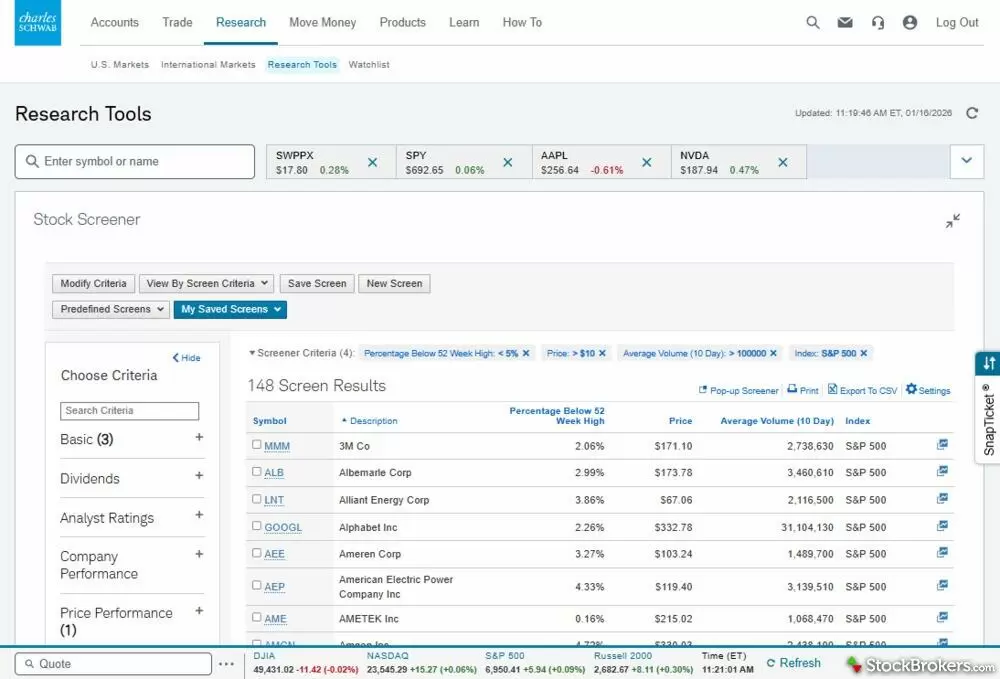
Schwab’s web-based stock screener stands out with advanced filtering tools that include forward-year P/E ratios, projected EPS growth, and revenue estimates—ideal for forward-looking investors. The platform allows users to screen for S&P 500 stocks based on future performance metrics, earnings surprises, and Schwab Analyst Ratings. Unlike many screeners that focus solely on historical data, Schwab helps investors identify high-potential opportunities based on forward projections.
3. Interactive Brokers – Best for sophisticated and international families
| Company | Overall | Custodial Accounts | Custodial IRAs | Fractional Shares (Stocks) |
 Interactive Brokers Interactive Brokers
|
|
Yes | Yes | Yes |
Interactive Brokers (IBKR) is the strong contender for parents who view a minor’s portfolio through an institutional lens. While you will not find 529 college savings plans here, I found that their UTMA, UGMA, and Custodial IRA offerings are perfectly suited for building highly customized, tax-efficient legacy portfolios. The platform is designed specifically for families managing complex wealth who demand professional-grade tools and global market access when investing for their kids, rather than for simple allowance tracking.
Institutional-grade tracking: The true power of managing a minor's assets at IBKR lies within the PortfolioAnalyst dashboard. I was thoroughly impressed by the ability to evaluate a custodial account’s performance using professional risk measures like the Sharpe ratio, standard deviation, alpha, and beta. Furthermore, the impact lens allows parents to align their child’s investments with specific family values, filtering out unwanted industries while seeking out companies that score highly on environmental and social metrics.
Advanced tax optimization: Managing the unearned income of a minor can create complicated tax liabilities, which is where the newly enhanced Tax Planner becomes essential. I found the tax-lot matching and tax loss harvesting features invaluable for projecting year-end taxes across multiple accounts. By allowing you to simulate the tax impact of selling a specific lot before executing the trade, IBKR ensures that the assets meant for your child’s future remain protected from unnecessary tax drag.
IBKR pays a competitive 3.12% on idle USD cash as of June 2026, but with two catches that hit custodial accounts specifically. The first $10,000 earns nothing, and you only reach the top rate once the account value clears $100,000. For a portfolio that starts small, your cash earns very little in the early years.
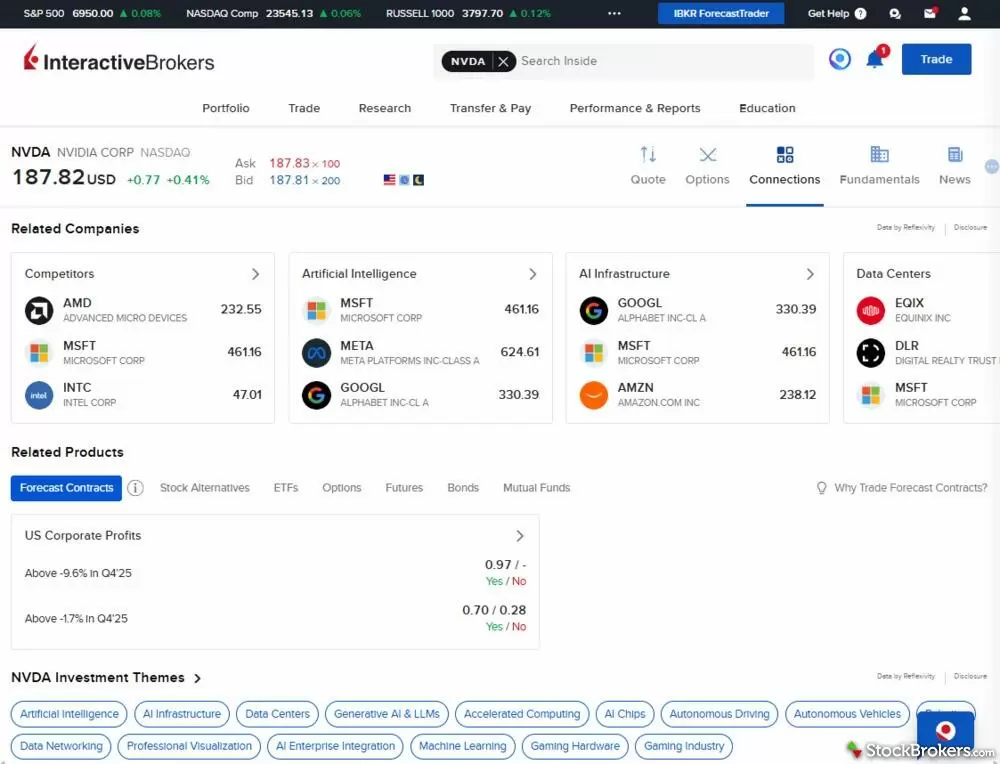
Interactive Brokers’ Connections tab, shown here for NVIDIA (NVDA), gives investors a 360° contextual research view by linking the selected stock to related competitors, thematic sectors like AI infrastructure and data centers, and tradable products such as Forecast Contracts and ETFs. Connections helps traders uncover peers, trends, and broader market relationships beyond just the price quote.
4. Merrill Edge – Best for banking integration
| Company | Overall | Custodial Accounts | Custodial IRAs | Fractional Shares (Stocks) |
 Merrill Edge Merrill Edge
|
|
Yes | No | No |
For families already entrenched in the Bank of America ecosystem, Merrill Edge offers unmatched convenience and unified account management. While it functions as a "niche specialist" for bank clients, the depth of its institutional research and life-stage planning tools makes it a formidable contender for long-term college savings.
Merrill provides the essential structures for a solid custodial account, including 529 plans and UTMA/UGMA accounts. I found the "Guidance and Retirement Center" particularly valuable for its life-stage approach. It offers a dedicated college planning journey that helps parents prioritize goals and select investments. The "Idea Builder" tool is also a great tool for parents, allowing you to discover ETFs and stocks based on forward-looking themes like AI or sustainability, rather than just dry financial ratios.
The true takeaway for Merrill is their industry-leading Tax Resource Center. Attempting to understand the unearned income tax and cost-basis reporting for a minor can be a headache, but Merrill simplifies this with clear FAQ sections on wash sales and automated links to tax software. While they lack custodial Roth IRAs and fractional shares, their "Dynamic Insights" dashboard provides a professional, holistic view of your child’s portfolio performance against the broader market. For those who value having their banking, rewards, and children's savings under one digital roof, Merrill is a highly recommended choice.
5. E*TRADE – Best for Coverdell ESAs and specialized minor accounts
| Company | Overall | Custodial Accounts | Custodial IRAs | Fractional Shares (Stocks) |
 E*TRADE E*TRADE
|
|
Yes | Yes | Yes |
For parents looking beyond standard college savings plans, E*TRADE earns its place by offering specialized structures like Coverdell Education Savings Accounts (ESAs) and Custodial IRAs. While testing the platform, I found their educational content on minor investing, particularly articles detailing how to fund a child's education using equity compensation and maximizing 529 estate planning benefits, to be exceptionally high in value. However, finding these specific resources required some digging, as the educational library can feel disorganized.
Portfolio management: Once the account is funded, managing a child's portfolio is remarkably straightforward. You gain direct access to Morgan Stanley’s premium research and curated mutual fund choice lists, making E*TRADE a highly capable specialist for parents actively managing tax-advantaged educational funds.
Tax resource center: To ensure those funds are managed effectively over the long term, I highly recommend utilizing E*TRADE's exceptional tax resource center. Managing the unearned income of a minor can introduce complexities like gift tax limits or unearned income tax thresholds, and I found their comprehensive guides and contextual FAQs on cost basis methods to be perfectly executed. Furthermore, the platform's risk assessment tool allows you to stress-test your child's portfolio against historical market events, such as the 2008 financial crisis, providing a valuable perspective when balancing aggressive growth with wealth preservation.
Custodial brokerage account comparison
Here is a summary of the different account types and pricing available at the brokers we chose for our top picks.
| Company | Overall | Minimum Deposit | Custodial Accounts | Custodial IRAs | 529 Accounts | Account Transfer Out (Full) | Account Transfer Out (Partial) | Fractional Shares (Stocks) | Fractional Shares (ETFs) |
|
Fidelity
|
|
$0.00 | Yes | Yes | Yes | $0.00 | $0.00 | Yes | Yes |
|
Charles Schwab
|
|
$0.00 | Yes | Yes | Yes | $50.00 | $0.00 | Yes | No |
|
Interactive Brokers
|
|
$0.00 | Yes | Yes | No | $0.00 | $0.00 | Yes | Yes |
|
Merrill Edge
|
|
$0.00 | Yes | No | Yes | $0.00 | $0.00 | No | No |
|
E*TRADE
|
|
$0.00 | Yes | Yes | No | $75.00 | $0.00 | Yes | Yes |
Custodial broker reviews
Read our 2026 E*TRADE review to see how powerful research, versatile platforms, and diverse investments make it a top choice for all investors.
Jessica Inskip September 14, 2026
Read our Interactive Brokers review and see why it's a top choice for active traders with low costs, cutting-edge platforms, and global reach.
Jessica Inskip July 31, 2026
Read our Charles Schwab review to learn why its platforms, research, and investor resources make it one of the top-ranked brokerages.
Jessica Inskip September 08, 2026
Read our Merrill Edge Self-Directed review and see how it combines powerful investing tools, robust research, and integrated banking benefits.
Jessica Inskip May 04, 2026
Fidelity charges $0 stock and ETF trades and won #1 for Research and Education in 2026. See our tested review of its fees, platforms, IRAs, and apps.
Jessica Inskip September 17, 2026Related guides

Find the best Roth IRA accounts. Fidelity, Schwab, and E*TRADE lead with low fees, smart investing tools, and retirement planning support.
Andrea Coombes April 27, 2026
Beginner’s guide to investing in stocks: learn how the stock market works, why passive beats trading, and simple strategies for long-term growth.
Blain Reinkensmeyer May 26, 2026
Discover the best stock brokers of 2026. Compare Schwab, Fidelity, Interactive Brokers, E*TRADE, and more to find the top trading platform for your needs.
Jessica Inskip August 06, 2026
Invest with any budget using fractional shares. See the top brokers, including Fidelity, Schwab, and Interactive Brokers.
Jessica Inskip June 25, 2026More guides

Find the best crypto trading platform for 2026. We rank eToro, Fidelity, Interactive Brokers, Webull, and Robinhood on fees, security, and coin selection.
Steven Hatzakis May 27, 2026
Explore the best international brokers for U.S. investors. Compare Interactive Brokers, Charles Schwab, and Fidelity for global stock trading access.
Jessica Inskip May 22, 2026
Start investing with ease. Explore the best beginner-friendly trading platforms with low fees, great education, and intuitive apps.
Jessica Inskip August 06, 2026
Find the best Roth IRA accounts. Fidelity, Schwab, and E*TRADE lead with low fees, smart investing tools, and retirement planning support.
Andrea Coombes April 27, 2026
Discover the best stock brokers of 2026. Compare Schwab, Fidelity, Interactive Brokers, E*TRADE, and more to find the top trading platform for your needs.
Jessica Inskip August 06, 2026
We tested the best options trading platforms for 2026. Compare tastytrade, Fidelity, IBKR, E*TRADE & Schwab on tools, fees, and picks for beginners.
Jessica Inskip September 09, 2026
Find the best penny stock brokers. Compare Fidelity, Firstrade, Schwab, E*TRADE, and TradeStation for OTC access, fees, and tools.
Jessica Inskip August 02, 2026
Find the top bank brokerages. From Merrill Edge to Ally, discover brokers that combine banking, investing, and rewards in one account.
Jessica Inskip April 16, 2026
Discover the best day trading platforms. Compare IBKR, Schwab, Fidelity, E*TRADE, and TradeStation for speed, tools, and margin rates.
Jessica Inskip August 03, 2026
Practice investing risk-free with the best paper trading platforms. Compare Webull, Schwab, Interactive Brokers, E*TRADE, and more.
Jessica Inskip July 24, 2026
Discover the best brokers for trade execution. Compare Fidelity, Interactive Brokers, and more for price improvement, speed, and transparency.
Jessica Inskip May 22, 2026
We tested the 5 best futures trading platforms of 2026. Compare commissions, margin rates, and tools for beginners and active traders. Find the right platform for you.
Jessica Inskip September 17, 2026
Find the best rollover IRA accounts. Compare Fidelity, Schwab, and E*TRADE for easy transfers, low fees, and smart retirement investing tools.
Andrea Coombes May 15, 2026
Find the best brokerage for high-net-worth investors. Compare Fidelity, Schwab, Merrill, and more for premium services and tailored investment tools.
Jessica Inskip January 27, 2026
Interactive Brokers and Fidelity lead our 2026 ranking of the best free stock trading platforms, tested on the true cost of $0 commissions and hidden fees.
Jessica Inskip September 02, 2026
Find the best IRA accounts. Compare Fidelity, Schwab, Merrill Edge, E*TRADE, & J.P. Morgan for retirement planning, fees, tools, and account flexibility.
Jessica Inskip March 31, 2026
Find top U.S. forex brokers. From tastyfx to OANDA, explore platforms with strong regulation, great tools, and user-friendly trading.
Steven Hatzakis May 29, 2026About the Editorial Team
Jessica Inskip is Director of Investor Research at StockBrokers.com, bringing 15 years of experience in brokerage and trading strategy. A former FINRA-licensed rep, she held Series 7, 63, 66, and 4 licenses. Jessica focuses on investor education and brokerage industry research, appears regularly on CNBC, Bloomberg, The Schwab Network, Fox Business, and Yahoo! Finance, and hosts the Market MakeHer podcast.
Jeff Anberg is a Senior Editor at StockBrokers.com. Along with years of experience in media distribution at a global newsroom, Jeff has a versatile knowledge base encompassing the technology and financial markets. He is a long-time active investor and engages in research on emerging markets like cryptocurrency. Jeff holds a Bachelor’s Degree in English Literature with a minor in Philosophy from San Francisco State University.
Joey Shadeck is the Content Strategist and Research Analyst for StockBrokers.com. He holds dual degrees in Finance and Marketing from Oakland University, and has been an active trader and investor for close to 10 years. An industry veteran, Joey obtains and verifies data, conducts research, and analyzes and validates our content.