 Charles Schwab
 Fidelity
 Interactive Brokers
 E*TRADE
 Webull
 TradeStation
 tastytrade
 eToro
eToro Trading 212
 Interactive Investor
 IG
IG Interactive Brokers
 XTB
XTB Hargreaves Lansdown
 Saxo
Saxo Charles Stanley Direct
 CIBC Investor's Edge
 Interactive Brokers
 Moomoo
 Questrade
 Qtrade
 TD Direct Investing
 Wealthsimple
 Finviz
 Stock Rover
 Seeking Alpha
 StockHero
 TipRanks
 TrendSpider
 Trade Ideas
 TraderSync
 TradingView
 Tradervue
 TradeZella
Best Brokers for AI Trading Agents

Written by Jessica Inskip
Director of Investor Research

Edited by Jeff Anberg
Senior Editor

Reviewed by Blain Reinkensmeyer
Managing Partner
Jessica InskipDirector of Investor Research
Jessica Inskip is Director of Investor Research at StockBrokers.com, bringing 15 years of experience in brokerage and trading strategy. Jessica focuses on investor education and brokerage industry research.


 Why you can trust us
Led by Jessica Inskip, Director of Investor Research, the StockBrokers.com research team collects thousands of data points across hundreds of variables. We evaluate features important to every kind of investor, including beginners, casual investors, passive investors, and active traders. We carefully track data on margin rates, trading costs, and fees to rate stock brokers across our proprietary testing categories.
Our researchers open personal brokerage accounts and test all available platforms on desktop, web, and mobile for each broker reviewed on StockBrokers.com. Learn more about how we test.
Five of the 14 brokers I test now run a first-party MCP server, which lets an AI trading agent read your positions and draft or place orders in a live account. Brokers launched all five of those servers in 2026, opening client accounts to ChatGPT, Claude, and other AI platforms for analysis and order entry. I opened funded accounts, connected each to Claude and ChatGPT where supported, and scored what the broker allows rather than what the AI model decides.
Interactive Brokers keeps execution outside the AI session, so the agent writes an instruction you submit yourself from an IBKR platform. Robinhood confines the agent to a separate account, though it can still read every account you hold. Webull and Public let it trade in your main one. The cost and ease of accessibility also differ among the brokerages. Interactive Brokers charges nothing extra. TradeStation requires a paid AI subscription and a $10,000 minimum balance. Here is my take on the best brokers for trading with AI.
Best Brokers for AI Trading Agents in 2026
How I tested for the best brokers for trading with AI
Not every broker offering an AI feature qualified for this guide. I required a first-party integration, which ruled out Charles Schwab, E*TRADE, and tastytrade, where the only MCP servers are community-built projects on the brokers' official APIs. I required a connection to a funded live account rather than paper trading, and general availability rather than a waitlist. I also required that the agent cannot withdraw or transfer money out. Four of the brokers I review, Ally Invest, Fidelity, Firstrade, and Merrill Edge, have no public API for an AI tool to reach at all. That left five with a first-party MCP server, plus eToro, which uses a scoped API key instead.
Ranking those brokers came down to what each one allows or enforces, not what the AI model decides. You may switch models next month, so a broker earns credit only when it rejects a bad order itself. For example, Interactive Brokers ranked highly because it removes execution from the AI session entirely, letting the agent write an instruction you submit from an IBKR platform, and it charges nothing extra and imposes no minimum. Robinhood gives the agent a separate account with spending limits, though its beta covers equities only. Webull publishes caps and a read-only mode but trades in your main account. TradeStation ranked below its January head start because a $10,000 minimum balance and a paid AI subscription put it out of reach for many readers.
- Minimum Deposit: $0.00
- Stock Trades: $0.00
- Options (Per Contract): $0.65
Interactive Brokers is the only broker in this guide where the AI agent never reaches the order book. It analyzes your portfolio and drafts a trade instruction, but converting that into a live order happens on an IBKR platform, where you review it and submit it yourself. The connection works with any MCP-compatible tool, including ChatGPT, Claude, Grok, and Cursor, and IBKR charges nothing for it. There is no separate account to open and no configuration to work through. Read full review
- Agent cannot place an order on its own
- Works with any MCP-compatible tool
- No added cost, no separate account
- Every order needs a second step in IBKR
- No read-only mode or caps documented
- Minimum Deposit: $0.00
- Stock Trades: $0.00
- Options (Per Contract): $0.00
Webull gives you the most granular controls of any broker here. You can cap the dollar value of a single order, cap share quantity, and restrict trading to a whitelist of symbols you choose, with a $10,000 notional limit already set by default on the local server. A read-only mode disables the trading tools entirely. There are four ways to connect, including a hosted server that takes one URL and a local server that keeps your keys on your own machine. Read full review
- Set hard caps on order size and value
- Read-only mode and symbol whitelist
- Four ways to connect, including a local server
- Agent trades in your main account
- Order preview is advised, not required
- Last of 11 brokers in our customer service testing
- Minimum Deposit: $20.00
- Stock Trades: $0.00
- Options (Per Contract): $0.00
Public runs two agent products, and the difference matters. A hosted MCP server connects Claude, ChatGPT, and Perplexity for conversational trading, with preflight checks that price an order before it goes in. Agentic Brokerage works differently, where you describe a strategy, confirm it once, and it executes on its own from then on without alerting you before each transaction. The agent reaches stocks, ETFs, options, crypto, and your tax lots, along with option Greeks the app itself leaves out. Read full review
- Hosted server needs no setup
- Agent reaches option Greeks the app omits
- Official skill for always-on OpenClaw agents
- Agents run unattended once approved
- No caps you can set yourself
- No paper trading to rehearse in
- Minimum Deposit: $0.00
- Stock Trades: $0.00
- Options (Per Contract): $0.00
Robinhood is the only broker here that gives your agent its own account. Agentic Trading requires opening a separate self-directed account, and the agent can place trades only there, so your primary account and IRA stay closed to it. Containment applies to trading rather than visibility, though. Once connected, the agent reads every Robinhood account you hold, including balances, order history, and watchlists. Orders cover long equities and options during the beta, and there is no cost or minimum to connect. Read full review
- Agent trades only in its own account
- Free, with no minimum balance
- Simulation tools return pre-trade warnings
- Reads every Robinhood account you hold
- No caps, whitelist or read-only mode
- Long equities and options only during beta
- Minimum Deposit: $0.00
- Stock Trades: $0.00
- Options (Per Contract): $0.80
TradeStation shipped the first MCP server at a US broker and won our Annual Award for #1 Innovation for it. Confirmation is enforced rather than suggested, so no order reaches the market until you approve it, and agent actions stay subject to the permissions already on your account. It also sets the highest bar to entry in this guide. Access requires a $10,000 minimum eligible balance and a paid Claude Pro or ChatGPT Plus subscription, and only those two AI tools are supported. Read full review
- Explicit confirmation enforced on every order
- Deepest futures and options access
- $10,000 minimum balance to connect
- Paid Claude or ChatGPT subscription required
- No other AI tools supported
Compare trading platforms head-to-head
Use the broker comparison tool to compare over 150 different account features and fees.
Top picks for brokers integrated with AI chatbots
1. Interactive Brokers — Best overall MCP integration
| Company | Overall | Minimum Deposit | Stock Trades | Options (Per Contract) |
 Interactive Brokers Interactive Brokers
|
|
$0.00 | $0.00 | $0.65 |
Interactive Brokers keeps order submission outside the AI session. Connect an AI tool to your account and it can analyze your portfolio, research positions, monitor risk, and draft trade instructions in plain language. Converting an instruction into a live order happens on an IBKR platform, where you review it and submit it yourself. An agent that misreads your intent, or acts on something buried in a document you asked it to summarize, has no path to the market on its own. Robinhood, Webull, Public, and Moomoo all let the agent place the order itself.
Connecting your account: IBKR built the integration on MCP from launch. Until late July, it worked only through the certified connector marketplaces for ChatGPT, Claude and Grok. It now accepts any MCP-compatible tool, including Claude Code, Cursor, Perplexity and Windsurf, with Gemini support announced. Setup takes the connector URL, a login through IBKR's own secure screen, and authorization for one account. No API keys or passwords change hands, and each authorization covers a single account rather than everything under your login.
What the agent can reach: Range matters more here than at a broker with a narrower lineup. One account reaches more than 170 markets, so the questions you can ask span asset classes rather than US equities alone. Rate sensitivity across your holdings, implied volatility on every position, currency exposure if the dollar weakens, portfolio impact from an index drawdown. Reviewing drafted instructions works across Client Portal, IBKR Desktop, GlobalTrader, IBKR Mobile and Trader Workstation.
IBKR's own AI tools: These sit inside the platforms and are separate from the MCP integration. Ask IBKR answers account questions directly. I asked what my exposure to the tech sector was and got an answer grounded in my own holdings rather than a generic explanation. The AI news summaries were the bigger time saver, condensing dozens of headlines into a short list of why a stock was actually moving. The natural-language screeners search more than 70,000 global stocks.
Cost: Nothing extra for the integration, no separate AI brokerage account, and no configuration work. IBKR Lite charges $0 commission on US-listed stocks and ETFs, while Pro charges per share and prioritizes execution quality. Margin runs 4.140% to 6.140%, well below what most competitors charge on smaller balances.
Jessica's take
"I rank Interactive Brokers first partly for its confirmation step, not for what its agent can do. Review-then-submit is slower than telling an agent to buy and watching it happen, and if that is what you want, Robinhood and Webull will give it to you. Personally, I prefer an AI mistake to cost me a deleted draft instead of a filled order. For real money, in a product category this new, I will take the extra click."
Jessica Inskip
Director of Investor Research

Interactive Brokers offers one of the most comprehensive watchlists in the industry, available on both its web and desktop trading platforms. This screenshot highlights the desktop experience, where investors can track real-time quotes, market data, and customizable columns across multiple asset classes.
2. Webull — Best MCP server for active traders
| Company | Overall | Minimum Deposit | Stock Trades | Options (Per Contract) |
 Webull Webull
|
|
$0.00 | $0.00 | $0.00 |
Webull gives you four ways to connect and the most granular controls of any broker here. A hosted server at api.webull.com/mcp handles ChatGPT, Claude, Cursor, Codex, and Kiro with no setup beyond pasting a URL. A local server runs on your own machine through uvx, so your keys never leave your device. There are also standalone agent skills for assistants that can run shell commands, and a CLI for scheduled jobs. Unlike Interactive Brokers, the agent places orders itself rather than drafting instructions for you to submit.
Guardrails you configure: You can cap the dollar value of a single order, cap share quantity, and restrict trading to a whitelist of symbols you choose. The local server ships with a $10,000 notional limit and a 1,000-share cap already set. A read-only mode disables the trading tools entirely, leaving the agent with account and market data access only. Preview endpoints let it show you order details before submitting, though Webull recommends that step rather than enforcing it. Connections unlink with one click.
What the agent can trade: Stocks, ETFs, options including multi-leg strategies, futures, crypto and event contracts. It handles combo orders such as OTO, OCO and OTOCO, and algorithmic orders using TWAP, VWAP and POV. That is a wider execution toolkit than any other broker in this guide hands an AI agent, and it is why Webull suits active traders especially well.
Test before going live: The local server defaults to Webull's sandbox rather than production, so you can watch an agent work a full session before it touches real money. Paper trading is already one of the things I like most about Webull, and the same discipline carries over here.
Cost and the catch: No commission on stocks, ETFs, or options contracts, which matters more than usual when an agent can place multi-leg options orders. Futures run $1.25 per contract and there is no minimum deposit. A market data subscription applies if your agent needs quotes. The real concern is support since Webull finished last of all brokers in this year's customer service testing, with calls that never came off hold. If an agent does something you did not expect, that is who you will be calling.

Webull’s trading platform brings everything together in one clean, customizable view, perfect for making fast, informed decisions. Here, with AAPL selected, you can see a real-time chart, a pre-filled limit order ticket, and a detailed quote panel that includes analyst ratings and sentiment breakdowns.
3. Public.com — Best agentic brokerage
| Company | Overall | Minimum Deposit | Stock Trades | Options (Per Contract) |
 Public.com Public.com
|
|
$20.00 | $0.00 | $0.00 |
Public.com runs two separate agent products, and the difference matters more than anything else here. A hosted MCP server connects Claude, ChatGPT, and Perplexity for conversational trading. Agentic Brokerage is Public's own automation, where you describe a strategy in plain language, confirm it once, and it runs on its own from then on.
Connecting an outside AI: The hosted server sits at mcp.public.com/mcp. Claude authorizes through the browser, Perplexity takes an API key, and ChatGPT can require extra approval before write actions. Preflight endpoints price single-leg and multi-leg orders before submission. The agent reaches stocks, ETFs, options, crypto, and your tax lots. Option Greeks and strategy quotes come through the API even though the app's own options chain omits Greeks and bid-ask spreads, so an agent can see data the interface will not show you.
Agents run unattended: Public's disclosure is direct about this. Once you confirm and activate an Agent, Public will not alert you before a pending transaction and will not wait for your confirmation before executing it. Executed transactions cannot be reversed. You approve the strategy, not the trades, and that is the loosest approval model of the five brokers here.
Published limits are ceilings, not guardrails: Public documents maximums of 10,000 shares or $5 million on equities and 1,999 option contracts. Those are venue caps, not safety settings. Unlike Webull, there is no dollar limit you can impose on your own agent, and no sandbox to rehearse in, because Public has no paper trading.
Where it earns the spot: The Public tool Generated Assets won our top industry award for AI innovation. You describe a theme in plain language and get a backtested index you can fund. I found it useful for brainstorming, though it compares growth better than total return since dividends are not fully reflected. Public also publishes an official agent skill for OpenClaw, so a self-hosted assistant running on WhatsApp or Telegram can monitor and trade your account. Trading is free on stocks, ETFs, and options, though advanced data and extended-hours trading need Premium at $10 a month unless you hold $50,000.

Public.com’s Markets screen on mobile looks nice. It has a clean layout, is easy to scan, and shows the major indices and top movers. That said, it’s definitely on the basic side. The earnings calendar is pretty limited, and if you’re looking for deeper insight or tools, you might find yourself wanting more. Still, it’s a nice starting point for a quick market check.
4. Robinhood — Best dedicated agent account
| Company | Overall | Minimum Deposit | Stock Trades | Options (Per Contract) |
 Robinhood Robinhood
|
|
$0.00 | $0.00 | $0.00 |
Robinhood is the only broker here that gives your agent its own account. Agentic Trading requires opening a separate self-directed individual account, and the agent can place trades only there. Your primary account, your IRA and everything else stay closed to it. If an agent misfires, the damage is capped by whatever you funded that one account with.
Read access is a different story: Containment applies to trading, not visibility. Once connected, the agent reads every Robinhood account you hold, including account numbers, all positions and balances, your full order history, and your watchlists and scans. Interactive Brokers, by contrast, authorizes access to a single account. It's worth understanding the full data view you're allowing before you connect.
What the agent can do: The toolkit is wider than the equities-and-options limit suggests. It pulls real-time Level 2 order books for up to four stocks, computes indicators like RSI and MACD, reads earnings calendars and reported financials, and builds and runs saved scans. Review tools simulate an order and surface pre-trade warnings first. Orders are limited to long equities and options for now, with more assets promised later.
Approval is a prompt, not a setting: Robinhood states plainly that your agent can place trades without confirmation if you have told it to work that way. On the trading side there is no broker-enforced order cap, no symbol whitelist and no read-only toggle. Webull lets you set a hard dollar limit the agent cannot exceed. Robinhood's own disclosure warns that agent strategies can move quickly and may be difficult to monitor or stop in real time.
Cost: Trading is free, with $0 on stocks, ETFs and options contracts and margin from 5.75% under $25,000. The AI Digests I like so much, which explain why a stock moved rather than just that it did, need Gold at $5 a month (or $50 annually).
5. TradeStation — Best for futures and options traders
| Company | Overall | Minimum Deposit | Stock Trades | Options (Per Contract) |
 TradeStation TradeStation
|
|
$0.00 | $0.00 | $0.80 |
TradeStation shipped the first MCP server at a U.S. broker in January 2026 and won our Annual Award for #1 Innovation for it. It also sets the highest bar to entry in this guide. Access requires a minimum eligible balance of $10,000 and a paid Claude Pro or ChatGPT Plus subscription, billed by the AI provider rather than TradeStation. No other broker here asks for either. The account itself still has no minimum, so the gate applies only to the MCP connection.
Confirmation is enforced, not suggested: TradeStation requires explicit confirmation before any order is placed, and agent actions remain subject to the trading permissions and risk controls already on your account. Webull recommends a preview step. Robinhood lets you waive approval by telling your agent to act alone. TradeStation does neither. Only Interactive Brokers, which moves submission out of the AI session entirely, is more strict.
A narrow set of AI tools: Claude and ChatGPT only, with others described as in development. Every other broker here accepts any MCP-compatible client, so if you want to run a local model or a self-hosted agent, this is the one that will not let you.
Cost beyond the gate: Stocks and ETFs are free up to 10,000 shares. Options start at $0.80 per contract and reach $0 above 10,000 contracts a month, though exercise costs $14.95 and assignment $5.95. Margin starts at 12.5% under $25,000, the highest here by a wide margin. AI client users may also see market data costs passed through. There is no spot crypto, no fractional shares and no forex.
How to connect a broker to an AI agent
1. Use an official connector
This is the path most people should take. Nothing to install, no code, and your broker password never reaches the AI tool. In Claude, open Settings, select Connectors, then Add custom connector and paste the broker's URL. ChatGPT and Grok work the same way, and a broker like Interactive Brokers also appears in their certified connector directories, so you can add it without even needing a URL.
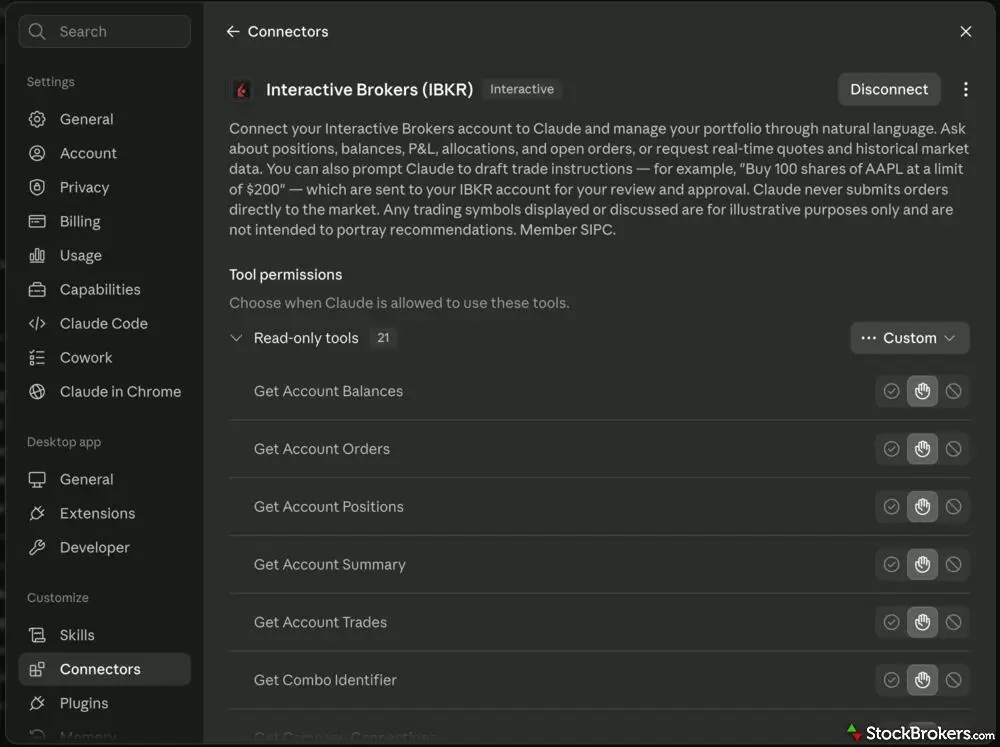
Interactive Brokers provides an official integration with Claude via a Connector. In the settings of Claude Desktop, each action available to Claude that accesses your IBKR account can be adjusted to always be allowed, require permission each time, or be rejected.
You then log in through the broker's own screen and authorize access there. Interactive Brokers scopes that authorization to a single account. Robinhood prompts you to open a separate agentic account during setup, which only works in a desktop browser. TradeStation requires you to request access first through HUB on the Platforms page.
Connector URLs: Interactive Brokers at api.ibkr.com/v1/api/mcp-public, Webull at api.webull.com/mcp, Public at mcp.public.com/mcp, and Robinhood at agent.robinhood.com/mcp/trading.
2. Connect to an MCP server directly
Agentic coding tools like Claude Code, Codex, Cursor and OpenClaw connect from the terminal instead. Adding Robinhood to Claude Code takes a single command, claude mcp add robinhood-trading --transport http https://agent.robinhood.com/mcp/trading, followed by /mcp to authenticate. Codex CLI uses its own add command with the same URL.
This route also reaches servers that run on your own machine rather than the broker's. Webull's local server launches through uvx and reads your app key and secret from a config file, so those credentials never leave your computer. Moomoo works similarly through its OpenD gateway.
There are two things to watch out for. Local setups usually mean handling API keys yourself, and a brokerage key should be treated like a password. And an always-on agent, whether that is OpenClaw on a messaging app or a scheduled job, keeps working while you sleep.
3. Use a local model
There are good reasons to want this. A hosted connector sends your positions to an AI provider's servers. You may prefer not to pay for a subscription or API tokens. Or you may simply want an open-weight model you control.
The protocol will not stop you, since MCP is model-agnostic and any client that speaks it can connect. The constraint is authentication. Brokers that authorize through a certified marketplace expect a client they recognize, so pointing a self-hosted model at one may not complete the login. For example, you may run into trouble trying to set up OpenClaw or Hermes to connect to Interactive Brokers' MCP server since those agentic tools are not in its whitelist of allowed clients.
The paths most likely to work are those using API keys rather than a browser sign-in, which means Webull's local server, Moomoo's OpenD gateway, and Public's key-based option. TradeStation is the one that will not work at all, since it accepts only Claude and ChatGPT. Be realistic about the tradeoff, though. Smaller local models are less reliable at multi-step tool use than frontier models, and one that misreads an order schema is a real risk with real money.
4. Start read-only, then widen access
Whichever route you take, do not let an agent trade in its first session. Webull can disable its trading tools entirely and run read-only, and its local server defaults to a sandbox rather than production. Moomoo defaults to paper trading and requires your trading password before it will place a live order.
When you do go live, set your limits first rather than after something goes wrong. Webull lets you cap order value and share quantity and restrict trading to a whitelist of symbols you choose. Robinhood and Public both provide simulation tools that show what an order would do before it is submitted.
Then check the boring things. Ask for your positions and balances, and confirm they match what your broker app shows. If an agent cannot read your account correctly, it has no business trading in it.
5. Making an example trade with AI
Here is an example workflow end to end using Claude and Interactive Brokers. I told Claude I expected USO at $140 within two weeks and asked it to pick an expiration, build a bull call spread, and draft the instruction to my IBKR account.
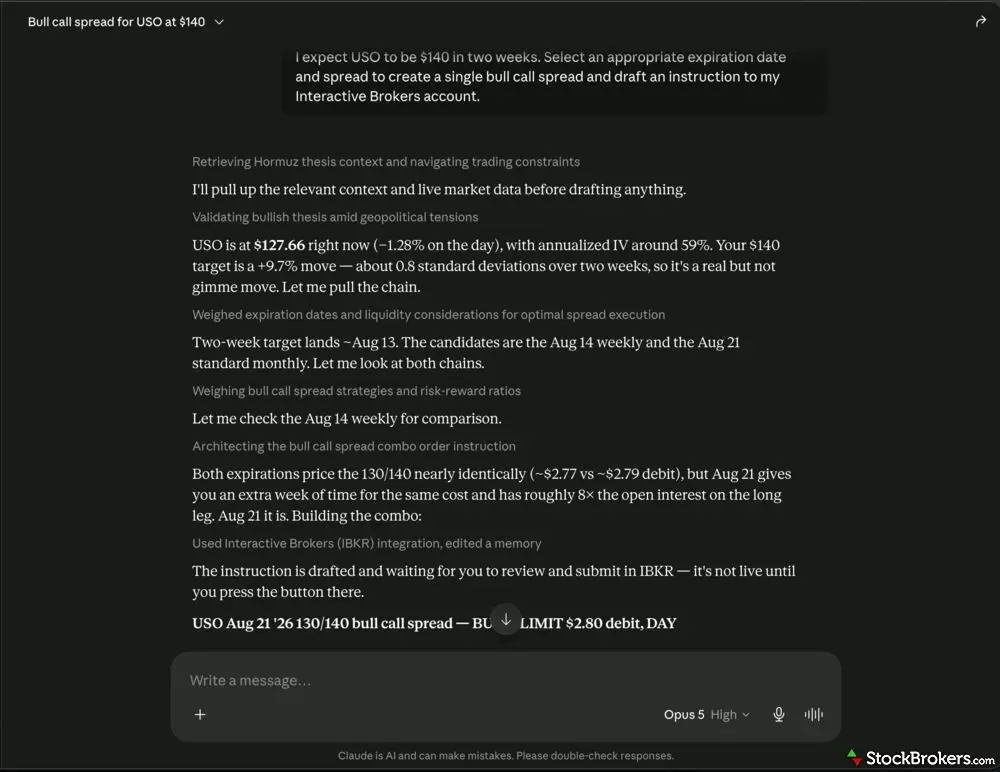
An example of a simple options strategy being created with natural language in Claude Chat using Opus 5. The model provides its full reasoning chain and then sends the trade draft to my Interactive Brokers account.
It pulled live data before writing anything. USO was at $127.66 with implied volatility near 59%. My $140 target meant a 9.7% move, about 0.8 standard deviations over two weeks, and that math checks out. It called the move real but not a given. That is the pushback I want from a tool about to draft an order. But a standard deviation converts straight into odds. At 0.8, USO had roughly a one in five chance of reaching $140, and Claude never made that conversion.
It then compared two expirations. The Aug 14 weekly and the Aug 21 monthly priced the 130/140 spread almost identically, at about $2.77 and $2.79. Claude picked Aug 21 for two reasons. The long leg carried roughly eight times the open interest, which is a sound liquidity argument. It also described the later expiration as buying "an extra week of time for the same cost." That second reason is where it went wrong.
Check the math before you submit
Claude picked the later expiration partly because it "gives you an extra week of time for the same cost." That is backwards. A bull call spread evaluated at your target price is worth less with more time left on it, not more, because the short leg still carries value. If USO printed $140 on Aug 13, the Aug 21 spread would be worth roughly $6.30 against roughly $8.30 for Aug 14. The extra week was a cost and not a free upgrade as portrayed. Flawed reasoning arrives in the same confident voice as sound reasoning, so check anything that drives your decision.
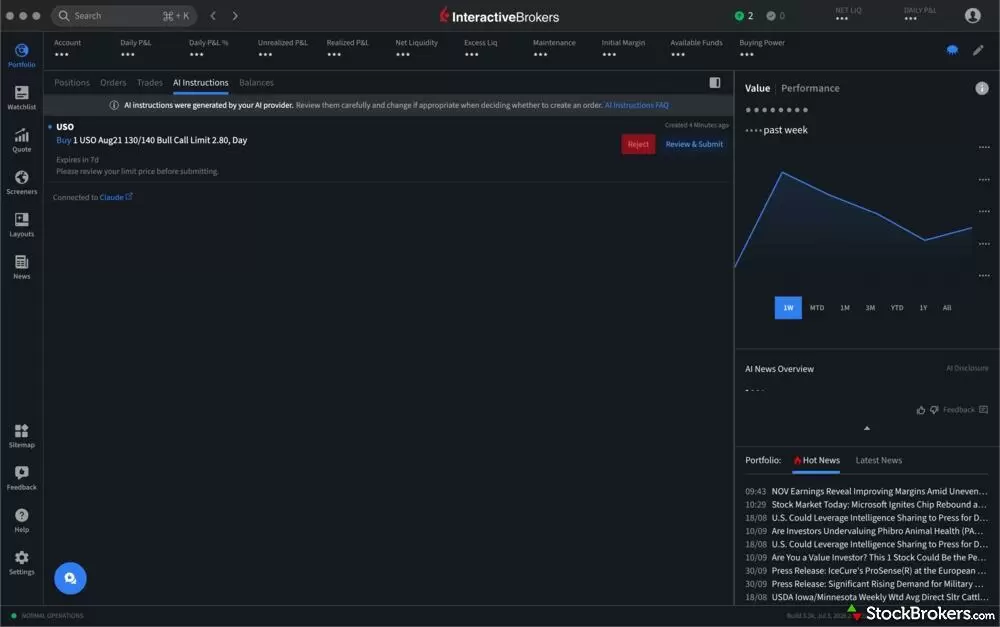
In this case, a drafted trade instruction from my Claude agent is delivered to my IBKR Desktop under the "AI Instructions" tab. I can then either reject it or open it into an order ticket to adjust the parameters and manually enter the trade like any other.
The draft landed in IBKR under its own AI Instructions tab, kept separate from my working orders, labeled as connected to Claude and set to expire in seven days. Claude had set the limit at $2.80, slightly above both quoted debits, which means the figures it quoted were computed off a price it was not proposing to pay. IBKR asks you to review that limit before submitting and gives two choices, Reject or Review and Submit.
That last step is the argument for this architecture. The analysis happened in the LLM, but the final decision happened in my brokerage account. What that buys you is a chance to catch a bad order, not a guarantee that one gets caught.
Reviews of brokers that support AI
Read our TradeStation review and discover why its pro-level tools, deep customization, and options focus make it a top choice for active traders.
Jessica Inskip September 11, 2026
Read our Interactive Brokers review and see why it's a top choice for active traders with low costs, cutting-edge platforms, and global reach.
Jessica Inskip July 31, 2026
Read our Webull review and discover its commission-free trading, sleek platforms, paper trading tools, and fractional shares.
Jessica Inskip August 10, 2026
Read our Public.com review to learn how its intuitive platform and community-driven features help simplify investing for first-time traders.
Jessica Inskip July 31, 2026
Read our Robinhood review and see why it’s a top pick for beginners, with a sleek mobile app, zero commissions, and standout educational tools.
Jessica Inskip September 03, 2026Related guides
Discover the best day trading platforms. Compare IBKR, Schwab, Fidelity, E*TRADE, and TradeStation for speed, tools, and margin rates.
Jessica Inskip August 03, 2026
Practice investing risk-free with the best paper trading platforms. Compare Webull, Schwab, Interactive Brokers, E*TRADE, and more.
Jessica Inskip July 24, 2026
Compare the best AI trading platforms, apps, and bots for 2026. We tested Trade Ideas, TrendSpider, and more to find the top AI stock trading tools for every type of investor.
Steven Hatzakis August 12, 2026
Compare the 5 best brokers for 24-hour trading in 2026. See overnight, pre-market, and after-hours access, session hours, and how many stocks each offers.
Jessica Inskip August 14, 2026More guides
Find the best rollover IRA accounts. Compare Fidelity, Schwab, and E*TRADE for easy transfers, low fees, and smart retirement investing tools.
Andrea Coombes May 15, 2026
We tested the best options trading platforms for 2026. Compare tastytrade, Fidelity, IBKR, E*TRADE & Schwab on tools, fees, and picks for beginners.
Jessica Inskip September 09, 2026
Discover the best day trading platforms. Compare IBKR, Schwab, Fidelity, E*TRADE, and TradeStation for speed, tools, and margin rates.
Jessica Inskip August 03, 2026
Explore the best international brokers for U.S. investors. Compare Interactive Brokers, Charles Schwab, and Fidelity for global stock trading access.
Jessica Inskip May 22, 2026
Discover the best stock brokers of 2026. Compare Schwab, Fidelity, Interactive Brokers, E*TRADE, and more to find the top trading platform for your needs.
Jessica Inskip August 06, 2026
Find top U.S. forex brokers. From tastyfx to OANDA, explore platforms with strong regulation, great tools, and user-friendly trading.
Steven Hatzakis May 29, 2026
Interactive Brokers and Fidelity lead our 2026 ranking of the best free stock trading platforms, tested on the true cost of $0 commissions and hidden fees.
Jessica Inskip September 02, 2026
Practice investing risk-free with the best paper trading platforms. Compare Webull, Schwab, Interactive Brokers, E*TRADE, and more.
Jessica Inskip July 24, 2026
Find the best brokerage for high-net-worth investors. Compare Fidelity, Schwab, Merrill, and more for premium services and tailored investment tools.
Jessica Inskip January 27, 2026
Find the best IRA accounts. Compare Fidelity, Schwab, Merrill Edge, E*TRADE, & J.P. Morgan for retirement planning, fees, tools, and account flexibility.
Jessica Inskip March 31, 2026
We tested the 5 best futures trading platforms of 2026. Compare commissions, margin rates, and tools for beginners and active traders. Find the right platform for you.
Jessica Inskip July 31, 2026
Find the best penny stock brokers. Compare Fidelity, Firstrade, Schwab, E*TRADE, and TradeStation for OTC access, fees, and tools.
Jessica Inskip August 02, 2026
Find the best Roth IRA accounts. Fidelity, Schwab, and E*TRADE lead with low fees, smart investing tools, and retirement planning support.
Andrea Coombes April 27, 2026
Find the top bank brokerages. From Merrill Edge to Ally, discover brokers that combine banking, investing, and rewards in one account.
Jessica Inskip April 16, 2026
Discover the best brokers for trade execution. Compare Fidelity, Interactive Brokers, and more for price improvement, speed, and transparency.
Jessica Inskip May 22, 2026
Start investing with ease. Explore the best beginner-friendly trading platforms with low fees, great education, and intuitive apps.
Jessica Inskip August 06, 2026
Find the best crypto trading platform for 2026. We rank eToro, Fidelity, Interactive Brokers, Webull, and Robinhood on fees, security, and coin selection.
Steven Hatzakis May 27, 2026About the Editorial Team
Jessica Inskip is Director of Investor Research at StockBrokers.com, bringing 15 years of experience in brokerage and trading strategy. A former FINRA-licensed rep, she held Series 7, 63, 66, and 4 licenses. Jessica focuses on investor education and brokerage industry research, appears regularly on CNBC, Bloomberg, The Schwab Network, Fox Business, and Yahoo! Finance, and hosts the Market MakeHer podcast.
Jeff Anberg is a Senior Editor at StockBrokers.com. Along with years of experience in media distribution at a global newsroom, Jeff has a versatile knowledge base encompassing the technology and financial markets. He is a long-time active investor and engages in research on emerging markets like cryptocurrency. Jeff holds a Bachelor’s Degree in English Literature with a minor in Philosophy from San Francisco State University.
Blain Reinkensmeyer has 25 years of trading experience with over 2,500 trades placed during that time. He heads research for all U.S.-based brokerages on StockBrokers.com and is respected by executives as the leading expert covering the online broker industry. Blain’s insights have been featured in the New York Times, Wall Street Journal, Forbes, and the Chicago Tribune, among other media outlets.